Books by Langston Hughes

Selected Poems of Langston Hughes: A Classic Collection of Poems by a Master of American Verse (Vintage Classics)
Langston Hughes electrified readers and launched a renaissance in Black writing in America—the poems in this collection were chosen by Hughes himself shortly before his death and represent stunning work from his entire career.
The poems Hughes wrote celebrated the experience of invisible men and women: of slaves who "rushed the boots of Washington"; of musicians on Lenox Avenue; of the poor and the lovesick; of losers in "the raffle of night." They conveyed that experience in a voice that blended the spoken with the sung, that turned poetic lines into the phrases of jazz and blues, and that ripped through the curtain separating high from popular culture. They spanned the range from the lyric to the polemic, ringing out "wonder and pain and terror—and the marrow of the bone of life."
The collection includes "The Negro Speaks of Rivers," "The Weary Blues," "Still Here," "Song for a Dark Girl," "Montage of a Dream Deferred," and "Refugee in America." It gives us a poet of extraordinary range, directness, and stylistic virtuosity.
Copies
-
$18.00

Tambourines to Glory: A Novel (Harlem Moon Classics)
For every bustling jazz joint that opened in Korean War–era Harlem, a new church seemed to spring up. Tambourines to Glory introduces you to an unlikely team behind a church whose rock was the curb at 126th and Lenox.
Essie Belle Johnson and Laura Reed live in adjoining tenement flats, adrift on public relief. Essie wants to somehow earn enough money to reunite with her daughter and provide her with a nice home; Laura loves young men, mink coats, and fine Scotch. On a day of inspiration, the friends decide to use a thrift-store tambourine and a layaway Bible to start a church.
Their sidewalk services are a hit: Laura’s a natural street performer who loves the limelight, while Essie is a charismatic singer with a quiet spirituality. Before long they move to a thousand-seat theatre called the Tambourine Temple. The two women are joined in their ministering by Birdie Lee, the little-old-lady trap drummer who can work the congregation to a feverish pitch, and Deacon Crow-For-Day, an impassioned confessor.
But then Laura falls for Buddy, a scam artist who suggests selling to the faithful lucky numbers from Scripture and bottles of tap water as “Holy Water from the Jordan.” Even with a Cadillac and piles of money from Laura, Buddy won’t stay faithful, igniting a crime of passion and betrayal.
Harlem Moon Classics is proud to reintroduce readers of all generations to this sparkling gem from the canon of Langston Hughes.
Copies
No copies available.

Let America Be America Again
A newly-illustrated edition of the classic poem, used extensively by John Kerry is his Presidential campaign. World-renowned poet and master of prose Langston Hughes enlightened Americans nationwide when his poem "Let America Be America Again" appeared in 1936. Today, more than half a century later, this poem's insights into American society and its dream of social justice continue to resonate powerfully among readers. In celebration of the poem's inspiring message, artist Antonio Frasconi illustrated Hughes' poem with thirty-two woodcuts in an extraordinary limited-edition artist's book, adding a rich visual dimension to the poet's verses. Henry Louis Gates, Jr., noted scholar and W. E. B. Du Bois Professor of the Humanities at Harvard University, contributed a foreword. A popular edition of this work, Let America Be America Again brings their important collaboration to a wider audience, faithfully reproducing the intricacy and subtlety of Frasconi's prints. Each coupling of image and stanza conveys Hughes'and Frasconi'sdream of justice for all with compelling force. A call to fulfill this country's potential for greatness, Let America Be America Again will touch every American who reads its pages.
Copies
No copies available.

Let America Be America Again: And Other Poems
A Vintage Original
“I believe in an America in which opportunity and justice truly are for all. That was the essence of the life an poetry of Langston Hughes.”—Senator John Kerry, from the Preface
A beautifully designed collection of some of the greatest poems by a quintessentially American poet, whose theme of the promise of American inclusiveness continues to ring true.
Langston Hughes was uncommonly attuned to the ideals of freedom and democracy and the sometimes elusive American dream. The poems collected here offer a hopeful, truly democratic vision for America. Incantatory and stirring, passionate and provocative, they are as resonant for our times as they were over half a century ago.
Contents:
“Let America Be America Again,” “Dream of Freedom,” “America,” “Search,” “Some Day,” “In Time of Silver Rain,” “Dare,” “Give Us Our Peace,” “I Dream a World.”
Copies
No copies available.

Mule Bone (Harper Perennial Modern Classics)
by Zora Neale Hurston, Langston Hughes, Zora Neale Hurston on
Mule Bone is the only collaboration between Zora Neale Hurston and Langston Hughes, two stars of the Harlem Renaissance, and it holds an unparalleled place in the annals of African-American theater. Set in Eatonville, Florida--Hurston's hometown and the inspiration for much of her fiction--this energetic and often farcical play centers on Jim and Dave, a two-man song-and-dance team, and Daisy, the woman who comes between them. Overcome by jealousy, Jim hits Dave with a mule bone and hilarity follows chaos as the town splits into two factions: the Methodists, who want to pardon Jim; and the Baptists, who wish to banish him for his crime.
Included in this edition is the fascinating account of the Mule Bone copyright dispute between Hurston and Hughes that ended their friendship and prevented the play from being performed until its debut production at the Lincoln Center Theater in New York City in 1991--sixty years after it was written. Also included is "The Bone of Contention," Hurston's short story on which the play was based; personal and often heated correspondence between the authors; and critical essays that illuminate the play and the dazzling period that came to be known as the Harlem Renaissance.
Copies
No copies available.

Mule Bone: A Comedy of Negro Life
by Zora Neale Hurston, Langston Hughes
The only collaboration between the two brightest lights of the Harlem Renaissance—Zora Neale Hurston and Langston Hughes
In 1930, two giants of African American literature joined forces to create a lively, insightful, often wildly farcical look inside a rural Southern black community—the three-act play Mule Bone. In this hilarious story, Jim and Dave are a struggling song-and-dance team, and when a woman comes between them, chaos ensues in their tiny Florida hometown. This extraordinary theatrical work broke new ground while triggering a bitter controversy between the collaborators that kept it out of the public eye for sixty years.
This edition of the rarely seen stage classic features Hurston's original short story, "The Bone of Contention," as well as the complete recounting of the acrimonious literary dispute that prevented Mule Bone from being produced or published until decades after the authors' deaths.
Copies
No copies available.

Langston Hughes and the *Chicago Defender*: Essays on Race, Politics, and Culture, 1942-62
Langston Hughes is well known as a poet, playwright, novelist, social activist, communist sympathizer, and brilliant member of the Harlem Renaissance. He has been referred to as the "Dean of Black Letters" and the "poet low-rate of Harlem."
But it was as a columnist for the famous African-American newspaper the Chicago Defender that Hughes chronicled the hopes and despair of his people. For twenty years, he wrote forcefully about international race relations, Jim Crow, the South, white supremacy, imperialism and fascism, segregation in the armed forces, the Soviet Union and communism, and African-American art and culture. None of the racial hypocrisies of American life escaped his searing, ironic prose.
This is the first collection of Hughes's nonfiction journalistic writings. For readers new to Hughes, it is an excellent introduction; for those familiar with him, it gives new insights into his poems and fiction.
Copies
No copies available.

Not Without Laughter (Penguin Classics)
Our greatest African American poet’s award-winning first novel, about a black boy’s coming-of-age in a largely white Kansas town
When first published in 1930, Not Without Laughter established Langston Hughes as not only a brilliant poet and leading light of the Harlem Renaissance but also a gifted novelist. In telling the story of Sandy Rogers, a young African American boy in small-town Kansas, and of his family—his mother, Annjee, a housekeeper for a wealthy white family; his irresponsible father, Jimboy, who plays the guitar and travels the country in search of employment; his strong-willed grandmother Hager, who clings to her faith; his Aunt Tempy, who marries a rich man; and his Aunt Harriet, who struggles to make it as a blues singer—Hughes gives the longings and lineaments of black life in the early twentieth century an important place in the history of racially divided America.
For more than seventy years, Penguin has been the leading publisher of classic literature in the English-speaking world. With more than 1,800 titles, Penguin Classics represents a global bookshelf of the best works throughout history and across genres and disciplines. Readers trust the series to provide authoritative texts enhanced by introductions and notes by distinguished scholars and contemporary authors, as well as up-to-date translations by award-winning translators.
Copies
No copies available.

Not Without Laughter (Penguin Vitae)
A collectible hardcover edition of our greatest African American poet's award-winning first novel, about a black boy's coming-of-age in a largely white Kansas town, featuring an introduction by National Book Award finalist Angela Flournoy
A Penguin Vitae Edition
When first published in 1930, Not Without Laughter established Langston Hughes as not only a brilliant poet and leading light of the Harlem Renaissance but also a gifted novelist. In telling the story of Sandy Rogers, a young African American boy in small-town Kansas, and of his family--his mother, Annjee, a housekeeper for a wealthy white family; his irresponsible father, Jimboy, who plays the guitar and travels the country in search of employment; his strong-willed grandmother Hager, who clings to her faith; his Aunt Tempy, who marries a rich man; and his Aunt Harriet, who struggles to make it as a blues singer--Hughes gives the longings and lineaments of black life in the early twentieth century an important place in the history of racially divided America.
Penguin Vitae--loosely translated as “Penguin of one’s life”--is a deluxe hardcover series from Penguin Classics celebrating a dynamic and diverse landscape of classic fiction and nonfiction from seventy-five years of classics publishing. Penguin Vitae provides readers with beautifully designed classics that have shaped the course of their lives, and welcomes new readers to discover these literary gifts of personal inspiration, intellectual engagement, and creative originality.
Copies
No copies available.

Lullaby (for a Black Mother) Board Book
This beloved poem by Langston Hughes, illustrated by the award-winning Sean Qualls, is an irresistible celebration of the love between mother and baby, now available in board book format.
Award-winning illustrator Sean Qualls’s painted and collaged artwork captures universally powerful maternal moments with tenderness. In the end, readers will find a rare photo of baby Hughes and his mother, a biographical note, further reading, and the complete lullaby. Like little love-ones, this beautiful book is a treasure.
“My little dark baby, / My little earth-thing, / My little love-one, / What shall I sing / For your lullaby?"
Copies
No copies available.

Selected Letters of Langston Hughes
This is the first comprehensive selection from the correspondence of the iconic and beloved Langston Hughes. It offers a life in letters that showcases his many struggles as well as his memorable achievements. Arranged by decade and linked by expert commentary, the volume guides us through Hughes’s journey in all its aspects: personal, political, practical, and—above all—literary. His letters range from those written to family members, notably his father (who opposed Langston’s literary ambitions), and to friends, fellow artists, critics, and readers who sought him out by mail. These figures include personalities such as Carl Van Vechten, Blanche Knopf, Zora Neale Hurston, Arna Bontemps, Vachel Lindsay, Ezra Pound, Richard Wright, Kurt Weill, Carl Sandburg, Gwendolyn Brooks, James Baldwin, Martin Luther King, Jr., Alice Walker, Amiri Baraka, and Muhammad Ali. The letters tell the story of a determined poet precociously finding his mature voice; struggling to realize his literary goals in an environment generally hostile to blacks; reaching out bravely to the young and challenging them to aspire beyond the bonds of segregation; using his artistic prestige to serve the disenfranchised and the cause of social justice; irrepressibly laughing at the world despite its quirks and humiliations. Venturing bravely on what he called the “big sea” of life, Hughes made his way forward always aware that his only hope of self-fulfillment and a sense of personal integrity lay in diligently pursuing his literary vocation. Hughes’s voice in these pages, enhanced by photographs and quotations from his poetry, allows us to know him intimately and gives us an unusually rich picture of this generous, visionary, gratifyingly good man who was also a genius of modern American letters.
Copies
No copies available.

Remember Me to Harlem: The Letters of Langston Hughes and Carl Van Vechten
by Langston Hughes, Carl Van Vechten
Langston Hughes is widely remembered as a celebrated star of the Harlem Renaissance -- a writer whose bluesy, lyrical poems and novels still have broad appeal. What's less well known about Hughes is that for much of his life he maintained a friendship with Carl Van Vechten, a flamboyant white critic, writer, and photographer whose ardent support of black artists was peerless.
Despite their differences — Van Vechten was forty-four to Hughes twenty-two when they met–Hughes’ and Van Vechten’s shared interest in black culture lead to a deeply-felt, if unconventional friendship that would span some forty years. Between them they knew everyone — from Zora Neale Hurston to Richard Wright, and their letters, lovingly and expertly collected here for the first time, are filled with gossip about the antics of the great and the forgotten, as well as with talk that ranged from race relations to blues lyrics to the nightspots of Harlem, which they both loved to prowl. It’s a correspondence that, as Emily Bernard notes in her introduction, provides “an unusual record of entertainment, politics, and culture as seen through the eyes of two fascinating and irreverent men.
Copies
No copies available.

The Weary Blues
This celebratory edition of the classic poetry collection reminds us of Hughes's stunning achievement, speaking directly, intimately, and powerfully of Black experiences at a time when Black voices were newly being heard in American literature. • With an introduction by poet Kevin Young.
Beginning with the opening “Proem” (prologue poem) Huges writes, “I am a Negro: / Black as the night is black, / Black like the depths of my Africa."
As the legendary Carl Van Vechten wrote in a brief introduction to the original 1926 edition, “His cabaret songs throb with the true jazz rhythm; his sea-pieces ache with a calm, melancholy lyricism; he cries bitterly from the heart of his race...Always, however, his stanzas are subjective, personal,” and, he concludes, they are the expression of “an essentially sensitive and subtly illusive nature.” That illusive nature darts among these early lines and begins to reveal itself, with precocious confidence and clarity.
In a new introduction to the work, the poet and editor Kevin Young suggests that Hughes, who was 24 at the time of the original publication, from this very first moment is “celebrating, critiquing, and completing the American dream,” and that he manages to take Walt Whitman’s American “I” and write himself into it.
We find here not only such classics as “The Negro Speaks of Rivers” and the great twentieth-century anthem that begins “I, too, sing America,” but also the poet’s shorter lyrics and fancies, which dream just as deeply. “Bring me all of your / Heart melodies,” the young Hughes offers, “That I may wrap them / In a blue cloud-cloth / Away from the too-rough fingers / Of the world.”
Copies
No copies available.

That Is My Dream!: A picture book of Langston Hughes's "Dream Variation"
“Dream Variation,” one of Langston Hughes's most celebrated poems, about the dream of a world free of discrimination and racial prejudice, is now a picture book stunningly illustrated by Daniel Miyares, the acclaimed creator of Float.
To fling my arms wide
In some place of the sun,
To whirl and to dance
Till the white day is done….
Langston Hughes's inspiring and timeless message of pride, joy, and the dream of a better life is brilliantly and beautifully interpreted in Daniel Miyares's gorgeous artwork.
Follow one African-American boy through the course of his day as the harsh reality of segregation and racial prejudice comes into vivid focus. But the boy dreams of a different life—one full of freedom, hope, and wild possibility, where he can fling his arms wide in the face of the sun.
Hughes's powerful vision, brought joyously to life by Daniel Miyares, is as relevant—and necessary—today as when it was first written.
Copies
No copies available.

Lullaby (for a Black Mother)
With graceful words as smooth as a song, the poet Langston Hughes celebrates the love between a mother and her baby. This picture book edition is a gift to share.
Award-winning illustrator Sean Qualls’s painted and collaged artwork captures universally powerful maternal moments with tenderness. In the end, readers will find a rare photo of baby Hughes and his mother, a biographical note, further reading, and the complete lullaby. Like little love-ones, this beautiful book is a treasure.
“My little dark baby, / My little earth-thing, / My little love-one, / What shall I sing / For your lullaby?"
Copies
No copies available.

The Collected Poems of Langston Hughes (Vintage Classics)
The definitive sampling of a writer whose poems were “at the forefront of the Harlem Renaissance and of modernism itself, and today are fundamentals of American culture” (OPRAH Magazine).
Here, for the first time, are all the poems that Langston Hughes published during his lifetime, arranged in the general order in which he wrote them. Lyrical and pungent, passionate and polemical, the result is a treasure of a book, the essential collection of a poet whose words have entered our common language.
The collection spans five decades, and is comprised of 868 poems (nearly 300 of which never before appeared in book form) with annotations by Arnold Rampersad and David Roessel.Alongside such famous works as "The Negro Speaks of Rivers" and Montage of a Dream Deferred, The Collected Poems includes Hughes's lesser-known verse for children; topical poems distributed through the Associated Negro Press; and poems such as "Goodbye Christ" that were once suppressed.
Copies
No copies available.

The Ways of White Folks: Stories (Vintage Classics)
A collection of vibrant and incisive short stories depicting the sometimes humorous, but more often tragic interactions between Black people and white people in America in the 1920s and ‘30s.
One of the most important writers to emerge from the Harlem Renaissance, Langston Hughes may be best known as a poet, but these stories showcase his talent as a lively storyteller. His work blends elements of blues and jazz, speech and song, into a triumphant and wholly original idiom.
Stories included in this collection:
"Cora Unashamed"
"Slave on the Block"
"Home"
"Passing"
"A Good Job Gone"
"Rejuvenation Through Joy"
"The Blues I'm Playing"
"Red-Headed Baby"
"Poor Little Black Fellow"
"Little Dog"
"Berry"
"Mother and Child"
"One Christmas Eve"
"Father and Son"
Copies
No copies available.

The Dream Keeper and Other Poems
Illus. in black-and-white. This classic collection of poetry is available in a handsome new gift edition that includes seven additional poems written after The Dream Keeper was first published. In a larger format, featuring Brian Pinkney's scratchboard art on every spread, Hughes's inspirational message to young people is as relevant today as it was in 1932.
Copies
No copies available.

The Negro Speaks of Rivers
Langston Hughes has long been acknowledged as the voice, and his poem, The Negro Speaks of Rivers, the song, of the Harlem Renaissance. Although he was only seventeen when he composed it, Hughes already had the insight to capture in words the strength and courage of black people in America.
Artist E.B. Lewis acts as interpreter and visionary, using watercolor to pay tribute to Hughes’s timeless poem, a poem that every child deserves to know.
Copies
No copies available.

I Wonder as I Wander: An Autobiographical Journey (American Century Series)
In I Wonder as I Wander, Langston Hughes vividly recalls the most dramatic and intimate moments of his life in the turbulent 1930s.
His wanderlust leads him to Cuba, Haiti, Russia, Soviet Central Asia, Japan, Spain (during its Civil War), through dictatorships, wars, revolutions. He meets and brings to life the famous and the humble, from Arthur Koestler to Emma, the Black Mammy of Moscow. It is the continuously amusing, wise revelation of an American writer journeying around the often strange and always exciting world he loves.
Copies
No copies available.

The Big Sea: An Autobiography (American Century Series)
Introduction by Arnold Rampersad.
Langston Hughes, born in 1902, came of age early in the 1920s. In The Big Sea he recounts those memorable years in the two great playgrounds of the decade--Harlem and Paris. In Paris he was a cook and waiter in nightclubs. He knew the musicians and dancers, the drunks and dope fiends. In Harlem he was a rising young poet--at the center of the "Harlem Renaissance."
Arnold Rampersad writes in his incisive new introduction to The Big Sea, an American classic: "This is American writing at its best--simpler than Hemingway; as simple and direct as that of another Missouri-born writer...Mark Twain."
Copies
No copies available.

The Weary Blues (Mint Editions (Black Narratives))
A celebration of music from beginning to end, The Weary Blues is the debut poetry collection by the foremost Harlem Renaissance poet, Langston Hughes.
Droning a drowsy syncopated tune, / Rocking back and forth to a mellow croon, / I heard a Negro play. / Down on Lenox Avenue the other night / By the pale dull pallor of an old gas light / He did a lazy sway. . .
With these first lines, Hughes invites the reader into an experimental playground that tells the story of a Black man's life in America. Featuring poems such as, "Dream Variations," "The Negro Speaks of Rivers," and "Our Land," Hughes weaves in and out of verse, highlighting the lows of struggle in the face of segregation and racism, but also the highs of creation from the time when, "the Negroes were in vogue."
Now considered to be an American classic, The Weary Blues embodies the feel of the rhythm, improvisation, and soul of Black classical music, pioneered the genre of "jazz poetry," and left an irreplaceable mark in the African-American literary canon.
Since our inception in 2020, Mint Editions has kept sustainability and innovation at the forefront of our mission. Each and every Mint Edition title gets a fresh, professionally typeset manuscript and a dazzling new cover, all while maintaining the integrity of the original book.
With thousands of titles in our collection, we aim to spotlight diverse public domain works to help them find modern audiences. Mint Editions celebrates a breadth of literary works, curated from both canonical and overlooked classics from writers around the globe.
Copies
No copies available.

Vintage Hughes
The perfect introduction to one of the most important writers to emerge from the Harlem Renaissance of the 1920s and ‘30s, featuring a career-spanning collection of poems and three of his most powerful stories.
"Langston Hughes is a titanic figure in 20th-century American literature ... a powerful interpreter of the American experience." The Philadelphia Inquirer
Hughes's work blends elements of blues and jazz, speech and song, into a triumphant and wholly original idiom.
Vintage Hughes includes the famed poems “The Negro Speaks of Rivers,” “I, Too,” “The Weary Blues,” “America,” “Let America Be America Again,” “Dream Variations,” “Young Sailor,” “Afro-American Fragment,” “Scottsboro,” “The Negro Mother,” “Good Morning Revolution,” “I Dream a World,” “The Heart of Harlem,” “Freedom Train,” “Song for Billie Holliday,” “Nightmare Boogie,” “Africa,” “Black Panther,” “Birmingham Sunday,” and “UnAmerican Investigators”; and three stories from the collection The Ways of White Folks: “Cora Unashamed,” “Home,” and “The Blues I’m Playing.”
Copies
No copies available.

Poetry for Young People: Langston Hughes
by Langston Hughes, Arnold Rampersad, David E. Roessel, David Roessel
Sterling proudly announces an exciting and vibrant addition to Poetry for Young People: The first African-American themed book in the series, featuring the poems of the extraordinary Langston Hughes. Edited by the two leading experts on Hughes’s work, and illustrated by the brilliant Benny Andrews, this very special volume is one to treasure forever.
A much-requested book that was years in the making…and well worth the wait. One of the central figures in the Harlem Renaissance—the flowering of black culture that took place in the 1920s and 30s—Langston Hughes captured the soul of his people, and gave voice to their concerns about race and social justice. His magnificent and powerful words still resonate today: that’s why it’s so important for young people to have access to his poems. Now they do, in a splendid volume edited and illustrated by a top-caliber team who are simply the best in their fields.
The introduction, biography, and annotations come from Arnold Rampersad, a Professor and Dean at Stanford University, who has written The Life of Langston Hughes, and David Roessel, co-editor with Professor Rampersad of The Collected Poems of Langston Hughes and editor of the Langston Hughes collection in Knopf’s Everyman series. Benny Andrews—a painter, printmaker, and arts advocate whose work is in the permanent collection of the Metropolitan Museum, the Museum of Modern Art, and the Smithsonian, among others—has created gallery-quality illustrations that pulse with energy and add rich dimension to the poems.
Among the anthologized poems are Hughes’s best-known and most loved works: “The Negro Speaks of Rivers”; “Aunt Sue’s Stories”; “Danse Africaine”; “Mother to Son”; “My People”; “Words Like Freedom”; “Harlem”; and “I, Too”—his sharp, pointed response to Walt Whitman’s earlier “I Hear America Singing.”
Poetry for Young People: Langston Hughes is a publishing event for all to celebrate.
A Selection of the Scholastic Book Club.
Copies
No copies available.

Poetry for Young People: Langston Hughes
by Langston Hughes, Arnold Rampersad, David E. Roessel, David Roessel
WINNER OF THE 2007 CORETTA SCOTT KING ILLUSTRATOR HONOR AWARD! A fresh design and appealing new cover enliven this award-winning collection in the acclaimed Poetry for Young People series. Showcasing the extraordinary Langston Hughes, its edited by two leading poetry experts and features gallery-quality art by Benny Andrews that adds rich dimension to the words. Hughess magnificent, powerful words still resonate today, and the anthologized poems in this splendid volume include his best-loved works: “The Negro Speaks of Rivers”; “My People”; “Words Like Freedom”; “Harlem”; and “I, Too”--his sharp, pointed response to Walt Whitmans “I Hear America Singing.”
Copies
No copies available.

My People (Coretta Scott King Award - Illustrator Winner Title(s))
This Coretta Scott King Award-winning photography book based on Langston Hughes’s classic poem is perfect for kids and moving and powerful for readers of all ages.
Langston Hughes’s spare yet eloquent tribute to his people has been cherished for generations. Now, acclaimed photographer Charles R. Smith Jr. interprets this beloved poem in vivid sepia photographs that capture the glory, the beauty, and the soul of being a black American today.
Copies
No copies available.

I, Too, Am America
Winner of the Coretta Scott King illustrator award, I, Too, Am America blends the poetic wisdom of Langston Hughes with visionary illustrations from Bryan Collier in this inspirational picture book that carries the promise of equality.
I, too, sing America.
I am the darker brother.
They send me to eat in the kitchen
When company comes,
But I laugh,
And eat well,
And grow strong.
Langston Hughes was a courageous voice of his time, and his authentic call for equality still rings true today. Beautiful paintings from Barack Obama illustrator Bryan Collier accompany and reinvent the celebrated lines of the poem "I, Too," creating a breathtaking reminder to all Americans that we are united despite our differences.
This picture book of Langston Hughes’s celebrated poem, "I, Too, Am America," is also a Common Core Text Exemplar for Poetry.
Copies
No copies available.

Sail Away
A celebration of mermaids, wildernesses of waves, and the creatures of the deep through poems by Langston Hughes and cut-paper collage illustrations by multiple Coretta Scott King Award winner Ashley Bryan.
The great African American poet Langston Hughes penned poem after poem about the majesty of the sea, and the great African American artist Ashley Bryan, who’s spent more than half his life on a small island, is as drawn to the sea as much as he draws the sea.
Their talents combine in this windswept collection of illustrated poems—from “The Negro Speaks of Rivers” to “Seascape,” from “Sea Calm” to “Sea Charm”—that celebrates all things oceanic.
Copies
No copies available.

Blues in Stereo: The Early Works of Langston Hughes
Harlem Renaissance poet Langston Hughes was most well-known for his poems, novels, and plays that highlight Black American life in post-slavery America. James Mercer Langston Hughes was born on February 1, 1901, in Joplin, Missouri and began writing poetry when he moved to Lincoln, Illinois. After graduating from high school, he spent a year in Mexico followed by a year at Columbia University. During this time, he worked as an assistant cook, a launderer, and a busboy. He also traveled to Africa and Europe working as a seaman before finishing his college education at Lincoln University in Pennsylvania three years later.
Setting the stage for an enduring and genre-defining career, Hughes wanted to tell the stories of his people in ways that reflected their actual culture, including their love of music, laughter, and language, alongside their suffering. He began writing short pieces in his personal notebooks before seeking a home for his resonant verse. Over the course of his four-decade career, Hughes published his first book of poetry with Knopf in 1926 as well as poems with Yale University and small, grassroots literary magazines. Today, he stands as one of the greatest literary innovators.
But how did this literary giant rise to such heights? Blues in Stereo zooms in on Hughes’s early work (1919-1929). National Book Award finalist Danez Smith joins as curator for this work, offering an introduction on Hughes’s lyrical, evocative, and award-winning poetry and notes on the formation of his signature style and craft. Collected from libraries and little-known publications across the country, Blues in Stereo features some of Hughes’s earliest undiscovered writings; the collection of his poems published in The Crisis, a monthly publication form the NAACP edited by W.E.B. DuBois from 1910-1934; and even an original unreleased play co-written with DuBois, complete with a full score. This beautifully rendered collection of Hughes’s early works is sure to become a bookshelf staple.
Copies
-
$25.00

Not Without Laughter
The award-winning first novel by the legendary Black American poet
When his award-winning first novel Not Without Laughter was first published in 1930, Langston Hughes was already a luminary of the Harlem Renaissance scene, best known for his groundbreaking poetry. Not Without Laughter, which he had begun drafting while studying at Lincoln University, established him as a gifted novelist as well as a beloved poet.
At the heart of the novel is Sandy Rogers, a young boy who grows into a young man over the course of the novel, surrounded by his family. His mother, Annjee, works as a housekeeper for a wealthy white family; his irresponsible father, Jimboy, plays the guitar and travels the country in search of employment; his strong-willed grandmother Hager clings to her faith; his Aunt Tempy marries a rich man in the hope of a better life; and his Aunt Harriet struggles to make it as a blues singer.
Hughes created a fictional family based on those he had known while growing up in Kansas, painting a vivid portrait of their joys and hardships. Not Without Laughter is a moving account of what it was like to grow up African-American in the racially divided society of rural Kansas in the early part of the twentieth century.
Copies
-
$12.00

Not Without Laughter
Langston Hughes's debut novel, a moving portrait of African American family life in 1930s Kansas, newly reissued for Union Square & Co.'s Herald Classics line.
Originally published in 1930, Not Without Laughter follows Sandy Rogers as a boy living in rural Kansas to his arrival in Chicago as a young man, set against a backdrop of poverty, racial segregation, and the onset of World War I. Orbiting Sandy are a host of vividly realized family members, including his mother Annjee, a housekeeper for a wealthy white family; his irresponsible father Jimboy, who plays guitar and is constantly in search of work; his aunts, blues-singing Aunt Harriet and social-climbing Aunt Tempy; and his pious, strong-willed grandmother Hager, who holds the generations together.
Partly inspired by Langston Hughes's early life in the Midwest, Not Without Laughter is the debut novel of the literary giant, a sweeping and elegiac family drama that traces Black life in the early twentieth century, an important setting in the history of a racially divided America.
Copies
-
$14.99

Aunt Sue's Stories
Storytelling is an ancient and powerful human tradition. It ties us to cultural memory and the experiences of those who came before us, linking one generation to the next. Oral tradition is of keen importance to Black heritage and is honored here in this classic work by poet and Harlem Renaissance leader Langston Hughes. Vivid illustrations by contemporary artist Gary Kelley pair with Hughes's 1926 poem in picture-book form to invite young learners to curl up and listen as Aunt Sue recounts her many shadow-crossed stories of slavery and a life hard lived.
Copies
No copies available.
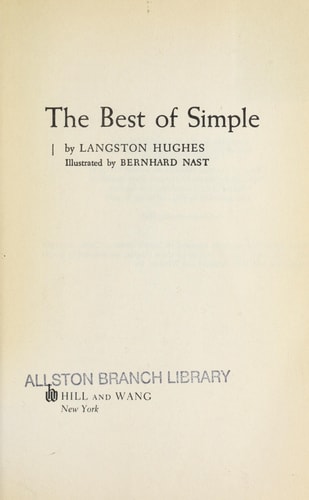
The Best of Simple: Stories (American Century)
Langston Hughes's stories about Jesse B. Semple--first composed for a weekly column in the Chicago Defender and then collected in Simple Speaks His Mind, Simple Takes a Wife, and Simple Stakes a Claim--have been read and loved by hundreds of thousands of readers. In The Best of Simple, the author picked his favorites from these earlier volumes, stories that not only have proved popular but are now part of a great and growing literary tradition.
Simple might be considered an Everyman for black Americans. Hughes himself wrote: "...these tales are about a great many people--although they are stories about no specific persons as such. But it is impossible to live in Harlem and not know at least a hundred Simples, fifty Joyces, twenty-five Zaritas, and several Cousin Minnies--or reasonable facsimiles thereof."
As Arnold Rampersad has written, Simple is "one of the most memorable and winning characters in the annals of American literature, justly regarded as one of Hughes's most inspired creations."
Langston Hughes was born in Joplin, Missouri, went to Cleveland, Ohio, lived for a number of years in Chicago, and long resided in New York City's Harlem. He graduated form Lincoln University in 1929 and was awarded an honorary Litt. D. in 1943. He was perhaps best known as a poet and the creator of Simple, but he also wrote novels, biography, history, plays (several of them Broadway hits), and children's books, and he edited several anthologies. Mr. Hughes died in 1967.
Copies
No copies available.

The Weary Blues; Not Without Laughter; The Ways of White Folks (Everyman's Library Contemporary Classics Series)
A major hardcover compendium of poetry and fiction by the legendary Black American poet of the Harlem Renaissance
One of the most important writers to emerge from the Harlem Renaissance, Langston Hughes may be best known as a poet, but he was also a brilliant storyteller, blending elements of blues and jazz, speech and song, into a triumphant and wholly original idiom. Perhaps more than any other writer, Langston Hughes made the white America of the 1920s and 1930s aware of the Black culture thriving in its midst. Hughes's poetry and fiction works are messages from that America, sharply etched vignettes of its daily life, cruelly accurate portrayals of Black and white collisions.
This Everyman's Library compendium comprises Hughes's debut poetry collection, The Weary Blues, which catapulted him into literary stardom at just twenty-four years old; his award-winning debut novel, Not Without Laughter, published in 1930 to critical raves; and his 1933 collection of short stories The Ways of White Folks, currently only available in Vintage Classics trade paperback.
Everyman's Library pursues the highest production standards, printing on acid-free paper, with full-cloth cases with two-color foil stamping, decorative endpapers, silk ribbon markers, European-style half-round spines, and a full-color illustrated jacket.
Copies
No copies available.

The Sweet Flypaper of Life (softcover)
by Langston Hughes, Roy DeCarava
“The people in these photographs had no walls up. They just accepted me and permitted me to take their photographs without any self-consciousness.” —Roy DeCarava
The Sweet Flypaper of Life is a “poem” about ordinary people, about teenagers around a jukebox, about children at an open fire hydrant, about riding the subway alone at night, about picket lines and artist work spaces. This renowned, life-affirming collaboration between artist Roy DeCarava and writer Langston Hughes honors in words and pictures what the authors saw, knew, and felt deeply about life in their city.
Hughes’s heart-warming description of Harlem in the late 1940s and early 1950s is seen through the eyes of one grandmother, Sister Mary Bradley. As she guides the reader through the lives of those around her, we imagine the babies born, families in struggle, children yet flourishing. We experience the sights and sounds of Harlem as seen through her learned and worldly eyes, expressed here through Hughes’s poetic prose. As she states, “I done got my feet caught in the sweet flypaper of life and I’ll be dogged if I want to get loose.” DeCarava’s photographs lay open a world of sense and feeling that begins with his perception and vision. The ruminations go beyond the limit of simple observation and contend with deeper meanings to reveal these individuals as subjects worthy of art. While Hughes states “We’ve had so many books about how bad life is, maybe it’s time to have one showing how good it is,” the photographs bring us back to this lively dialogue and a complex reality, to a resolution that stands with the optimism of the photographic medium and the certainty of DeCarava’s artistic moment.
In 1952 DeCarava became the first African American photographer to win a John Simon Guggenheim Memorial Fellowship. The one-year grant enabled DeCarava to focus full time on the photography he had been creating since the mid-1940s and to complete a project that would eventually result in The Sweet Flypaper of Life, a moving, photo-poetic work in the urban setting of Harlem. DeCarava compiled a set of images from which Hughes chose 141 and adeptly supplied a fictive narration, reflecting on life in that city-within-a-city. First published in 1955, the book, widely considered a classic of photographic visual literature, was reprinted by public demand several times. This fourth printing, the Heritage Edition, is the first authorized English-language edition since 1983 and includes an afterword by Sherry Turner DeCarava tracing the history and ongoing importance of this book.
Copies
No copies available.

Autobiography: The Big Sea (Collected Works of Langston Hughes, Vol 13) (Volume 13)
by Langston Hughes, Joseph McLaren
Langston Hughes was among the Harlem Renaissance authors who traveled widely during the 1920s. In the first volume of his autobiography, The Big Sea, covering the years through 1931, Hughes offers recollections of his childhood in Kansas, his high school years in Cleveland, his sojourn with his father in Mexico, and his initial reactions to New York City and Harlem.
Commentaries on the "Black Renaissance" in Harlem and Washington, D.C., are intertwined with recollections of his student years at Lincoln University in Pennsylvania, his travels through the South, and his association as a "younger generation" poet with the New York and Harlem literary establishment represented by the magazines Crisis and Opportunity. Personal memories of Jessie Fauset, Countee Cullen, Jean Toomer, W. E. B. Du Bois, Wallace Thurman, Alain Locke, Carter G. Woodson, Vachel Lindsay, A'Lelia Walker, and others are augmented by allusions to such celebrities as Duke Ellington, Florence Mills, Eubie Blake, Florence Embry, Josephine Baker, Bert Williams, Theodore Dreiser, Ethel Barrymore, and Bessie Smith.
Hughes addresses such controversial issues as his literary and personal disagreements with Zora Neale Hurston over their play Mule Bone, Carl Van Vechten's problematic novel Nigger Heaven, racial matters at Lincoln University, the Jim Crow laws in the South, and the failures of white patronage. Furthermore, Hughes refers to the sources of a blues poetry aesthetic, his visit to Cuba, and the struggle to complete his first novel, Not without Laughter. A rare autobiographical presentation of the Harlem Renaissance from the perspective of an insider, The Big Sea is a veritable catalog of notables. In addition, it offers a "black perspective" on the expatriate life in Europe during the Jazz Age.
Copies
No copies available.

Letters from Langston: From the Harlem Renaissance to the Red Scare and Beyond
Langston Hughes, one of America's greatest writers, was an innovator of jazz poetry and a leader of the Harlem Renaissance whose poems and plays resonate widely today. Accessible, personal, and inspirational, Hughes’s poems portray the African American community in struggle in the context of a turbulent modern United States and a rising black freedom movement. This indispensable volume of letters between Hughes and four leftist confidants sheds vivid light on his life and politics.
Letters from Langston begins in 1930 and ends shortly before his death in 1967, providing a window into a unique, self-created world where Hughes lived at ease. This distinctive volume collects the stories of Hughes and his friends in an era of uncertainty and reveals their visions of an idealized world—one without hunger, war, racism, and class oppression.
Copies
No copies available.

Not Without Laughter (Dover Thrift Editions: Black History)
A shining star of the Harlem Renaissance movement, Langston Hughes is one of modern literature's most revered African American authors. Although best known for his poetry, Hughes produced in Not Without Laughter a powerful and pioneering classic novel.
This stirring coming-of-age tale unfolds in 1930s rural Kansas. A poignant portrait of African American family life in the early twentieth century, it follows the story of young Sandy Rogers as he grows from a boy to a man. We meet Sandy's mother, Annjee, who works as a housekeeper for a wealthy white family; his strong-willed grandmother, Hager; Jimboy, Sandy's father, who travels the country looking for work; Aunt Tempy, the social climber; and Aunt Harriet, the blues singer who has turned away from her faith.
A fascinating chronicle of a family's joys and hardships, Not Without Laughter is a vivid exploration of growing up and growing strong in a racially divided society. A rich and important work, it masterfully echoes the black American experience.
Copies
No copies available.

The Langston Hughes Reader
With art and wit, Langston Hughes defined the place of Black Americans in all of the forms of American literary expression. Available again is the classic anthology from the leader of the Harlem Renaissance. First published in 1958, this compilation of the writings of Langston Hughes is drawn from every category of his prodigious literary achievement. It combines highlights of the novels, stories, plays, poems, songs, and essays that have established his commanding position in world literature. Among the selections are the complete libretto of his popular musical comedy Simply Heavenly; the text of his pageant Glory of Negro History; his one-act play, Soul Gone Home; generous portions of his autobiographies, The Big Sea and I Wonder as I Wander; and of the incomparable Simple trilogy: Simple Takes a Wife, Simple Speaks his Mind, and Simple Stakes a Claim.
Copies
No copies available.

The Sweet and Sour Animal Book (The Iona and Peter Opie Library of Children's Literature)
In 26 never-before-published short and wonderfully clever poems, Langston Hughes takes children through both the alphabet and the animal world. From Ape to Zebra--with bees, camels, fish, and even a unicorn in between--he paints a picture of each animal with just a few simple, but telling, words.
Copies
No copies available.

The Later Simple Stories (LH8) (Volume 8) (The Collected Works of Langston Hughes)
In Volume 8 of The Collected Works of Langston Hughes, the genial Harlem everyman, Jesse B. Semple returns with his more cosmopolitan bar buddy, Ananias Boyd. Social climber Joyce Lane is now Mrs. Jesse B. Semple, and Simple has minimized his flirtatious contacts with other women. Despite these ongoing characters, the later Simple stories are very different from the earlier Simple tales. The later stories evoke the historical and social context within which they were written, a politically dangerous time for the fictional adventures and fantasies of the main characters.
The Later Simple Stories returns to print Hughes's third and fourth Simple collections, Simple Stakes a Claim and Simple's Uncle Sam, along with some episodes Hughes did not include in any of his books. Simple Stakes a Claim was published in 1957, and it reflects the troubled and troublesome era of the Cold War and McCarthy hearings. Simple's Uncle Sam appeared in 1965, and it captures the turbulent decade when black Americans asserted their rights, including the privilege to call themselves "Black" and wear their hair in natural styles. The nonviolent strategies of civil disobedience and the violent strategies of urban rioting had converged to amplify African American voices as they demanded justice.
The innocent humor of the earlier Simple stories is replaced here by new strengths. Remarkably powerful female characters emerge in this volume. We observe Cousin Minnie's self-preservation skills and her willingness to riot to defend her rights as a citizen. We read about Simple's cousin Lynn Clarisse, who is a social activist educated at Fisk University. And we see Joyce herself emerge from her prim niche to display pride and knowledge about her African heritage.
The Later Simple Stories rounds out Hughes's presentation of Jesse B. Semple and the various people of his world. Simple and his foil still make us chuckle, but more important, they make us think. While these episodes often focus on particularities of the times, they also articulate broader truths that remain valuable.
Copies
No copies available.

The Early Simple Stories (Collected Works of Langston Hughes, Vol 7) (Volume 7)
Jesse B. Semple first sprang to life in Langston Hughes's weekly Chicago Defender column in 1943. Almost immediately, the "Simple stories," as they were routinely called, had a large and ever-increasing audience. Simple soon became Harlem's Everyman—an ordinary black workingman, representative of the masses of black folks in the 1940s.
Simple had migrated to Harlem, like many other blacks, seeking to escape the racism of the South, and he celebrated his new freedoms despite the economic struggles he still confronted. Simple's bar buddy and foil in the stories is the better-educated, more articulate Boyd, who has never lived in the South. Their conversations permit Simple to speak the wisdom of the working class.
By the time the first book of Simple stories was published, Hughes had honed and polished these two characters, enhancing the distinctions between the vernacular language of Simple and the more educated diction of his friend. Remaining within the Afrocentric world that was his chosen sphere, Hughes makes clear the message that Simple and Boyd are very much alike; both are black men in a racially unbalanced society. Both exist in a world within a world, in Harlem, the separate black community of New York City.
"You imply that there is no fun to be had around white folks."
"I never had none," said Simple.
"You have a color complex."
"A colored complexion," said Simple.
"I said complex, not complexion."
"I added the shun myself," said Simple. "I'm colored, and being around white folks makes me feel more colored—since most of them shun Negroes."
Countless exchanges between Simple and his companion offer wit and wisdom that remind contemporary readers why Langston Hughes is so special.
Copies
No copies available.

The Panther & the Lash
Hughes's last collection of poems commemorates the experience of Black Americans in a voice that no reader could fail to hear—the last testament of a great American writer who grappled fearlessly and artfully with the most compelling issues of his time.
“Langston Hughes is a titanic figure in 20th-century American literature ... a powerful interpreter of the American experience.” —The Philadelphia Inquirer
From the publication of his first book in 1926, Langston Hughes was America's acknowledged poet of color. Here, Hughes's voice—sometimes ironic, sometimes bitter, always powerful—is more pointed than ever before, as he explicitly addresses the racial politics of the sixties in such pieces as "Prime," "Motto," "Dream Deferred," "Frederick Douglass: 1817-1895," "Still Here," "Birmingham Sunday." " History," "Slave," "Warning," and "Daybreak in Alabama."
Copies
No copies available.

Hughes: Poems Edited by David Roessel
From the publication of his first book in 1926, Langston Hughes was hailed as the poet laureate of black America, the first to commemorate the experience of African Americans in a voice that no reader, black or white, could fail to hear. Lyrical and pungent, passionate and polemical, this volume is a treasure-an essential collection of the work of a poet whose words have entered our common language.
Copies
No copies available.