Books by Plato

LAST DAYS OF SOCRATES : PENGUIN CLASSICS / HUGH TREDENN
by Plato
The trial and death of Socrates (469-399 BCE) have almost as central a place in Western consciousness as the trial and death of Jesus. In four superb dialogues, Plato provides the classic account. Euthyphro finds Socrates outside the court-house, debating the nature of piety, while the Apology is his robust rebuttal of the charges of impiety and a defence of the philosopher's life. In the Crito, while awaiting execution in prison, Socrates counters the arguments of friends urging him to escape. Finally, in the Phaedo, he is shown calmly confident in the face of death, skilfully arguing the case for the immortality of the soul.
For more than seventy years, Penguin has been the leading publisher of classic literature in the English-speaking world. With more than 1,700 titles, Penguin Classics represents a global bookshelf of the best works throughout history and across genres and disciplines. Readers trust the series to provide authoritative texts enhanced by introductions and notes by distinguished scholars and contemporary authors, as well as up-to-date translations by award-winning translators.
Copies
-
$14.00

Great Dialogues of Plato (Signet Classics)
by Plato
A new translation of the complete texts of the Republic, Apology, Crito Phaido, Ion, Meno, and Symposium reveals the genius of Plato as he struggled with education, justice, the "philosopher king," and utopian visions of society. Reprint. BAKER & TAYLOR Bks
Copies
No copies available.

The Symposium (Penguin Great Ideas)
by Plato
The perfect books for the true book lover, Penguin's Great Ideas series features twelve more groundbreaking works by some of history's most prodigious thinkers. Each volume is beautifully packaged with a unique type-driven design that highlights the bookmaker's art. Offering great literature in great packages at great prices, this series is ideal for those readers who want to explore and savor the Great Ideas that have shaped our world.
Plato's retelling of the discourses between Socrates and his friends on such subjects as love and desire, truth and illusion, spiritual transcendence and the qualities of a good ruler, profoundly affected the ways in which we view human relationships, society and leadership—and shaped the whole tradition of Western philosophy.
Copies
No copies available.

Early Socratic Dialogues (Penguin Classics)
by Plato
Rich in drama and humour, the Early Socratic Dialogues include the controversial Ion, a debate on poetic inspiration; Laches, in which Socrates seeks to define bravery; and Euthydemus, which considers the relationship between philosophy and politics. Together, these dialogues provide a definitive portrait of the real Socrates and raise issues still keenly debated by philosophers, forming an incisive overview of Plato's philosophy.
For more than seventy years, Penguin has been the leading publisher of classic literature in the English-speaking world. With more than 1,700 titles, Penguin Classics represents a global bookshelf of the best works throughout history and across genres and disciplines. Readers trust the series to provide authoritative texts enhanced by introductions and notes by distinguished scholars and contemporary authors, as well as up-to-date translations by award-winning translators.
Copies
No copies available.

The Republic (Penguin Classics)
by Plato
Plato's The Republic is widely acknowledged as the cornerstone of Western philosophy.
Presented in the form of a dialogue between Socrates and three different interlocutors, it is an inquiry into the notion of a perfect community and the ideal individual within it. During the conversation other questions are raised: what is goodness; what is reality; what is knowledge? The Republic also addresses the purpose of education and the role of both women and men as "guardians" of the people. With remarkable lucidity and deft use of allegory, Plato arrives at a depiction of a state bound by harmony and ruled by "philosopher kings."
For more than seventy years, Penguin has been the leading publisher of classic literature in the English-speaking world. With more than 1,700 titles, Penguin Classics represents a global bookshelf of the best works throughout history and across genres and disciplines. Readers trust the series to provide authoritative texts enhanced by introductions and notes by distinguished scholars and contemporary authors, as well as up-to-date translations by award-winning translators.
Copies
-
$13.00

The Last Days of Socrates (Penguin Classics)
by Plato
"Consider just this, and give your minds to this alone: whether or not what I say is just"
Plato's account of Socrates' trial and death (399 BC) is a significant moment in Classical literature and the life of Classical Athens. In these four dialogues, Plato develops the Socratic belief in responsibility for one's self and shows Socrates living and dying under his philosophy. In Euthyphro, Socrates debates goodness outside the courthouse; Apology sees him in court, rebutting all charges of impiety; in Crito, he refuses an entreaty to escape from prison; and in Phaedo, Socrates faces his impending death with calmness and skilful discussion of immortality. Christopher Rowe's introduction to his powerful new translation examines the book's themes of identity and confrontation, and explores how its content is less historical fact than a promotion of Plato's Socratic philosophy.
For more than seventy years, Penguin has been the leading publisher of classic literature in the English-speaking world. With more than 1,700 titles, Penguin Classics represents a global bookshelf of the best works throughout history and across genres and disciplines. Readers trust the series to provide authoritative texts enhanced by introductions and notes by distinguished scholars and contemporary authors, as well as up-to-date translations by award-winning translators.
Copies
No copies available.

The Symposium (Penguin Classics)
by Plato
A fascinating discussion on sex, gender, and human instincts, as relevant today as ever
In the course of a lively drinking party, a group of Athenian intellectuals exchange views on eros, or desire. From their conversation emerges a series of subtle reflections on gender roles, sex in society and the sublimation of basic human instincts. The discussion culminates in a radical challenge to conventional views by Plato's mentor, Socrates, who advocates transcendence through spiritual love. The Symposium is a deft interweaving of different viewpoints and ideas about the nature of love—as a response to beauty, a cosmic force, a motive for social action and as a means of ethical education.
For more than seventy years, Penguin has been the leading publisher of classic literature in the English-speaking world. With more than 1,700 titles, Penguin Classics represents a global bookshelf of the best works throughout history and across genres and disciplines. Readers trust the series to provide authoritative texts enhanced by introductions and notes by distinguished scholars and contemporary authors, as well as up-to-date translations by award-winning translators.
Copies
-
$11.00

The Laws (Penguin Classics)
by Plato
In The Laws, Plato describes in fascinating detail a comprehensive system of legislation in a small agricultural utopia he named Magnesia. His laws not only govern crime and punishment, but also form a code of conduct for all aspects of life in his ideal state—from education, sport and religion to sexual behaviour, marriage and drinking parties. Plato sets out a plan for the day-to-day rule of Magnesia, administered by citizens and elected officials, with supreme power held by a Council. Although Plato's views that citizens should act in complete obedience to the law have been read as totalitarian, The Laws nonetheless constitutes a highly impressive programme for the reform of society and provides a crucial insight into the mind of one of Classical Greece's foremost thinkers.
For more than seventy years, Penguin has been the leading publisher of classic literature in the English-speaking world. With more than 1,700 titles, Penguin Classics represents a global bookshelf of the best works throughout history and across genres and disciplines. Readers trust the series to provide authoritative texts enhanced by introductions and notes by distinguished scholars and contemporary authors, as well as up-to-date translations by award-winning translators.
Copies
No copies available.

Timaeus and Critias (Penguin Classics)
by Plato
Timaeus and Critias is a Socratic dialogue in two parts. A response to an account of an ideal state told by Socrates, it begins with Timaeus’s theoretical exposition of the cosmos and his story describing the creation of the universe, from its very beginning to the coming of man. Timaeus introduces the idea of a creator God and speculates on the structure and composition of the physical world. Critias, the second part of Plato’s dialogue, comprises an account of the rise and fall of Atlantis, an ancient, mighty and prosperous empire ruled by the descendents of Poseidon, which ultimately sank into the sea.
For more than seventy years, Penguin has been the leading publisher of classic literature in the English-speaking world. With more than 1,700 titles, Penguin Classics represents a global bookshelf of the best works throughout history and across genres and disciplines. Readers trust the series to provide authoritative texts enhanced by introductions and notes by distinguished scholars and contemporary authors, as well as up-to-date translations by award-winning translators.
Copies
No copies available.

Gorgias (Penguin Classics)
by Plato
The classic political dialogue, as relevant today as in Plato's time
Taking the form of a dialogue between Socrates, Gorgias, Polus and Callicles, Gorgias debates perennial questions about the nature of government and those who aspire to public office. Are high moral standards essential or should we give our preference to the pragmatist who gets things done or negotiates successfully? Should individuals be motivated by a desire for personal power and prestige, or genuine concern for the moral betterment of the citizens? These questions go to the heart of Athenian democratic principles and are more relevant than ever in today's political climate.
For more than seventy years, Penguin has been the leading publisher of classic literature in the English-speaking world. With more than 1,700 titles, Penguin Classics represents a global bookshelf of the best works throughout history and across genres and disciplines. Readers trust the series to provide authoritative texts enhanced by introductions and notes by distinguished scholars and contemporary authors, as well as up-to-date translations by award-winning translators.
Copies
No copies available.

Protagoras and Meno (Penguin Classics)
by Plato
Two of Plato's finest dialogues; together they offer a rich and entertaining exploration of the origins of right and wrong, hedonism, self-control, the teachability of goodness, and the sources of our knowledge.
Exploring the question of what exactly makes good people good, Protagoras and Meno are two of the most enjoyable and accessible of all of Plato's dialogues. Widely regarded as his finest dramatic work, the Protagoras, set during the golden age of Pericles, pits a youthful Socrates against the revered sophist Protagoras, whose brilliance and humanity make him one the most interesting and likeable of Socrates' philosophical opponents, and turns their encounter into a genuine and lively battle of minds. The Meno sees an older but ever ironic Socrates humbling a proud young aristocrat as they search for a clear understanding of what it is to be a good man, and setting out the startling idea that all human learning may be the recovery of knowledge already possessed by our immortal souls.
For more than seventy years, Penguin has been the leading publisher of classic literature in the English-speaking world. With more than 1,700 titles, Penguin Classics represents a global bookshelf of the best works throughout history and across genres and disciplines. Readers trust the series to provide authoritative texts enhanced by introductions and notes by distinguished scholars and contemporary authors, as well as up-to-date translations by award-winning translators.
Copies
No copies available.

The Republic
by Plato
R. E. Allen’s highly regarded translations of the dialogues of Plato have been praised for their faithfulness and readability. Many years in the making, his translation of The Republic has been eagerly awaited. It comes now to crown a distinguished classicist’s efforts to make Plato’s works available in readable and accurate translations. This new, lucid translation of Plato’s greatest dialogue is the first major translation in English since the publication of F. M. Cornford’s and G. M. A. Grube’s renditions more than a generation ago. It is likely to be the standard translation for years to come.
This edition, intended for the student and general reader, is accompanied by Allen’s notes and introduction. The Republic is, of course, many things: metaphysics and epistemology, moral psychology and ethics, educational theory and aesthetics, and poetry and eschatology. In his introduction, Allen takes up its threshold questionthe politicaland argues that its particular formulation by Plato had a direct and profound influence on the Founding Fathers and the development of American constitutional law.
Copies
No copies available.

The Republic
by Plato
A major new translation of one of the central works of Western Civilization
R. E. Allen’s highly regarded translations of the dialogues of Plato have been praised for their faithfulness and readability. Many years in the making, his translation of The Republic has been eagerly awaited. It comes now to crown a distinguished classicist’s efforts to make Plato’s works available in readable and accurate translations. This new, lucid translation of Plato’s greatest dialogue is the first major translation in English since the publication of F. M. Cornford’s and G. M. A. Grube’s renditions more than a generation ago. It is likely to be the standard translation for years to come.
This edition, intended for the student and general reader, is accompanied by Allen’s notes and introduction. The Republic is, of course, many things: metaphysics and epistemology, moral psychology and ethics, educational theory and aesthetics, and poetry and eschatology. In his introduction, Allen takes up its threshold question—the political—and argues that its particular formulation by Plato had a direct and profound influence on the Founding Fathers and the development of American constitutional law.
Copies
No copies available.

The Republic
by Plato
Plato, the great philosopher of Athens, was born in 427 BCE. In early manhood an admirer of Socrates, he later founded the famous school of philosophy in the grove Academus. Much else recorded of his life is uncertain; that he left Athens for a time after Socrates' execution is probable; that later he went to Cyrene, Egypt, and Sicily is possible; that he was wealthy is likely; that he was critical of 'advanced' democracy is obvious. He lived to be 80 years old. Linguistic tests including those of computer science still try to establish the order of his extant philosophical dialogues, written in splendid prose and revealing Socrates' mind fused with Plato's thought.
In Laches, Charmides, and Lysis, Socrates and others discuss separate ethical conceptions. Protagoras, Ion, and Meno discuss whether righteousness can be taught. In Gorgias, Socrates is estranged from his city's thought, and his fate is impending. The Apology (not a dialogue), Crito, Euthyphro, and the unforgettable Phaedo relate the trial and death of Socrates and propound the immortality of the soul. In the famous Symposium and Phaedrus, written when Socrates was still alive, we find the origin and meaning of love. Cratylus discusses the nature of language. The great masterpiece in ten books, the Republic, concerns righteousness (and involves education, equality of the sexes, the structure of society, and abolition of slavery). Of the six so-called dialectical dialogues Euthydemus deals with philosophy; metaphysical Parmenides is about general concepts and absolute being; Theaetetus reasons about the theory of knowledge. Of its sequels, Sophist deals with not-being; Politicus with good and bad statesmanship and governments; Philebus with what is good. The Timaeus seeks the origin of the visible universe out of abstract geometrical elements. The unfinished Critias treats of lost Atlantis. Unfinished also is Plato's last work of the twelve books of Laws (Socrates is absent from it), a critical discussion of principles of law which Plato thought the Greeks might accept.
The Loeb Classical Library edition of Plato is in twelve volumes.
Copies
No copies available.

The Republic
by Plato
Famous philosophical treatise of the 4th century BC concerns itself chiefly with the idea of justice, as well as such Platonic theories as that of ideas, the criticism of poetry, and the philosopher's role. Source of the famous cave myth and prototype for other imaginary commonwealths, including those of Cicero, St. Augustine, and More. Benjamin Jowett translation.
Copies
No copies available.

The Republic
by Plato
Presented in the form of a dialogue between Socrates and three different interlocutors, this classic text is an enquiry into the notion of a perfect community and the ideal individual within it. During the conversation, other questions are raised: what is goodness? What is reality? And what is knowledge? The Republic also addresses the purpose of education and the role of both women and men as guardians of the people. With remarkable lucidity and deft use of allegory, Plato arrives at a depiction of a state bound by harmony and ruled by philosopher kings.
Copies
No copies available.

The Republic
by Plato
The unabridged version of this definitive work is now available in this highly designed hardcover with an introduction by Odysseus Makridis.
Published around 380 BCE, Plato's most famous work explores the idea of justness, among other things, through a Socratic dialogue. Considered to be one of the most influential writings in the development of Western philosophy and political theory, The Republic is as relevant today as when it was originally published. This collectible edition features:
- An elegant faux-leather cover with foil-embossed designs
- Unabridged text
- An introduction by Odysseus Makridis
Enhance your home library with this timeless, display-worthy volume.
Essential volumes for the shelves of every classic literature lover, these deluxe classics editions include beautifully presented works from some of the most important authors in literary history. Other deluxe classics from Chartwell include Little Women, Alice's Adventures in Wonderland, Anne of Green Gables, The Inferno, Dracula, The Iliad, The Essential Tales of Edgar Allan Poe, Meditations, and Irish Fairy and Folk Tales.
Copies
No copies available.

Great Dialogues of Plato
by Plato
Written in the form of debates, Great Dialogues of Plato comprises the most influential body of philosophy of the Western world—covering every subject from art and beauty to virtue and the nature of love.
Copies
No copies available.

Great Dialogues of Plato
by Plato
“Plato is philosophy, and philosophy, Plato.”—Emerson
The Republic and other great dialogues by the immortal Greek philosopher Plato are masterpieces that form part of the most important single body of writing in the history of philosophy. Beauty, love, immortality, knowledge, and justice are discussed in these dialogues, which magnificently express the glowing spirit of Platonic philosophy.
Translated by W. H. D. Rouse, one of the world’s most outstanding classical scholars and translator of Homer’s The Odyssey and The Iliad, this volume features the complete texts of seven of Plato’s most revered works.
“In Rouse’s pages Socrates’ strength of mind, his dedication to philosophical truth, are borne in on the modern reader with something of the power that impressed and disturbed the ancient Greeks.”—Time
Copies
No copies available.

The Trial and Death of Socrates: Four Dialogues (Dover Thrift Editions: Philosophy)
by Plato
The Dialogues of Plato (427–347 B.C.) rank with the writings of Aristotle as the most important and influential philosophical works in Western thought. In them Plato cast his teacher Socrates as the central disputant in colloquies that brilliantly probe a vast spectrum of philosophical ideas and issues. None is more exciting and revelatory than the four dialogues — Euthyphro, Apology, Crito, and Phaedo — on themes evoked by the trial and death of Socrates, accused by his enemies and detractors of crimes against the state, among them "impiety" and "corruption of the young."
In Euthyphro, Socrates explores the concepts and aims of piety and religion: in Apology, he courageously defends the integrity of his teachings; in Crito, he demonstrates his respect for the law in his refusal to flee his death sentence; and in Phaedo embraces death and discusses the immortality of the soul. The four dialogues are presented here in the authoritative translation by the distinguished classical scholar Benjamin Jowett, renowned for his translations of Plato.
Copies
-
$3.00

How to Talk about Love: An Ancient Guide for Modern Lovers (Ancient Wisdom for Modern Readers)
by Plato
Explore the nature of love in this charming new translation of selections from Plato’s great dramatic work, the Symposium
What is love? In poetry, songs, fiction, movies, psychology, and philosophy, love has been described, admired, lamented, and dissected in endless ways. Is love based on physical attraction? Does it bring out our better selves? How does it relate to sex? Is love divine? Plato’s Symposium is one of the oldest, most influential, and most profound explorations of such questions—it is even the source of the idea of “Platonic love.” How to Talk about Love introduces and presents the key passages and central ideas of Plato’s philosophical dialogue in a lively and highly readable new translation, which also features the original Greek on facing pages.
The Symposium is set at a fictional drinking party during which prominent Athenians engage in a friendly competition by delivering improvised speeches in praise of Eros, the Greek god of love and sex. The aristocrat Phaedrus, the legal expert Pausanias, the physician Eryximachus, the comic playwright Aristophanes, and the tragic poet Agathon—each by turn celebrates different aspects of love before Socrates proposes not to praise love but to tell the truth about it. In the final speech, the politician and libertine Alcibiades argues that Socrates himself is the epitome of love.
Deftly capturing the essence and spirit of Plato’s masterpiece, How to Talk about Love makes the Symposium more accessible and enjoyable than ever before.
Copies
-
$17.95

Plato: Laches, Protagoras, Meno, Euthydemus, (Loeb Classical Library, No. 165) (Greek and English Edition)
by Plato
On virtue in education and argumentation.
Plato, the great philosopher of Athens, was born in 427 BC. In early manhood an admirer of Socrates, he later founded the famous school of philosophy in the grove Academus. Much else recorded of his life is uncertain; that he left Athens for a time after Socrates’ execution is probable; that later he went to Cyrene, Egypt, and Sicily is possible; that he was wealthy is likely; that he was critical of “advanced” democracy is obvious. He lived to be 80 years old. Linguistic tests including those of computer science still try to establish the order of his extant philosophical dialogues, written in splendid prose and revealing Socrates’ mind fused with Plato’s thought.
In Laches, Charmides, and Lysis, Socrates and others discuss separate ethical conceptions. Protagoras, Ion, and Meno discuss whether righteousness can be taught. In Gorgias, Socrates is estranged from his city’s thought, and his fate is impending. The Apology (not a dialogue), Crito, Euthyphro, and the unforgettable Phaedo relate the trial and death of Socrates and propound the immortality of the soul. In the famous Symposium and Phaedrus, written when Socrates was still alive, we find the origin and meaning of love. Cratylus discusses the nature of language. The great masterpiece in ten books, the Republic, concerns righteousness (and involves education, equality of the sexes, the structure of society, and abolition of slavery). Of the six so-called dialectical dialogues Euthydemus deals with philosophy; metaphysical Parmenides is about general concepts and absolute being; Theaetetus reasons about the theory of knowledge. Of its sequels, Sophist deals with not-being; Politicus with good and bad statesmanship and governments; Philebus with what is good. The Timaeus seeks the origin of the visible universe out of abstract geometrical elements. The unfinished Critias treats of lost Atlantis. Unfinished also is Plato’s last work, Laws, a critical discussion of principles of law which Plato thought the Greeks might accept.
The Loeb Classical Library edition of Plato is in twelve volumes.
Copies
No copies available.

Plato: Timaeus, Critias, Cleitophon, Menexenus, Epistles (Loeb Classical Library No. 234)
by Plato
On the creation of the world, and the destruction of Atlantis.
Plato, the great philosopher of Athens, was born in 427 BC. In early manhood an admirer of Socrates, he later founded the famous school of philosophy in the grove Academus. Much else recorded of his life is uncertain; that he left Athens for a time after Socrates’ execution is probable; that later he went to Cyrene, Egypt, and Sicily is possible; that he was wealthy is likely; that he was critical of “advanced” democracy is obvious. He lived to be 80 years old. Linguistic tests including those of computer science still try to establish the order of his extant philosophical dialogues, written in splendid prose and revealing Socrates’ mind fused with Plato’s thought.
In Laches, Charmides, and Lysis, Socrates and others discuss separate ethical conceptions. Protagoras, Ion, and Meno discuss whether righteousness can be taught. In Gorgias, Socrates is estranged from his city’s thought, and his fate is impending. The Apology (not a dialogue), Crito, Euthyphro, and the unforgettable Phaedo relate the trial and death of Socrates and propound the immortality of the soul. In the famous Symposium and Phaedrus, written when Socrates was still alive, we find the origin and meaning of love. Cratylus discusses the nature of language. The great masterpiece in ten books, the Republic, concerns righteousness (and involves education, equality of the sexes, the structure of society, and abolition of slavery). Of the six so-called dialectical dialogues Euthydemus deals with philosophy; metaphysical Parmenides is about general concepts and absolute being; Theaetetus reasons about the theory of knowledge. Of its sequels, Sophist deals with not-being; Politicus with good and bad statesmanship and governments; Philebus with what is good. The Timaeus seeks the origin of the visible universe out of abstract geometrical elements. The unfinished Critias treats of lost Atlantis. Unfinished also is Plato’s last work, Laws, a critical discussion of principles of law which Plato thought the Greeks might accept.
The Loeb Classical Library edition of Plato is in twelve volumes.
Copies
No copies available.

Republic, Volume II: Books 6-10 (Loeb Classical Library)
by Plato
The Platonic ideal of government.
Plato of Athens, who laid the foundations of the Western philosophical tradition and in range and depth ranks among its greatest practitioners, was born to a prosperous and politically active family ca. 427 BC. In early life an admirer of Socrates, Plato later founded the first institution of higher learning in the West, the Academy, among whose many notable alumni was Aristotle. Traditionally ascribed to Plato are thirty-six dialogues developing Socrates’ dialectic method and composed with great stylistic virtuosity, together with thirteen letters.
Republic, a masterpiece of philosophical and political thought, concerns righteousness both in individuals and in communities, and proposes an ideal state organized and governed on philosophical principles. This edition, which replaces the original Loeb edition by Paul Shorey, offers text, translation, and annotation that are fully current with modern scholarship. The Loeb Classical Library edition of Plato is in twelve volumes.
Copies
No copies available.

Republic, Volume I: Books 1-5 (Loeb Classical Library)
by Plato
The Platonic ideal of government.
Plato of Athens, who laid the foundations of the Western philosophical tradition and in range and depth ranks among its greatest practitioners, was born to a prosperous and politically active family ca. 427 BC. In early life an admirer of Socrates, Plato later founded the first institution of higher learning in the West, the Academy, among whose many notable alumni was Aristotle. Traditionally ascribed to Plato are thirty-six dialogues developing Socrates’ dialectic method and composed with great stylistic virtuosity, together with thirteen letters.
Republic, a masterpiece of philosophical and political thought, concerns righteousness both in individuals and in communities, and proposes an ideal state organized and governed on philosophical principles. This edition, which replaces the original Loeb edition by Paul Shorey, offers text, translation, and annotation that are fully current with modern scholarship. The Loeb Classical Library edition of Plato is in twelve volumes.
Copies
No copies available.

Euthyphro. Apology. Crito. Phaedo (Loeb Classical Library)
by Plato
The fundamental tetralogy on Socrates’ final days.
Plato of Athens, who laid the foundations of the Western philosophical tradition and in range and depth ranks among its greatest practitioners, was born to a prosperous and politically active family circa 427 BC. In early life an admirer of Socrates, Plato later founded the first institution of higher learning in the West, the Academy, among whose many notable alumni was Aristotle. Traditionally ascribed to Plato are thirty-five dialogues developing Socrates’ dialectic method and composed with great stylistic virtuosity, together with the Apology and thirteen letters.
The four works in this volume recount the circumstances of Socrates’ trial and execution in 399 BC. In Euthyphro, set in the weeks before the trial, Socrates and Euthyphro attempt to define holiness. In Apology, Socrates answers his accusers at trial and unapologetically defends his philosophical career. In Crito, a discussion of justice and injustice explains Socrates’ refusal of Crito’s offer to finance his escape from prison. And in Phaedo, Socrates discusses the concept of an afterlife and offers arguments for the immortality of the soul. This edition, which replaces the original Loeb edition by Harold North Fowler, offers text, translation, and annotation that are fully current with modern scholarship.
Copies
No copies available.

The Republic: Introduction by Alexander Nehamas (Everyman's Library Classics Series)
by Plato
Toward the end of the astonishing period of Athenian creativity that furnished Western civilization with the greater part of its intellectual, artistic, and political wealth, Plato wrote The Republic, his discussion of the nature and meaning of justice and of the ideal state and its ruler. All subsequent European thinking about these subjects owes its character, directly or indirectly, to this most famous (and most accessible) of the Platonic dialogues. Although he describes a society that looks to some like the ideal human community and to others like a totalitarian nightmare, in the course of his description Plato raises enduringly relevant questions about politics, art, education, and the general conduct of life. The translation is by A. D. Lindsay.
Copies
No copies available.

The Collected Dialogues of Plato (Bollingen Series)
by Plato
This Classic One-volume Edition Of The Complete Writings Of Plato Is Now Available In Paperback For The Very First Time. The Editors, Edith Hamilton And Huntington Cairns, Chose The Contents From The Work Of The Best Modern British And American Translators. The Volume Contains Prefatory Notes To Each Dialogue, By Hamilton; An Introductory Essay On Plato's Philosophy And Writings, By Cairns; And A Comprehensive Index With Cross References. In A New Foreword, Acclaimed Philosopher And Novelist Rebecca Newberger Goldstein Describes Plato's Unparalleled Importance To Philosophy Down To The Present Day, Why He Chose The Artful Form Of The Dialogue, And What Makes This Edition Of His Writings Special-- Provided By Publisher.
Copies
-
$39.95

Republic by Plato ( Author ) ON Oct-01-2004, Paperback
by Plato
This edition includes a select bibliography, a synopsis of each book, a glossary of terms, a glossary and index of names, and a general index.
"Reeve's new translation of Republic is the one to order for students. . . . Reeve draws on his thorough understanding of Plato's central work to provide an informed translation and properly brief supporting apparatus. A highlight is the concise, substantive Introduction that usefully encapsulates much of Reeve's own scholarship."
—P.W. Wakefield, in CHOICE
Copies
No copies available.
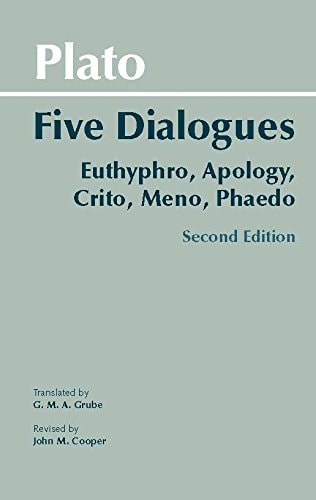
Plato: Five Dialogues: Euthyphro, Apology, Crito, Meno, Phaedo (Hackett Classics)
by Plato
The second edition of Five Dialogues presents G. M. A. Grube's distinguished translations, as revised by John Cooper for Plato, Complete Works. A number of new or expanded footnotes are also included along with an updated bibliography.
Copies
No copies available.

The Dialogues of Plato (Bantam Classics)
by Plato
Socrates’ ancient words are still true, and the ideas found in Plato’s Dialogues still form the foundation of a thinking person’s education. This superb collection contains excellent contemporary translations selected for their clarity and accessibility to today’s reader, as well as an incisive introduction by Erich Segal, which reveals Plato’s life and clarifies the philosophical issues examined in each dialogue. The first four dialogues recount the trial and execution of Socrates–the extraordinary tragedy that changed Plato’s life and forever altered the course of Western thought. Other dialogues create a rich tableau of intellectual life in Athens in the fourth century b.c., and examine such timeless–and timely–issues as the nature of virtue and love, knowledge and truth, society and the individual. Resounding with the humor and astounding brilliance of Socrates, the immortal iconoclast, these great works remain powerful, probing, and essential.
Copies
No copies available.

The Republic: The Statesman of Plato (Classic Reprint)
by Plato
An authoritative new translation of Plato's foundational work of Western philosophy
The Republic is Plato's masterwork. It was written 2,400 years ago and remains one of the most widely read books in the world, famous for both the richness of its ideas and the virtuosity of its writing. Presented as a dialogue between Plato's teacher Socrates and various interlocutors, it is an exhortation to study philosophy, inviting its readers to reflect on the choices we must make if we are to live the best life available to us. This complex, dynamic work creates a picture of an ideal society governed not money, power, or fame, but by philosophy, wisdom, and justice.
For more than seventy years, Penguin has been the leading publisher of classic literature in the English-speaking world. With more than 1,700 titles, Penguin Classics represents a global bookshelf of the best works throughout history and across genres and disciplines. Readers trust the series to provide authoritative texts enhanced by introductions and notes by distinguished scholars and contemporary authors, as well as up-to-date translations by award-winning translators.
Copies
No copies available.

The Portable Plato (Portable Library)
by Plato
Writing in the fourth century B.C., in an Athens that had suffered a humiliating defeat in the Peloponnesian War, Plato formulated questions that have haunted the moral, religious, and political imagination of the West for more than 2,000 years: what is virtue? How should we love? What constitutes a good society? Is there a soul that outlasts the body and a truth that transcends appearance? What do we know and how do we know it? Plato's inquiries were all the more resonant because he couched them in the form of dramatic and often highly comic dialogues, whose principal personage was the ironic, teasing, and relentlessly searching philosopher Socrates.
In this splendid collection, Scott Buchanan brings together the most important of Plato's dialogues, including Protagoras, The Symposium, with its barbed conjectures about the relation between love and madness, Phaedo and The Republic, his monumental work of political philosophy. Buchanan's learned and engaging introduction allows us to see Plato both as a commentator on his society and as a shaper of the societies that followed, who bequeathed to us a hunger for the ideal as well as a redeeming habit of humane skepticism.
Copies
No copies available.

Theatetus (Penguin Classics)
by Plato
Set immediately prior to the trial and execution of Socrates in 399 BC, Theaetetus shows the great philosopher considering the nature of knowledge itself, in a debate with the geometrician Theodorus and his young follower Theaetetus. Their dialogue covers many questions, such as: is knowledge purely subjective, composed of the ever-changing flow of impressions we receive from the outside world? Is it better thought of as "true belief"? Or is it, as many modern philosophers argue, "justified true belief," in which the belief is supported by argument or evidence? With skill and eloquence, Socrates guides the debate, drawing out the implications of these theories and subjecting them to merciless and mesmerising criticism. One of the founding works of epistemology, this profound discussion of the problem of knowledge continues to intrigue and inspire.
For more than seventy years, Penguin has been the leading publisher of classic literature in the English-speaking world. With more than 1,700 titles, Penguin Classics represents a global bookshelf of the best works throughout history and across genres and disciplines. Readers trust the series to provide authoritative texts enhanced by introductions and notes by distinguished scholars and contemporary authors, as well as up-to-date translations by award-winning translators.
Copies
No copies available.

Phaedrus (Penguin Classics)
by Plato
Phaedrus is widely recognized as one of Plato's most profound and beautiful works. It takes the form of a dialogue between Socrates and Phaedrus and its ostensible subject is love, especially homoerotic love. This new translation is accompanied by an introduction, further reading, and full notes on the text and translation that discuss the structure of the dialogue and elucidate issues that might puzzle the modern reader.
For more than seventy years, Penguin has been the leading publisher of classic literature in the English-speaking world. With more than 1,700 titles, Penguin Classics represents a global bookshelf of the best works throughout history and across genres and disciplines. Readers trust the series to provide authoritative texts enhanced by introductions and notes by distinguished scholars and contemporary authors, as well as up-to-date translations by award-winning translators.
Copies
No copies available.

Plato: Crito (Greek Texts)
by Plato
Plato's Socrates, in prison and being urged to flee execution, raises in acute form, and for the first time in European thought, a central question: is it right to disobey the state? Socrates' controversial answer in "Crito" has generated much contemporary literature, but no English commentary of the Greek text for seventy-five years. This new edition aims to provide an up-to-date literary and philosophical analysis suitable for a wide range of readers, including those with post-beginners Greek. It represents an ideal introduction, not only to the social and philosophical world of Classical Greece, but also to the personality of one of its greatest thinkers.
Copies
No copies available.

Plato: Laws 1 And 2
by Plato
Susan Sauvé Meyer presents a new translation of Plato's Laws, 1 and 2. In these opening books of Plato's last work, a Cretan, a Spartan, and an Athenian discuss legislative theory, moral psychology, and the criteria for evaluating art. The interlocutors compare the relative merits of different nomoi (laws, practices, institutions), in particular, the communal meals (sussitia) practiced in Sparta and Crete and the paradigmatically Athenian institution of the drinking party (sumposion). They agree that the legislator's goal is to inculcate virtue in the citizens, but they disagree about what the virtues are, and what institutions are required to inculcate them. The Spartan and Cretan, who value military strength in a city and courage in its citizens, see no value in drinking parties, which they take to encourage softness and susceptibility to pleasure. The Athenian insists that drinking parties train citizens in moderation, just as military exercises train citizens in courage. He defends this paradoxical thesis by offering a moral psychology and theory of virtue (rather different from that of the Republic but highly evocative of Aristotle's Ethics), along with a theory of education in which choral song and dance play an important role. A detailed discussion of the criteria for evaluating works of art rounds out the discussion, and here too the reader will find a discussion very different from the treatment of art in the Republic. Meyer's fluent and readable translation achieves a high standard of fidelity to the original Greek. The commentary lays bare the structure of the argumentation, illuminates the philosophical issues, and explains difficult passages, making this complex and intricate work accessible to students and scholars alike.
Copies
No copies available.

Protagoras (Oxford World's Classics)
by Plato
In the fifth century BC professional educators, the sophists, travelled the Greek world claiming to teach success in public and private life. In this dialogue Plato shows the pretensions of the leading sophist, Protagoras, challenged by the critical arguments of Socrates. From criticism of the educational aims and methods of the sophists the dialogue broadens out to consider the nature of the good life, and the role of pleasure and intellect in the context of that life.
About the Series: For over 100 years Oxford World's Classics has made available the broadest spectrum of literature from around the globe. Each affordable volume reflects Oxford's commitment to scholarship, providing the most accurate text plus a wealth of other valuable features, including expert introductions by leading authorities, voluminous notes to clarify the text, up-to-date bibliographies for further study, and much more.
Copies
No copies available.

Copies
No copies available.

A Greek Prose Course: Unit 2: Philosophy
by Plato
This is part two of a four-part prose reading course designed for beginners in Greek and other learners wishing to consolidate their reading skills. Particular attention is paid to idiomatic usage (both in Greek and English), word order and the use of particles and particle-combinations, while practical guidance is given on mastering the verbal systems and other features of the language which beginners generally find problematic. The four units may be studied in succession as part of a progressive course, but each unit is sufficiently self-contained to permit the pursuit of particular interests.
Copies
No copies available.

Theaetetus (Oxford World's Classics)
by Plato, Lesley Brown, John McDowell
'What exactly is knowledge?'
The Theaetetus is a seminal text in the philosophy of knowledge, and is acknowledged as one of Plato's finest works. Cast as a conversation between Socrates and a clever but modest student, Theaetetus, it explores one of the key issues in philosophy: what is knowledge? Though no definite answer is reached, the discussion is penetrating and wide-ranging, covering the claims of perception to be knowledge, the theory that all is in motion, and the perennially tempting idea that knowledge and truth are relative to different individuals or states. The inquirers go on to explore the connection between knowledge and true judgement, and the famous threefold definition of knowledge as justified true belief. Packed with subtle arguments, the dialogue is also a work of literary genius, with an unforgettable portrait of Socrates as a midwife of wisdom.
This new edition uses the acclaimed translation by John McDowell. It includes a valuable introduction that locates the work in Plato's oeuvre, and explains some of the competing interpretations of its overall meaning. The notes elucidate Plato's arguments and draw connections within the work and with other philosophical discussions.
About the Series: For over 100 years Oxford World's Classics has made available the broadest spectrum of literature from around the globe. Each affordable volume reflects Oxford's commitment to scholarship, providing the most accurate text plus a wealth of other valuable features, including expert introductions by leading authorities, voluminous notes to clarify the text, up-to-date bibliographies for further study, and much more.
Copies
No copies available.

Plato: Lysis. Symposium. Gorgias. (Loeb Classical Library No. 166)
by Plato
Plato, the great philosopher of Athens, was born in 427 BCE. In early manhood an admirer of Socrates, he later founded the famous school of philosophy in the grove Academus. Much else recorded of his life is uncertain; that he left Athens for a time after Socrates' execution is probable; that later he went to Cyrene, Egypt, and Sicily is possible; that he was wealthy is likely; that he was critical of 'advanced' democracy is obvious. He lived to be 80 years old. Linguistic tests including those of computer science still try to establish the order of his extant philosophical dialogues, written in splendid prose and revealing Socrates' mind fused with Plato's thought.
In Laches, Charmides, and Lysis, Socrates and others discuss separate ethical conceptions. Protagoras, Ion, and Meno discuss whether righteousness can be taught. In Gorgias, Socrates is estranged from his city's thought, and his fate is impending. The Apology (not a dialogue), Crito, Euthyphro, and the unforgettable Phaedo relate the trial and death of Socrates and propound the immortality of the soul. In the famous Symposium and Phaedrus, written when Socrates was still alive, we find the origin and meaning of love. Cratylus discusses the nature of language. The great masterpiece in ten books, the Republic, concerns righteousness (and involves education, equality of the sexes, the structure of society, and abolition of slavery). Of the six so-called dialectical dialogues Euthydemus deals with philosophy; metaphysical Parmenides is about general concepts and absolute being; Theaetetus reasons about the theory of knowledge. Of its sequels, Sophist deals with not-being; Politicus with good and bad statesmanship and governments; Philebus with what is good. The Timaeus seeks the origin of the visible universe out of abstract geometrical elements. The unfinished Critias treats of lost Atlantis. Unfinished also is Plato's last work of the twelve books of Laws (Socrates is absent from it), a critical discussion of principles of law which Plato thought the Greeks might accept.
The Loeb Classical Library edition of Plato is in twelve volumes.
Copies
No copies available.

Plato: Cratylus. Parmenides. Greater Hippias. Lesser Hippias. (Loeb Classical Library No. 167)
by Plato
On names, forms, beauty, and lies.
Plato, the great philosopher of Athens, was born in 427 BC. In early manhood an admirer of Socrates, he later founded the famous school of philosophy in the grove Academus. Much else recorded of his life is uncertain; that he left Athens for a time after Socrates’ execution is probable; that later he went to Cyrene, Egypt, and Sicily is possible; that he was wealthy is likely; that he was critical of “advanced” democracy is obvious. He lived to be 80 years old. Linguistic tests including those of computer science still try to establish the order of his extant philosophical dialogues, written in splendid prose and revealing Socrates’ mind fused with Plato’s thought.
In Laches, Charmides, and Lysis, Socrates and others discuss separate ethical conceptions. Protagoras, Ion, and Meno discuss whether righteousness can be taught. In Gorgias, Socrates is estranged from his city’s thought, and his fate is impending. The Apology (not a dialogue), Crito, Euthyphro, and the unforgettable Phaedo relate the trial and death of Socrates and propound the immortality of the soul. In the famous Symposium and Phaedrus, written when Socrates was still alive, we find the origin and meaning of love. Cratylus discusses the nature of language. The great masterpiece in ten books, the Republic, concerns righteousness (and involves education, equality of the sexes, the structure of society, and abolition of slavery). Of the six so-called dialectical dialogues Euthydemus deals with philosophy; metaphysical Parmenides is about general concepts and absolute being; Theaetetus reasons about the theory of knowledge. Of its sequels, Sophist deals with not-being; Politicus with good and bad statesmanship and governments; Philebus with what is good. The Timaeus seeks the origin of the visible universe out of abstract geometrical elements. The unfinished Critias treats of lost Atlantis. Unfinished also is Plato’s last work, Laws, a critical discussion of principles of law which Plato thought the Greeks might accept.
The Loeb Classical Library edition of Plato is in twelve volumes.
Copies
No copies available.

Plato: Euthyphro. Apology. Crito. Phaedo. Phaedrus (Loeb Classical Library)
by Plato
Plato, the great philosopher of Athens, was born in 427 BCE. In early manhood an admirer of Socrates, he later founded the famous school of philosophy in the grove Academus. Much else recorded of his life is uncertain; that he left Athens for a time after Socrates' execution is probable; that later he went to Cyrene, Egypt, and Sicily is possible; that he was wealthy is likely; that he was critical of 'advanced' democracy is obvious. He lived to be 80 years old. Linguistic tests including those of computer science still try to establish the order of his extant philosophical dialogues, written in splendid prose and revealing Socrates' mind fused with Plato's thought.
In Laches, Charmides, and Lysis, Socrates and others discuss separate ethical conceptions. Protagoras, Ion, and Meno discuss whether righteousness can be taught. In Gorgias, Socrates is estranged from his city's thought, and his fate is impending. The Apology (not a dialogue), Crito, Euthyphro, and the unforgettable Phaedo relate the trial and death of Socrates and propound the immortality of the soul. In the famous Symposium and Phaedrus, written when Socrates was still alive, we find the origin and meaning of love. Cratylus discusses the nature of language. The great masterpiece in ten books, the Republic, concerns righteousness (and involves education, equality of the sexes, the structure of society, and abolition of slavery). Of the six so-called dialectical dialogues Euthydemus deals with philosophy; metaphysical Parmenides is about general concepts and absolute being; Theaetetus reasons about the theory of knowledge. Of its sequels, Sophist deals with not-being; Politicus with good and bad statesmanship and governments; Philebus with what is good. The Timaeus seeks the origin of the visible universe out of abstract geometrical elements. The unfinished Critias treats of lost Atlantis. Unfinished also is Plato's last work of the twelve books of Laws (Socrates is absent from it), a critical discussion of principles of law which Plato thought the Greeks might accept.
The Loeb Classical Library edition of Plato is in twelve volumes.
Copies
No copies available.

Theaetetus. Sophist
by Plato
An epistemological diptych.
Plato, the great philosopher of Athens, was born in 427 BC. In early manhood an admirer of Socrates, he later founded the famous school of philosophy in the grove Academus. Much else recorded of his life is uncertain; that he left Athens for a time after Socrates’ execution is probable; that later he went to Cyrene, Egypt, and Sicily is possible; that he was wealthy is likely; that he was critical of “advanced” democracy is obvious. He lived to be 80 years old. Linguistic tests including those of computer science still try to establish the order of his extant philosophical dialogues, written in splendid prose and revealing Socrates’ mind fused with Plato’s thought.
In Laches, Charmides, and Lysis, Socrates and others discuss separate ethical conceptions. Protagoras, Ion, and Meno discuss whether righteousness can be taught. In Gorgias, Socrates is estranged from his city’s thought, and his fate is impending. The Apology (not a dialogue), Crito, Euthyphro, and the unforgettable Phaedo relate the trial and death of Socrates and propound the immortality of the soul. In the famous Symposium and Phaedrus, written when Socrates was still alive, we find the origin and meaning of love. Cratylus discusses the nature of language. The great masterpiece in ten books, the Republic, concerns righteousness (and involves education, equality of the sexes, the structure of society, and abolition of slavery). Of the six so-called dialectical dialogues Euthydemus deals with philosophy; metaphysical Parmenides is about general concepts and absolute being; Theaetetus reasons about the theory of knowledge. Of its sequels, Sophist deals with not-being; Politicus with good and bad statesmanship and governments; Philebus with what is good. The Timaeus seeks the origin of the visible universe out of abstract geometrical elements. The unfinished Critias treats of lost Atlantis. Unfinished also is Plato’s last work, Laws, a critical discussion of principles of law which Plato thought the Greeks might accept.
The Loeb Classical Library edition of Plato is in twelve volumes.
Copies
No copies available.

Plato: Charmides, Alcibiades 1 & 2, Hipparchus, The Lovers, Theages, Minos, Epinomis. (Loeb Classical Library No. 201)
by Plato
Mostly doubtful dialogues.
Plato, the great philosopher of Athens, was born in 427 BC. In early manhood an admirer of Socrates, he later founded the famous school of philosophy in the grove Academus. Much else recorded of his life is uncertain; that he left Athens for a time after Socrates’ execution is probable; that later he went to Cyrene, Egypt, and Sicily is possible; that he was wealthy is likely; that he was critical of “advanced” democracy is obvious. He lived to be 80 years old. Linguistic tests including those of computer science still try to establish the order of his extant philosophical dialogues, written in splendid prose and revealing Socrates’ mind fused with Plato’s thought.
In Laches, Charmides, and Lysis, Socrates and others discuss separate ethical conceptions. Protagoras, Ion, and Meno discuss whether righteousness can be taught. In Gorgias, Socrates is estranged from his city’s thought, and his fate is impending. The Apology (not a dialogue), Crito, Euthyphro, and the unforgettable Phaedo relate the trial and death of Socrates and propound the immortality of the soul. In the famous Symposium and Phaedrus, written when Socrates was still alive, we find the origin and meaning of love. Cratylus discusses the nature of language. The great masterpiece in ten books, the Republic, concerns righteousness (and involves education, equality of the sexes, the structure of society, and abolition of slavery). Of the six so-called dialectical dialogues Euthydemus deals with philosophy; metaphysical Parmenides is about general concepts and absolute being; Theaetetus reasons about the theory of knowledge. Of its sequels, Sophist deals with not-being; Politicus with good and bad statesmanship and governments; Philebus with what is good. The Timaeus seeks the origin of the visible universe out of abstract geometrical elements. The unfinished Critias treats of lost Atlantis. Unfinished also is Plato’s last work, Laws, a critical discussion of principles of law which Plato thought the Greeks might accept.
The Loeb Classical Library edition of Plato is in twelve volumes.
Copies
No copies available.

Plato: Statesman. Philebus. Ion. (Loeb Classical Library No. 164)
by Plato
On politics, pleasure, and poetry.
Plato, the great philosopher of Athens, was born in 427 BC. In early manhood an admirer of Socrates, he later founded the famous school of philosophy in the grove Academus. Much else recorded of his life is uncertain; that he left Athens for a time after Socrates’ execution is probable; that later he went to Cyrene, Egypt, and Sicily is possible; that he was wealthy is likely; that he was critical of “advanced” democracy is obvious. He lived to be 80 years old. Linguistic tests including those of computer science still try to establish the order of his extant philosophical dialogues, written in splendid prose and revealing Socrates’ mind fused with Plato’s thought.
In Laches, Charmides, and Lysis, Socrates and others discuss separate ethical conceptions. Protagoras, Ion, and Meno discuss whether righteousness can be taught. In Gorgias, Socrates is estranged from his city’s thought, and his fate is impending. The Apology (not a dialogue), Crito, Euthyphro, and the unforgettable Phaedo relate the trial and death of Socrates and propound the immortality of the soul. In the famous Symposium and Phaedrus, written when Socrates was still alive, we find the origin and meaning of love. Cratylus discusses the nature of language. The great masterpiece in ten books, the Republic, concerns righteousness (and involves education, equality of the sexes, the structure of society, and abolition of slavery). Of the six so-called dialectical dialogues Euthydemus deals with philosophy; metaphysical Parmenides is about general concepts and absolute being; Theaetetus reasons about the theory of knowledge. Of its sequels, Sophist deals with not-being; Politicus with good and bad statesmanship and governments; Philebus with what is good. The Timaeus seeks the origin of the visible universe out of abstract geometrical elements. The unfinished Critias treats of lost Atlantis. Unfinished also is Plato’s last work, Laws, a critical discussion of principles of law which Plato thought the Greeks might accept.
The Loeb Classical Library edition of Plato is in twelve volumes.
Copies
No copies available.

Plato: Laws, Books 7-12 (Loeb Classical Library No. 192) (Volume II)
by Plato
Final thoughts on an ideal constitution.
Plato, the great philosopher of Athens, was born in 427 BC. In early manhood an admirer of Socrates, he later founded the famous school of philosophy in the grove Academus. Much else recorded of his life is uncertain; that he left Athens for a time after Socrates’ execution is probable; that later he went to Cyrene, Egypt, and Sicily is possible; that he was wealthy is likely; that he was critical of “advanced” democracy is obvious. He lived to be 80 years old. Linguistic tests including those of computer science still try to establish the order of his extant philosophical dialogues, written in splendid prose and revealing Socrates’ mind fused with Plato’s thought.
In Laches, Charmides, and Lysis, Socrates and others discuss separate ethical conceptions. Protagoras, Ion, and Meno discuss whether righteousness can be taught. In Gorgias, Socrates is estranged from his city’s thought, and his fate is impending. The Apology (not a dialogue), Crito, Euthyphro, and the unforgettable Phaedo relate the trial and death of Socrates and propound the immortality of the soul. In the famous Symposium and Phaedrus, written when Socrates was still alive, we find the origin and meaning of love. Cratylus discusses the nature of language. The great masterpiece in ten books, the Republic, concerns righteousness (and involves education, equality of the sexes, the structure of society, and abolition of slavery). Of the six so-called dialectical dialogues Euthydemus deals with philosophy; metaphysical Parmenides is about general concepts and absolute being; Theaetetus reasons about the theory of knowledge. Of its sequels, Sophist deals with not-being; Politicus with good and bad statesmanship and governments; Philebus with what is good. The Timaeus seeks the origin of the visible universe out of abstract geometrical elements. The unfinished Critias treats of lost Atlantis. Unfinished also is Plato’s last work, Laws, a critical discussion of principles of law which Plato thought the Greeks might accept.
The Loeb Classical Library edition of Plato is in twelve volumes.
Copies
No copies available.

Gorgias (Clarendon Plato Series)
by Plato
The Gorgias is a vivid introduction to central problems of moral and political philosophy. In answer to an eloquent attack on morality as conspiration of the weak against the strong, Plato develops his own doctrine, insisting that the benefits of being moral always outweigh any benefits to be won from immorality. He applies his views to such questions as the errors of democracy, the role of the political expert in society, and the justification of punishment.
In the notes to this translation, Professor Irwin discusses the historical and social context of the dialogue, expounds and criticizes the arguments, and tries above all to suggest the questions a modern reader ought to raise about Plato's doctrines.
Copies
No copies available.

Plato: Laws, Books 1-6 (Loeb Classical Library No. 187) (Volume I)
by Plato
Final thoughts on an ideal constitution.
Plato, the great philosopher of Athens, was born in 427 BC. In early manhood an admirer of Socrates, he later founded the famous school of philosophy in the grove Academus. Much else recorded of his life is uncertain; that he left Athens for a time after Socrates’ execution is probable; that later he went to Cyrene, Egypt, and Sicily is possible; that he was wealthy is likely; that he was critical of “advanced” democracy is obvious. He lived to be 80 years old. Linguistic tests including those of computer science still try to establish the order of his extant philosophical dialogues, written in splendid prose and revealing Socrates’ mind fused with Plato’s thought.
In Laches, Charmides, and Lysis, Socrates and others discuss separate ethical conceptions. Protagoras, Ion, and Meno discuss whether righteousness can be taught. In Gorgias, Socrates is estranged from his city’s thought, and his fate is impending. The Apology (not a dialogue), Crito, Euthyphro, and the unforgettable Phaedo relate the trial and death of Socrates and propound the immortality of the soul. In the famous Symposium and Phaedrus, written when Socrates was still alive, we find the origin and meaning of love. Cratylus discusses the nature of language. The great masterpiece in ten books, the Republic, concerns righteousness (and involves education, equality of the sexes, the structure of society, and abolition of slavery). Of the six so-called dialectical dialogues Euthydemus deals with philosophy; metaphysical Parmenides is about general concepts and absolute being; Theaetetus reasons about the theory of knowledge. Of its sequels, Sophist deals with not-being; Politicus with good and bad statesmanship and governments; Philebus with what is good. The Timaeus seeks the origin of the visible universe out of abstract geometrical elements. The unfinished Critias treats of lost Atlantis. Unfinished also is Plato’s last work, Laws, a critical discussion of principles of law which Plato thought the Greeks might accept.
The Loeb Classical Library edition of Plato is in twelve volumes.
Copies
No copies available.

Gorgias: A Revised Text, with Introduction and Commentary (Clarendon Paperbacks)
by Plato
Based on a fresh survey of the work, this revised edition of the late E.R. Dodds's standard edition of Plato's Gorgias includes two major manuscripts, collated here for the first time, and examines new papyri. A full introduction by E.R. Dodds, who was for many years Regius Professor of Greek at Oxford, supplements the text, explaining the subject and structure of the dialogue, its characters and historical setting, the real date of composition, and background to Plato and Athens at the time of composition.
Copies
No copies available.

Phaedo (Oxford World's Classics)
by Plato
The Phaedo is acknowledged to be one of Plato's masterpieces, showing him both as a philosopher and as a dramatist at the height of his powers. For its moving account of the execution of Socrates, the Phaedo ranks among the supreme literary achievements of antiquity. It is also a document crucial to the understanding of many ideas deeply ingrained in western culture, and provides one of the best introductions to Plato's thought. This new edition is eminently suitable for readers new to Plato, offering a readable translation which is accessible without the aid of a commentary and assumes no prior knowledge of the ancient Greek world or language.
About the Series: For over 100 years Oxford World's Classics has made available the broadest spectrum of literature from around the globe. Each affordable volume reflects Oxford's commitment to scholarship, providing the most accurate text plus a wealth of other valuable features, including expert introductions by leading authorities, voluminous notes to clarify the text, up-to-date bibliographies for further study, and much more.
Copies
No copies available.

Plato Opera: v.1: Euthyphro, Apologia, Crito, Phaedo, Cratylus, Theaetetus, Sophista, Politicus: Euthyphro, Apologia, Crito, Phaedo, Cratylus, Theaetetus, Sophista, Politicus (Oxford Classical Texts)
by Plato
This long awaited new edition contains seven of the dialogues of Plato, and is the first in the five-volume complete edition of Plato's works in the Oxford Classical Texts series. The result of many years of painstaking scholarship, the new volume will replace the now nearly one hundred-year-old original edition, and is destined to become just as long lasting a classic.
Copies
No copies available.

Theaetetus (Clarendon Plato Series)
by Plato
This series is intended to serve the needs of philosophers and students of philosophy interested in Plato in much the same way as those interested in Aristotle are served by the well-known Clarendon Aristotle Series. Each volume contains a new translation (usually of a single, medium-length dialogue), and exegetical and critical notes on the philosophical content and agruments.
Copies
No copies available.

Plato's Statesman (The Being of the Beautiful, Part 3)
by Plato
Theaetetus, the Sophist, and the Statesman are a trilogy of Platonic dialogues that show Socrates formulating his conception of philosophy as he prepares the defense for his trial. Originally published together as The Being of the Beautiful, these translations can be read separately or as a trilogy. Each includes an introduction, extensive notes, and comprehensive commentary that examines the trilogy's motifs and relationships.
"Seth Benardete is one of the very few contemporary classicists who combine the highest philological competence with a subtlety and taste that approximate that of the ancients. At the same time, he as set himself the entirely modern hermeneutical task of uncovering what the ancients preferred to keep veiled, of making explicit what they indicated, and hence...of showing the naked ugliness of artificial beauty."—Stanley Rose, Graduate Faculty Philosophy Journal
Seth Benardete (1930-2001) was professor of classics at New York University. He was the author or translator of many books, most recently The Argument of the Action, Plato's "Laws," and Plato's "Symposium," all published by the University of Chicago Press.
Copies
No copies available.

Plato's Theaetetus: Part I of The Being of the Beautiful
by Plato
Theaetetus, the Sophist, and the Statesman are a trilogy of Platonic dialogues that show Socrates formulating his conception of philosophy as he prepares the defense for his trial. Originally published together as The Being of the Beautiful, these translations can be read separately or as a trilogy. Each includes an introduction, extensive notes, and comprehensive commentary that examines the trilogy's motifs and relationships.
"Seth Benardete is one of the very few contemporary classicists who combine the highest philological competence with a subtlety and taste that approximate that of the ancients. At the same time, he as set himself the entirely modern hermeneutical task of uncovering what the ancients preferred to keep veiled, of making explicit what they indicated, and hence...of showing the naked ugliness of artificial beauty."—Stanley Rose, Graduate Faculty Philosophy Journal
Seth Benardete (1930-2001) was professor of classics at New York University. He was the author or translator of many books, most recently The Argument of the Action, Plato's "Laws," and Plato's "Symposium," all published by the University of Chicago Press.
Copies
No copies available.

Timaeus (The Focus Philosophical Library)
by Plato
Both an ideal entrée for beginning readers and a solid text for scholars, the second edition of Peter Kalkavage's acclaimed translation of Plato's Timaeus brings enhanced accessibility to a rendering well known for its faithfulness to the original text.
An extensive essay offers insights into the reading of the work, the nature of Platonic dialogue, and the cultural background of the Timaeus. Appendices on music, astronomy, and geometry provide additional guidance. A brief outline of the themes of the work, a detailed glossary, and a selected bibliography are also included.
Copies
No copies available.

The Being of the Beautiful: Plato's Theaetetus, Sophist, and Statesman
by Plato
The Being of the Beautiful collects Plato’s three dialogues, the Theaetetus, Sophist, and Statesmen, in which Socrates formulates his conception of philosophy while preparing for trial. Renowned classicist Seth Benardete’s careful translations clearly illuminate the dramatic and philosophical unity of these dialogues and highlight Plato’s subtle interplay of language and structure. Extensive notes and commentaries, furthermore, underscore the trilogy’s motifs and relationships.
“The translations are masterpieces of literalness. . . . They are honest, accurate, and give the reader a wonderful sense of the Greek.”—Drew A. Hyland, Review of Metaphysics
Copies
No copies available.

Euthyphro, Apology of Socrates, and Crito (Clarendon Paperbacks)
by Plato
Review
"Likely to be the standard edition of these dialogues for some time to come."--The Times (London)
"Excellent edition. I'm glad to see it kept in print and it will be a staple of my Greek courses."--John Gibert, University of Colorado
Product description
Shipped from UK, please allow 10 to 21 business days for arrival. Greek text with copious notes; almost as new, no annotations; ownership label inside front cover vii, 300 p. ; 19 cm.. . In Greek; notes in English. Includes bibliographical referenced and index..
About the Author
Plato (c. 427-c. 347 BC) was an immensely influential ancient Greek philosopher, a student of Socrates, writer of philosophical dialogues, and founder of the Academy in Athens where Aristotle studied.
Copies
No copies available.

Plato's Sophist: Part II of The Being of the Beautiful
by Plato
Theaetetus, the Sophist, and the Statesman are a trilogy of Platonic dialogues that show Socrates formulating his conception of philosophy as he prepares the defense for his trial. Originally published together as The Being of the Beautiful, these translations can be read separately or as a trilogy. Each includes an introduction, extensive notes, and comprehensive commentary that examines the trilogy's motifs and relationships.
"Seth Benardete is one of the very few contemporary classicists who combine the highest philological competence with a subtlety and taste that approximate that of the ancients. At the same time, he as set himself the entirely modern hermeneutical task of uncovering what the ancients preferred to keep veiled, of making explicit what they indicated, and hence...of showing the naked ugliness of artificial beauty."—Stanley Rose, Graduate Faculty Philosophy Journal
Seth Benardete (1930-2001) was professor of classics at New York University. He was the author or translator of many books, most recently The Argument of the Action, Plato's "Laws," and Plato's "Symposium," all published by the University of Chicago Press.
Copies
No copies available.

Timaeus and Critias
by Plato, Andrew Gregory
'The god wanted everything to be good, marred by as little imperfection as possible.'
Timaeus, one of Plato's acknowledged masterpieces, is an attempt to construct the universe and explain its contents by means of as few axioms as possible. The result is a brilliant, bizarre, and surreal cosmos - the product of the rational thinking of a creator god and his astral assistants, and of purely mechanistic causes based on the behaviour of the four elements. At times dazzlingly clear, at times intriguingly opaque, this was state-of-the-art science in the middle of the fourth century BC. The world is presented as a battlefield of forces that are unified only by the will of God, who had to do the best he could with recalcitrant building materials.
The unfinished companion piece, Critias, is the foundational text for the story of Atlantis. It tells how a model society became corrupt, and how a lost race of Athenians defeated the aggression of the invading Atlanteans. This new edition combines the clearest translation yet of these crucial ancient texts with an illuminating introduction and diagrams.
About the Series: For over 100 years Oxford World's Classics has made available the broadest spectrum of literature from around the globe. Each affordable volume reflects Oxford's commitment to scholarship, providing the most accurate text plus a wealth of other valuable features, including expert introductions by leading authorities, voluminous notes to clarify the text, up-to-date bibliographies for further study, and much more.
Copies
No copies available.

Plato: Laws (Cambridge Texts in the History of Political Thought)
by Plato
Plato's Laws is one of the most important surviving works of ancient Greek political thought. It offers sustained reflection on the enterprise of legislation, and on its role in the social and religious regulation of society in all its aspects. Many of its ideas were drawn upon by later political thinkers, from Aristotle and Cicero to Thomas More and Montesquieu. This book presents the first translation of the complete text of the Laws for thirty-five years, in Tom Griffith's readable and reliable English. Malcolm Schofield, a leading scholar of Greek philosophy, introduces the main themes and characteristics of the work, as well as supplying authoritative notes on the structure and detail of Plato's argument, together with a guide to further reading. The book will be a key resource for those interested in Greek philosophy and of the history of political thought.
Copies
No copies available.

Empire and the Ends of Politics
by Plato, Thucydides
This text brings together for the first time two complete key works from classical antiquity on the politics of Athens: Plato's Menexenus and Pericles' funeral oration (from Thucydides' history of the Peloponnesian War).
Copies
No copies available.

The Republic of Plato: Second Edition
by Plato
Long regarded as the most accurate rendering of Plato's Republic that has yet been published, this widely acclaimed work is the first strictly literal translation of a timeless classic. This second edition includes a new introduction by Professor Bloom, whose careful translation and interpretation of The Republic was first published in 1968. In addition to the corrected text itself there is also a rich and valuable essayas well as indexeswhich will better enable the reader to approach the heart of Plato's intention.
Copies
No copies available.

The Laws of Plato
by Plato
The Laws, Plato's longest dialogue, has for centuries been recognized as the most comprehensive exposition of the practical consequences of his philosophy, a necessary corrective to the more visionary and utopian Republic. In this animated encounter between a foreign philosopher and a powerful statesman, not only do we see reflected, in Plato's own thought, eternal questions of the relation between political theory and practice, but we also witness the working out of a detailed plan for a new political order that embodies the results of Plato's mature reflection on the family, the status of women, property rights, criminal law, and the role of religion and the fine arts in a healthy republic.
"Because it succeeds in being both literal and comprehensive, it is by far superior to any translation available. By reproducing dramatic detail often omitted, such as oaths, hesitations, repetitions, and forms of address, Pangle allows the reader to follow the dialogue's interplay between argument and dramatic context. . . . Pangle's translation captures the excitement and the drama of Plato's text."—Mary P. Nichols, Ancient Philosophy
"Pangle's achievement is remarkable. . . . The accompanying interpretive essay is an excellent distillation of a dialogue three times its size. The commentary is thoughtful, even profound; and it amply demonstrates the importance of reading Plato carefully and from a translation that is true to his language."—Patrick Coby, American Political Science Review
Copies
No copies available.

Plato: 'The Republic'
by Plato
First published in 2000, this translation of one of the great works of Western political thought is based on the assumption that when Plato chose the dialogue form for his writing, he intended these dialogues to sound like conversations - although conversations of a philosophical sort. In addition to a vivid, dignified and accurate rendition of Plato's text, the student and general reader will find many aids to comprehension in this volume: an introduction that assesses the cultural background to the Republic, its place within political philosophy, and its general argument; succinct notes in the body of the text; an analytical summary of the work's content; a full glossary of proper names; a chronology of important events; and a guide to further reading. The result is an accomplished and accessible edition of this seminal work, suitable for philosophers and classicists as well as historians of political thought at all levels.
Copies
No copies available.

The Trials of Socrates: Six Classic Texts
by Plato, Xenophon, Aristophanes
Lampooned in 406 B.C.E. in a blistering Aristophanic satire, Socrates was tried in 399 B.C.E. on a charge of corrupting the youth, convicted by a jury of about five hundred of his peers, and condemned to death. Glimpsed today through the extant writings of his contemporaries and near-contemporaries, he remains for us as compelling, enigmatic, and elusive a figure as Jesus or Buddha. Although present-day (like ancient Greek) opinion on the real Socrates diverges widely, six classic texts that any informed judgment of him must take into account appear together, for the first time, in this volume. Those of Plato and Xenophon appear in new, previously unpublished translations that combine accuracy, accessibility, and readability; that of Aristophanes' Clouds offers these same qualities in an unbowdlerized translation that captures brilliantly the bite of Aristophanes' wit. An Introduction to each text and judicious footnotes provide crucial background information and important cross-references.
Copies
No copies available.

A Plato Reader: Eight Essential Dialogues (Hackett Classics)
by Plato
A Plato Reader offers eight of Plato's best-known works--Euthyphro, Apology, Crito, Meno, Phaedo, Symposium, Phaedrus, and Republic--unabridged, expertly introduced and annotated, and in widely admired translations by C. D. C. Reeve, G. M. A. Grube, Alexander Nehamas, and Paul Woodruff.
The collection features Socrates as its central character and a model of the examined life. Its range allows us to see him in action in very different settings and philosophical modes: from the elenctic Socrates of the Meno and the dialogues concerning his trial and death, to the erotic Socrates of the Symposium and Phaedrus, to the dialectician of the Republic.
Of Reeve's translation of this final masterpiece, Lloyd P. Gerson writes, "Taking full advantage of S. R. Slings' new Greek text of the Republic, Reeve has given us a translation both accurate and limpid. Loving attention to detail and deep familiarity with Plato's thought are evident on every page. Reeve's brilliant decision to cast the dialogue into direct speech produces a compelling impression of immediacy unmatched by other English translations currently available."
Copies
No copies available.

Plato's Dialogue on Friendship: An Interpretation of the "Lysis', with a New Translation (Agora Editions)
by Plato
Originally published in 1979, Plato's Dialogue on Friendship is the first book-length interpretation of the Lysis in English, offering both a full analysis and a literal translation of this frequently neglected Platonic dialogue.
David Bolotin interprets the Lysis as an important work in its own right and places it in the context of Plato's other writings. He attempts to show that despite Socrates' apparent failure to discover what a friend is, a coherent understanding of friendship emerges in the Lysis. His commentary follows the dialogue closely, and his interpretation unfolds gradually, as he is providing a detailed summary of the Lysis itself.
Mr. Bolotin's translation captures the playfulness and rich ambiguities of the Lysis and its effectiveness as conversational drama. His book, written with precision and clarity, should be useful to students of political philosophy and ancient philosophy.
Copies
No copies available.

Four Texts on Socrates: Plato's "Euthyphro", "Apology of Socrates", and "Crito" and Aristophanes' "Clouds"
by Plato, Aristophanes
For this new edition, Thomas West has revised the introduction and updated the annotated bibliography, which includes the best of the secondary literature on Socrates and on the texts included in this book.
Widely adopted for classroom use, this book offers translations of four major works of ancient Greek literature which treat the life and thought of Socrates, focusing particularly on his trial and defense (three dialogues by Plato: Euthyphro, Apology of Socrates, and Crito) and on the charges against Socrates (Aristophanes' comedy Clouds).
This is the only collection of the three Platonic dialogues that also includes Clouds, a work that is fundamental for understanding the thought of Socrates in relation to the Athenian political community and to Greek poetry. Thomas G. West's introduction provides an overview of the principal themes and arguments of the four works. There are extensive explanatory notes to the translations.
In their translations, the Wests capture successfully the simplicity and vigor of straightforward Greek diction. They strive for as high a degree of accuracy as possible, subordinating concerns for elegance and smoothness to the goal of producing the most faithful and most reliable English versions of these texts.
Copies
No copies available.

Gorgias (Oxford World's Classics)
by Plato
One of Plato's most widely read dialogues, Gorgias treats the temptations of worldly success and the rewards of the genuinely moral life. Appealing to philosophers as a classic text of moral philosophy--and to everyone for its vividness, clarity, and occassional bitter humor--this new translation is accompanied by explanatory notes and an illuminating and accessible introduction.
About the Series: For over 100 years Oxford World's Classics has made available the broadest spectrum of literature from around the globe. Each affordable volume reflects Oxford's commitment to scholarship, providing the most accurate text plus a wealth of other valuable features, including expert introductions by leading authorities, voluminous notes to clarify the text, up-to-date bibliographies for further study, and much more.
Copies
No copies available.

Defence of Socrates, Euthyphro, Crito (Oxford World's Classics)
by Plato
These new translations of the Defence of Socrates, the Euthyphro, and the Crito present Plato's remarkable dramatizations of the momentous events surrounding the trial of Socrates in 399 BC, on charges of irreligion and corrupting the young. They form a dramatic and thematic sequence, raising fundamental questions about the basis of moral, religious, legal, and political obligation. The Introduction provides a stimulating philosophical and historical analysis of these texts, complemented by useful explanatory notes and an index of names.
About the Series: For over 100 years Oxford World's Classics has made available the broadest spectrum of literature from around the globe. Each affordable volume reflects Oxford's commitment to scholarship, providing the most accurate text plus a wealth of other valuable features, including expert introductions by leading authorities, voluminous notes to clarify the text, up-to-date bibliographies for further study, and much more.
Copies
No copies available.

Selected Myths (Oxford World's Classics)
by Plato
"Once upon a time there were just the gods; mortal beings did not yet exist."
We are used to thinking of myths containing lines like this simply as stories, and modern myths as made up and fictitious. For the ancient Greeks, however, a myth was unveiled reality, and for Plato, who was a myth-maker as well as a myth-teller, a myth could tell us something important about ourselves and our world. The ultimate purpose of Plato's myths is to help us live a better life, and to teach philosophical truths in a form we can most easily understand. This volume brings together ten of the most celebrated Platonic myths from eight of Plato's dialogues, ranging from the early Protagoras and Gorgias to the later Timaeus and Critias. The collection includes the famous myth of the cave from Republic as well as "The Judgement of Souls" and "The Birth of Love." Each myth is a self-contained story, prefaced by a short explanatory note. An introduction to the volume considers Plato's use of myth and imagery.
These myths are both thought-provoking and profound, and together they provide an ideal introduction to Plato's philosophy.
About the Series: For over 100 years Oxford World's Classics has made available the broadest spectrum of literature from around the globe. Each affordable volume reflects Oxford's commitment to scholarship, providing the most accurate text plus a wealth of other valuable features, including expert introductions by leading authorities, voluminous notes to clarify the text, up-to-date bibliographies for further study, and much more.
Copies
No copies available.

Plato: Symposium (Cambridge Greek and Latin Classics) (Greek Edition)
by Plato
Plato's Symposium is the most literary of all his works and one which all students of classics are likely to want to read whether or not they are studying Plato's philosophy. But the reader does need help in appreciating both the artistry and the arguments, and in comprehending the social and cultural background against which the 'praise of love' is delivered. Sir Kenneth Dover provides here a sympathetic and modern edition of the kind that is long overdue. It consists of an introduction, the Greek text accompanied by a very abbreviated critical apparatus, and a commentary on the text which is intended to elucidate the Greek, to make the philosophical argument intelligible, and to relate the content of what is said to the concepts and assumptions of contemporary morality and society. An edition for students of Greek in universities and the upper forms of schools.
Copies
No copies available.

Plato: The Statesman (Cambridge Texts in the History of Political Thought)
by Plato
The Statesman is Plato's neglected political work, but it is crucial for an understanding of the development of his political thinking. It continues themes from the Republic, particularly the importance of knowledge as entitlement to rule. But there are also changes: Plato has altered his view of the moral psychology of the citizen, and revised his position on the role of law and institutions. This new translation makes accessible the dialogue to students of political thought and the introduction outlines the philosophical and historical backgrounds.
Copies
No copies available.

The Collected Dialogues of Plato: Including the Letters (Bollingen Series LXXI)
by Plato
A landmark one-volume edition of the complete Plato in classic modern translations
All the writings of Plato generally considered to be authentic are here presented in the only complete one-volume Plato available in English. The editors set out to choose the contents of this collected edition from the work of the best modern British and American translators. The volume contains prefatory notes to each dialogue, by Edith Hamilton; an introductory essay on Plato's philosophy and writings, by Huntington Cairns; and a comprehensive index with cross references to assist the reader with the philosophical vocabulary of the different translators.
Copies
No copies available.

The Dialogues of Plato, Volume 4: Plato’s Parmenides, Revised Edition
by Plato
Among Plato's later dialogues, the Parmenides is one of the most significant. Not only a document of profound philosophical importance in its own right, it also contributes to the understanding of Platonic dialogues that followed it, and it exhibits the foundations of the physics and ontology that Aristotle offered in his Physics and Metaphysics VII.
In this book, R.E. Allen provides a superb translation of the Parmenides along with a structural analysis that procedes on the assumption that formal elements, logical and dramatic, are important to its interpretation and that the argument of the Parmenides is aporetic, a statement of metaphysical perplexities. Allen's original translation of and commentary on the Parmenides were published in 1983 to great acclaim and have now been revised by the author.
Copies
No copies available.

Plato's Symposium: A Translation by Seth Benardete with Commentaries by Allan Bloom and Seth Benardete
by Plato
Plato, Allan Bloom wrote, is "the most erotic of philosophers," and his Symposium is one of the greatest works on the nature of love ever written. This new edition brings together the English translation of the renowned Plato scholar and translator, Seth Benardete, with two illuminating commentaries on it: Benardete's "On Plato's Symposium" and Allan Bloom's provocative essay, "The Ladder of Love." In the Symposium, Plato recounts a drinking party following an evening meal, where the guests include the poet Aristophanes, the drunken Alcibiades, and, of course, the wise Socrates. The revelers give their views on the timeless topics of love and desire, all the while addressing many of the major themes of Platonic philosophy: the relationship of philosophy and poetry, the good, and the beautiful.
Copies
No copies available.

Plato: Gorgias (Focus Philosophical Library)
by Plato
This is an English translation of Plato’s dialogue of Socrates seeking the true definition of rhetoric, with an attempt to show the flaws of the sophistic orators. Includes speeches from Thucydides’ History of the Peloponnesian Wars that reflect Plato’s themes.
Focus Philosophical Library translations are close to and are non-interpretative of the original text, with the notes and a glossary intending to provide the reader with some sense of the terms and the concepts as they were understood by Plato’s immediate audience.
Copies
No copies available.

Selected Dialogues of Plato: The Benjamin Jowett Translation (Modern Library Classics)
by Plato
Benjamin Jowett's translations of Plato have long been classics in their own right. In this volume, Professor Hayden Pelliccia has revised Jowett's renderings of five key dialogues, giving us a modern Plato faithful to both Jowett's best features and Plato's own masterly style.
Gathered here are many of Plato's liveliest and richest texts. Ion takes up the question of poetry and introduces the Socratic method. Protagoras discusses poetic interpretation and shows why cross-examination is the best way to get at the truth. Phaedrus takes on the nature of rhetoric, psychology, and love, as does the famous Symposium. Finally, Apology gives us Socrates' art of persuasion put to the ultimate test--defending his own life.
Pelliccia's new Introduction to this volume clarifies its contents and addresses the challenges of translating Plato freshly and accurately. In its combination of accessibility and depth, Selected Dialogues of Plato is the ideal introduction to one of the key thinkers of all time.
Copies
No copies available.

Ion (Bryn Mawr Commentaries, Greek) (Ancient Greek and English Edition)
by Plato
Text in Greek, Commentary in English.
Bryn Mawr Commentaries have been admired and used by Greek and Latin teachers at every level for twenty years. They provide clear, concise, accurate, and consistent support for students making the transition from introductory and intermediate texts to the direct experience of ancient literature. They assume that the student will know the basics of grammar and vocabulary and then provide the specific grammatical and lexical notes that a student requires to begin the task of interpretation. The volumes in the series are modestly priced and remain in print indefinitely. The text in each volume is in either the original Greek or Latin, with grammatical and lexical commentary in English.
Copies
No copies available.

Plato: Republic I (Greek Texts)
by Plato
What is the true nature of dikaiosyne (justice)? In the dialogue that forms Book I of The Republic Socrates meets the arguments first of Polemarchus, that justice means speaking the truth and paying one's dues in the broadest sense; then of Thrasymachus, that it is nothing more than the power which the strong exercise over the weaker members of society. In reality, Book I concludes, justice, self-control (sophrosyne), and virtue (arete) are 'natural'; the city which displays them is most truly free; the individuals who possess them will achieve their true destiny.
Copies
No copies available.

The Republic and Other Works
by Plato
A compilation of the essential works of Plato in one paperback volume: The Republic, The Symposium, Parmenides, Euthyphro, Apology, Crito, and Phaedo.
Copies
No copies available.

Symposium and Phaedrus Introduction by Richard Rutherford
by Plato
It has been said that, after the Bible, Plato's dialogues are the most influential books in Western culture. Of the dialogues, the Symposium is the most delightful and accessible, requiring no special knowledge of ancient Greek philosophy or customs. Dramatizing a party in fifth-century B.C. Athens, the deceptively unassuming Symposium introduces—in the guise of convivial after-dinner conversation—profound ideas about the nature of love. In Phaedrus, here published together with the Symposium, Plato discusses the place of eloquence in expounding truth. In both dialogues, Socrates plays the leading role, by turns teasing, arguing, analyzing, joking, inspiring, and cajoling his followers into understanding ideas that have remained central to Western thought through the centuries.
Copies
No copies available.

Plato: Phaedo (Cambridge Greek and Latin Classics) (Greek Edition)
by Plato
Plato's dialogue Phaedo portrays Socrates in prison awaiting execution and discussing with his friends the fate of the soul after death. In this edition, consisting of introduction, text and commentary, Professor Rowe guides the reader through the difficulties--linguistic, literary and philosophical--of individual passages and of the dialogue as a whole. The comparative beginner is not neglected, but the commentary is intended for any student, classical scholar, or philosopher with an interest in the close reading of Plato.
Copies
No copies available.

Symposium
by Plato
In his celebrated masterpiece, Symposium, Plato imagines a high-society dinner-party in Athens in 416 BC at which the guests - including the comic poet Aristophanes and, of course, Plato's mentor Socrates - each deliver a short speech in praise of love. The sequence of dazzling speeches culminates in Socrates' famous account of the views of Diotima, a prophetess who taught him that love is our means of trying to attain goodness. And then into the party bursts the drunken Alcibiades, the most popular and notorious Athenian of the time, who insists on praising Socrates himself rather than love, and gives us a brilliant sketch of this enigmatic character. The power, humour, and pathos of Plato's creation engages the reader on every page. This new translation is complemented by full explanatory notes and an illuminating introduction. ABOUT THE SERIES: For over 100 years Oxford World's Classics has made available the widest range of literature from around the globe. Each affordable volume reflects Oxford's commitment to scholarship, providing the most accurate text plus a wealth of other valuable features, including expert introductions by leading authorities, helpful notes to clarify the text, up-to-date bibliographies for further study, and much more.
Copies
No copies available.

The Tragedy and Comedy of Life Plato's Philebus
by Plato
With The Tragedy and Comedy of Life, Seth Benardete completes his examination of Plato's understanding of the beautiful, the just, and the good. Benardete first treated the beautiful in The Being of the Beautiful (1984), which dealt with the Theaetetus, Sophist, and Statesman; and he treated the just in Socrates Second Sailing (1989), which dealt with the Republic and sought to determine the just in its relation to the beautiful and the good. Benardete focuses in this volume on the good as discussed in the Philebus, which is widely regarded as one of Plato's most complex dialogues. Traditionally, the Philebus is interpreted as affirming the supposedly Platonic doctrine that the good resides in thought and mind rather than in pleasure or the body. Benardete challenges this view, arguing that Socrates vindicates the life of the mind over against the life of pleasure not by separating the two and advocating a strict asceticism, but by mixing pleasure and pain with mind in such a way that the philosophic life emerges as the only possible human life. Socrates accomplishes this by making use of two principles - the limited and the unlimited - and shows that the very possibility of philosophy requires not just the limited but also the unlimited, for the unlimited permeates the entirety of life as well as the endless perplexity of thinking itself. Benardete combines a probing and challenging commentary that subtly mirrors and illumines the complexities of this extraordinarily difficult dialogue with the finest English translation of the Philebus yet available. The result is a work that will be of great value to classicists, philosophers, and political theorists alike.
Copies
No copies available.

Plato on Love: Lysis, Symposium, Phaedrus, Alcibiades, with Selections from Republic and Laws (Hackett Classics)
by Plato
This collection features Plato's writings on sex and love in the preeminent translations of Stanley Lombardo, Paul Woodruff and Alexander Nehamas, D. S. Hutchinson, and C. D. C. Reeve.
Reeve's Introduction provides a wealth of historical information about Plato and Socrates, and the sexual norms of classical Athens. His introductory essay looks closely at the dialogues themselves and includes the following sections: Socrates and the Art of Love; Socrates and Athenian Paiderastia; Loving Socrates; Love and the Ascent to the Beautiful; The Art and Psychology of Love Explained; and Writing about Love.
Copies
No copies available.

Plato Phaedo
by Plato
This is an English translation of one of Plato’s great dialogues of Socrates talking about death, dying, and the soul due to his impending execution. Included is an introduction and glossary of key terms.
Focus Philosophical Library translations are close to and are non-interpretative of the original text, with the notes and a glossary intending to provide the reader with some sense of the terms and the concepts as they were understood by Plato's immediate audience.
Copies
No copies available.

Plato's Symposium (Focus Philosophical Library)
by Plato
This is an English translation of Plato account of an important dialogue on the nature of love between Phaedrus, Pausanias, Eryximachus, Aristophanes, Agathon, Socrates and Alcibiades.
Focus Philosophical Library translations are close to and are non-interpretative of the original text, with the notes and a glossary intending to provide the reader with some sense of the terms and the concepts as they were understood by Plato’s immediate audience.
Copies
No copies available.

Gorgias (Agora Editions)
by Plato
With a masterful sense of the place of rhetoric in both thought and practice and an ear attuned to the clarity, natural simplicity, and charm of Plato's Greek prose, James H. Nichols, Jr., offers a precise yet unusually readable translation of one of the great Platonic dialogues on rhetoric.
The Gorgias presents an intransigent argument that justice is superior to injustice—to the extent that suffering an injustice is preferable to committing an unjust act. The dialogue contains some of Plato's most significant and famous discussions of major political themes, and focuses dramatically and with unrivaled intensity on Socrates as a political thinker and actor.
Nichols's attention to dramatic detail brings this dialogue to life. Plato's striking variety in conversational address (names and various terms of relative warmth and coolness) is carefully reproduced, as is alteration in tone and implication even in the short responses. The translation renders references to the gods accurately and non-monotheistically for the first time, and includes a fascinating variety of oaths and invocations. Nichols believes that Plato's thought on rhetoric has been largely misunderstood, and he uses his translation as an opportunity to reconstruct the classical position on right relations between thought and public activity.
Copies
No copies available.

Republic (Hackett Classics)
by Plato
The revised edition of Grube's classic translation follows and furthers Grube's noted success in combining fidelity to Plato’s text with natural readability, while reflecting the fruits of new scholarship and insights into Plato's thought since publication of the first edition in 1974. A new introduction, index, and bibliography by Professor Reeve are included in this new rendering.
Copies
No copies available.

The Symposium
by Plato
Among the most influential thinkers in Western history, Plato presented his thought in a series of dramatic dialogues in which different speakers present various aspects of a philosophical problem. This volume contains two of the most interesting and important of these dialogues.
The philosophic goal of the Symposium is to find the ultimate manifestation of the love that controls the world, leading to mystic union with eternal and supercosmic beauty. Phaedrus discusses the psychology of love, resulting in the concept of the familiar Platonic "forms" as objects of transcendental emotion. In this inexpensive edition of the renowned Jowett translation, they will be welcomed by anyone interested in Greek thought or the philosophy of Plato.
Copies
No copies available.

Six Great Dialogues: Apology, Crito, Phaedo, Phaedrus, Symposium, The Republic (Dover Thrift Editions: Philosophy)
by Plato
Plato's brilliant dialogues, written in the fourth century B.C., rank among Western civilization's most important philosophical works. Presented as a series of probing conversations between Socrates and his students and fellow citizens, they form a magnificent dialectical quest that examines enduring political, ethical, metaphysical, and epistemological issues.
Here, in one inexpensive edition, are six of Plato's remarkable and revelatory dialogues, each translated by distinguished classical scholar Benjamin Jowett. Apology defends the integrity of Socrates' teachings. Crito discusses respect for the law. Phaedo considers death and the immortality of the soul. Phaedrus explores the psychology of love. Symposium reflects on the ultimate manifestation of the love that controls the world, and The Republic ponders society and the philosopher's role within it. Stimulating, dramatic, and always relevant, these dialogues have profoundly influenced the history of intellectual thought, and offer crucial insight into mystical, aesthetic, and other aspects of Platonic doctrine.
Copies
No copies available.

Plato: Phaedrus
by Plato
The dialogue begins with a playful discussion of erotic passion, then extends the theme to consider the nature of inspiration, love and knowledge. The centerpiece is the myth of the charioteer - the famous and moving account of the vision, fall and incarnation of the soul. Professor Hackforth here translates the dialogue for the student and general reader. There is a running commentary on the course of the argument and the meaning of the key Greek terms, and a full intoduction to explain the philosophical background and the place of this work among Plato's writings.
Copies
No copies available.

Plato: Phaedrus
by Plato
Ostensibly a discussion about love, the debate in the Phaedrus also encompasses the art of rhetoric and how it should be practised. This new edition contains an introductory essay outlining the argument of the dialogue as a whole and Plato's arguments about rhetoric and eros in particular. The Introduction also considers Plato's style and offers an account of the reception of the dialogue from its composition to the twentieth century. A new Greek text of the dialogue is accompanied by a select textual apparatus. The greater part of the book consists of a Commentary, which elucidates the text and makes clear how Plato achieves his philosophical and literary objectives. Primarily intended for advanced undergraduates and graduate students of ancient Greek literature and philosophy, it will also benefit scholars who want an up-to-date account of how to understand the text, argument, style and background of the work.
Copies
No copies available.

Symposium of Plato
by Plato
A superb example of the bookmaker's and translator's art, this new edition of Plato's Symposium exhibits aesthetic, literary, and intellectual excellences rarely found together in a single volume.
Tom Griffith's translation of this foundation work of Western culture is unsurpassed for the balance it achieves between readability and fidelity to Plato's Greek. For felicity of phrasing, freshness, care to match the sense of the Greek rather than its wording, and for its idiomatic rendering of the spoken word, it has no peer.
Originally published in a limited edition with facing Greek and color wood engravings, Griffith's translation is here presented in reduced format that retains the aesthetic quality of the original version at an affordable price.
Copies
No copies available.

Meno and Other Dialogues (Oxford World's Classics)
by Plato
A unique selection of four dialogues in which Plato considers virtue-- individual virtue as well as virtue as a whole-- and its definition. Charmides, Laches, and Lysis investigate the specific virtues of self-control, courage, and friendship. The later Meno discusses the concept of virtue as awhole, and whether it is something that can be taught.
Plato is a major figure in the history of Western philosophy, and these dialogues are an essential part of his work. Robin Waterfield is an acclaimed translator of Plato, Euripedes, Plutarch, and Aristotle. The introduction and notes explain the course of the four dialogues and analyze the philosophical importance of Socrates' questions and arguments, providing an invaluable aid to understanding for student and non-specialist alike.
About the Series: For over 100 years Oxford World's Classics has made available the broadest spectrum of literature from around the globe. Each affordable volume reflects Oxford's commitment to scholarship, providing the most accurate text plus a wealth of other valuable features, including expert introductions by leading authorities, voluminous notes to clarify the text, up-to-date bibliographies for further study, and much more.
Copies
No copies available.

Plato on Poetry: Ion; Republic 376e–398b9; Republic 595–608b10 (Cambridge Greek and Latin Classics)
by Plato
This is a commentary on selected texts of Plato concerned with poetry: the Ion and relevant sections of the Republic. It is the first commentary to present these texts together in one volume, and the first in English on Republic 2 and 3 and Ion for nearly 100 years. The introduction sets Plato's views in their Greek context and outlines their influence on later aesthetic thought. An important feature of the commentary is its exploration of the ambivalence of Plato's pronouncements through an analysis of his own skill as a writer.
Copies
No copies available.

Phaedrus
by Plato
'Some of our greatest blessings come from madness Phaedrus is widely recognized as one of Plato's most profound and beautiful works. It takes the form of a dialogue between Socrates and Phaedrus and its ostensible subject is love, especially homoerotic love. Socrates reveals it to be a kind of divine madness that can allow our souls to grow wings and soar to their greatest heights. Then the conversation changes direction and turns to a discussion of rhetoric, which must be based on truth passionately sought, thus allying it to philosophy. The dialogue closes by denigrating the value of the written word in any context, compared to the living teaching of a Socratic philosopher. The shifts of topic and register have given rise to doubts about the unity of the dialogue, doubts which are addressed in the introduction to this volume. Full explanatory notes also elucidate issues throughout the dialogue that might puzzle a modern reader. ABOUT THE SERIES: For over 100 years Oxford World's Classics has made available the widest range of literature from around the globe. Each affordable volume reflects Oxford's commitment to scholarship, providing the most accurate text plus a wealth of other valuable features, including expert introductions by leading authorities, helpful notes to clarify the text, up-to-date bibliographies for further study, and much more.
Copies
No copies available.

Phaedrus
by Plato
"A superb translation that captures the rhetorical brilliance of the Greek. . . . The translation is faithful in the very best sense: it reflects both the meaning and the beauty of the Greek text. . . . The footnotes are always helpful, never obtrusive. A one-page outline is useful since there are no editorial additions to mark major divisions in the dialogue. An appendix containing fragments of early Greek love poetry helps the reader appreciate the rich, and perhaps elusive, meaning of eros. . . . The entire Introduction is crisply written, and the authors' erudition shines throughout, without a trace of pedantry. . . . this is an excellent book that deservedly should find wide circulation for many years to come." --Tim Mahoney, University of Texas at Arlington
Copies
No copies available.

Plato: Complete Works
by Plato
Outstanding translations by leading contemporary scholars--many commissioned especially for this volume--are presented here in the first single edition to include the entire surviving corpus of works attributed to Plato in antiquity. In his introductory essay, John Cooper explains the presentation of these works, discusses questions concerning the chronology of their composition, comments on the dialogue form in which Plato wrote, and offers guidance on approaching the reading and study of Plato's works.
Also included are concise introductions by Cooper and Hutchinson to each translation, meticulous annotation designed to serve both scholar and general reader, and a comprehensive index. This handsome volume offers fine paper and a high-quality Smyth-sewn cloth binding in a sturdy, elegant edition.
Copies
No copies available.

The Trial and Death of Socrates
by Plato, John M. Cooper
The third edition of The Trial and Death of Socrates presents G. M. A. Grube's distinguished translations, as revised by John Cooper for Plato, Complete Works. A number of new or expanded footnotes are also included along with a Select Bibliography.
Copies
No copies available.

Gorgias
by Plato, Donald J. Zeyl
"This is an excellent translation. It achieves a very high standard of accuracy and readability, two goals very difficult to attain in combination when it comes to such a master of prose and philosophical argument as Plato. Because of this the book is suitable for courses at all levels in philosophy, from introductory courses on Plato, or problems in Philosophy, to graduate seminars." -- Gerasimos Santas, Teaching Philosophy
Copies
No copies available.

Statesman (Hackett Publishing Co.)
An annotated and modified version of the translation published by Aris and Phillips Ltd.
A model of accuracy and fluency, Christopher Rowe's translation of Statesman--as modified for publication in Plato, Complete Works (Hackett Publishing Co., 1997)--is now available in a student edition, with a brief introduction, notes, and a select bibliography.
Copies
No copies available.

The Republic: The Complete and Unabridged Jowett Translation (Vintage Classics)
by Plato
A monumental work of moral and political philosophy, a book surpassed only by the Bible in its formative influence on two thousand years of Western thought.
What does it mean to be good? What enables us to distinguish right from wrong? How should human virtues be translated into a just society?
In the course of its tautly reasoned Socratic dialogues, The Republic accomplishes nothing less than an anatomy of the soul and an exhaustive description of a State that both mirrors and enforces the soul’s ideal harmony. The resulting text is at once mystical and elegantly logical and may be read as a template for the societies in which most of us live today.
Copies
No copies available.

Laches and Charmides (Hackett Classics)
by Plato
Rosamond Kent Sprague’s translations of the Laches and Charmides are highly regarded, and relied on, for their lucidity and philosophical acuity. This edition includes notes by Sprague and an updated bibliography.
Copies
No copies available.

Statesman
by Plato
This edition of Martin Ostwald's revised version of J. B. Skemp's 1952 translation of Statesman includes a new selected bibliography, as well as Ostwald's interpretive introduction, which traces the evolution in Plato's political philosophy from Republic to Statesman to Laws--from philosopher-king to royal statesman.
Copies
No copies available.

Timaeus
by Plato, Donald J. Zeyl
First published in Plato, Complete Works, Donald Zeyl's translation of Timaeus is presented here with his substantial introductory essay, which situates the dialogue in the development of Greek science, discusses points of contemporary interest in the Timaeus, deals at length with long-standing and current issues of interpretation, and provides a consecutive commentary on the work as a whole. Includes an analytic table of contents and a select bibliography.
Copies
No copies available.

Plato's Cosmology: The Timaeus of Plato
by Plato, Francis MacDonald Cornford
A reprint of the Routledge edition of 1935.
Copies
No copies available.

Hippias Major
by Plato
Published with the assistance of a grant from the National Endowment for the Humanities.
Copies
No copies available.

Two Comic Dialogues: Ion and Hippias Major (Hackett Classics)
by Plato
Together these two dialogues contain Plato’s most important work on poetry and beauty.
Copies
No copies available.

Euthydemus (Hackett Classics)
by Plato
"This is the best translation available of a lively and challenging dialogue, which sets before the reader profound questions about the use and misuse of reason." --Myles Burnyeat, University of Cambridge
Copies
No copies available.

Plato : Meno (Focus Philosophical Library)
by Plato
This is an English translation of Plato’s Socratic dialogue attempting to achieve a definition of virtue that applies equally to all particular virtues and serves as a great introduction to Socratic dialogues. It contains a short introduction, notes, standard Stephanus numbers, speech numbers, and an appendix containing a unique gallery of step-by-step geometrical diagrams. It also includes illustrations, a bibliography, and a glossary.
Focus Philosophical Library translations are close to and are non-interpretative of the original text, with the notes and a glossary intending to provide the reader with some sense of the terms and the concepts as they were understood by Plato’s immediate audience.
Copies
No copies available.

Cratylus (Hackett Classics)
by Plato, C. D. C. Reeve
"It is. . . remarkable that Reeve's is the first new English translation since Fowler's Loeb edition of 1926. Fortunately, Reeve has done an excellent job. His version is not slavishly literal but is in general very accurate. It is also very clear and readable. Reeve is particularly to be congratulated for having produced versions of some of the more torturous passages, which are not only faithful to the text but also make good sense in English. The long and detailed introduction is worth reading in its own right." --R. F. Stalley, The Classical Review
Copies
No copies available.

Lysis, Phaedrus, and Symposium (Great Books in Philosophy)
by Plato
"And when the other is beside him, he shares his respite from anguish; when he is absent, he likewise shares his longing and being longed for, since he possesses that counterlove which is the image of love, though he supposes it to be friendship rather than love, and calls it by that name" (from the Phaedrus).The nature of love and friendship and their varying manifestations have stimulated philosophical interest for centuries. How should we understand such concepts as: the beloved, physical beauty, the beauty that transcends the physical, and the power of love between men as the ancient Greeks understood it? In these three dialogues, the Lysis, Phaedrus, and Symposium, Socrates, the gadfly of Athens, searches for the truth about love and friendship. In doing so, he reveals how his Athenian contemporaries regarded homosexual love as an educative, aesthetic, and social force.
Copies
No copies available.

Plato : Phaedrus: A Translation With Notes, Glossary, Appendices, Interpretive Essay and Introduction (Focus Philosophical Library)
by Plato
This is an English translation of one of Plato's least political dialogues of Socrates and Phaedrus discussing many themes: the art and practice of rhetoric, love, reincarnation, and the soul. It includes an introduction, notes, glossary, appendices, and an interpretive essay and introduction. Also included are rarely seen illustrations, stone carvings, and vase paintings.
Focus Philosophical Library translations are close to and are non-interpretative of the original text, with the notes and a glossary intending to provide the reader with some sense of the terms and the concepts as they were understood by Plato’s immediate audience.
Copies
No copies available.

Sophist (Hackett Classics)
by Plato
A fluent and accurate new translation of the dialogue that, of all Plato's works, has seemed to speak most directly to the interests of contemporary and analytical philosophers. White's extensive introduction explores the dialogue's central themes, its connection with related discussions in other dialogues, and its implicaiton for the interpretation of Plato's metaphysics.
Copies
No copies available.

Theaetetus (Hackett Classics)
by Plato
M. J. Levett's elegant translation of Plato's Theaetetus, first published in 1928, is here revised by Myles Burnyeat to reflect contemporary standards of accuracy while retaining the style, imagery, and idiomatic speech for which the Levett translation is unparalleled. Bernard William’s concise introduction, aimed at undergraduate students, illuminates the powerful argument of this complex dialogue, and illustrates its connections to contemporary metaphysical and epistemological concerns.
Copies
No copies available.

Laws: Plato (Xist Classics)
by Plato
Plato's fascinating dialogue about legislation and governance in an ideal state supposedly takes place among three travellers passing the time during a long journey by foot through the countryside of Crete. The participants in the conversation are an Athenian visitor, the dominant speaker; a citizen of Knossos, who along with nine other citizens has been commissioned by the state of Crete to found and administer government in a new colony; and a Spartan.After preliminary discussions about the education of youth; the means of instilling citizens with the cardinal virtues of justice, temperance, wisdom, and courage; and the necessity of basing laws on these virtues, the focus of the conversation turns to an elaboration of the particular laws that should be enacted in the new Cretan colony. Much of the remainder of the work consists of monologues by the Athenian, who is clearly Plato's spokesman, in which the details of setting up the government and of laws governing every aspect of life are painstakingly laid out. Plato covers a great deal of philosophical ground in this dialogue ranging from mundane, everyday affairs (marriage laws, sexual habits, crime and punishment, trade, slavery, and many other topics) to deep questions about the existence of the gods, the nature of the soul, and the problem of evil.In the final analysis he envisions a political state described as a mean between monarchy and democracy ruled by a council of the most virtuous elders who are the guardians of the law. This classic work by one of the towering thinkers of Western civilization is indispensable for students of both political science and philosophy, and anyone interested in the perennial human quest to establish a just society.
Copies
No copies available.

Parmenides
by Plato
"Gill's and Ryan's Parmenides is, simply, superb: the Introduction, more than a hundred pages long, is transparently clear, takes the reader meticulously through the arguments, avoids perverseness, and still manages to make sense of the dialogue as a whole; there is a fine selective bibliography; and those parts of the translation I have looked at in detail suggest that it too is very good indeed." --Christopher Rowe, Phronesis
Copies
No copies available.

The Theaetetus of Plato
by Plato, Myles Burnyeat
M. J. Levett’s elegant translation of Plato’s Theaetetus, first published in 1928, is here revised by Myles Burnyeat to reflect contemporary standards of accuracy while retaining the style, imagery, and idiomatic speech for which the Levett translation is unparalleled. Bernard William’s concise introduction, aimed at undergraduate students, illuminates the powerful argument of this complex dialogue, and illustrates its connections to contemporary metaphysical and epistemological concerns.
Copies
No copies available.

Plato : Sophist: The Professor of Wisdom (Focus Philosophical Library)
by Plato
This is an English translation of Plato presenting a new conception of the Theory of Forms. Socrates and others discuss the epistemological and metaphysical puzzles of the Parmenides, with aims to define the meaning of the Sophist. The glossary of key terms is a unique addition to Platonic literature by which concepts central to each dialogue are discussed and cross-referenced as to their occurrences throughout the work. In such a way students are encouraged to see beyond the words into concepts.
Focus Philosophical Library translations are close to and are non-interpretative of the original text, with the notes and a glossary intending to provide the reader with some sense of the terms and the concepts as they were understood by Plato’s immediate audience.
Copies
No copies available.

Dialogues of Plato
by Plato
In these influential dialogues—Euthyphro, Apology, Crito, Meno, Phaedo, Symposium—Plato employs the dialectic method to examine the trial and death of his mentor, Socrates, and address the eternal questions of human existence.
Dialogues of Plato offers a philosophy that has guided man through the ages. In his magnificent writings, Plato, considered one of the greatest philosophers in history, examines our virtues and vices, our problems and questions. With remarkable literary grace, he shows us how man can understand his place in the world and live an intelligent and happy life. This revised edition features the complete texts of Euthyphro, Apology, Crito, Meno, Phaedo, and Symposium.
This edition includes:
-A concise introduction that gives the reader important background information
-A chronology of the author’s life and work
-A timeline of significant events that provides the book’s historical context
-An outline of key themes and plot points to guide the reader’s own interpretations
-Detailed explanatory notes
-Critical analysis and modern perspectives on the work
-Discussion questions to promote lively classroom and book group interaction
-A list of recommended related books and films to broaden the reader’s experience
Simon & Schuster Enriched Classics offer readers affordable editions of great works of literature enhanced by helpful notes and insightful commentary. The scholarship provided in Enriched Classics enables readers to appreciate, understand, and enjoy the world’s finest books to their full potential.
Copies
No copies available.

Plato: Apology (Greek Edition) (Greek and English Edition)
by Plato
The revised edition of this popular textbook features revised vocabulary and grammatical notes that now appear on the same page as the text, sentence diagrams, principal parts of verbs listed both by Stephanus page and alphabetically, word frequency list for words occurring more than twice, and complete vocabulary.
Also available:
Meleager: The Poems - ISBN 0865162549
Asclepiades of Samos and Leonidas of Tarentum: The Poems - ISBN 0865164568
For over 30 years Bolchazy-Carducci Publishers has produced the highest quality Latin and ancient Greek books. From Dr. Seuss books in Latin to Plato's Apology, Bolchazy-Carducci's titles help readers learn about ancient Rome and Greece; the Latin and ancient Greek languages are alive and well with titles like Cicero's De Amicitia and Kaegi's Greek Grammar. We also feature a line of contemporary eastern European and WWII books.
Some of the areas we publish in include:
Selections From The Aeneid
Latin Grammar & Pronunciation
Greek Grammar & Pronunciation
Texts Supporting Wheelock's Latin
Classical author workbooks: Vergil, Ovid, Horace, Catullus, Cicero
Vocabulary Cards For AP Selections: Vergil, Ovid, Catullus, Horace
Greek Mythology
Greek Lexicon
Slovak Culture And History
Copies
No copies available.

Philebus (Hackett Classics)
by Plato
This translation by Dorothea Frede of Plato's dialogue on the nature of pleasure and its relation to thought and knowledge achieves a high standard of readability and fidelity to the Greek text. The volume includes a cogent introduction, notes, and comprehensive bibliography by Frede.
Copies
No copies available.

Charmides (Hackett Classics)
by Plato, Thomas G. West
A literal translation, allowing the simplicity and vigor of the Greek diction to shine through.
Copies
No copies available.

Protagoras
Lombardo and Bell have translated this important early dialogue on virtue, wisdom, and the nature of Sophistic teaching into an idiom remarkable for its liveliness and subtlety. Michael Frede has provided a substantial introduction that illuminates the dialogue's perennial interest, its Athenian political background, and the particular difficulties and ironic nuances of its argument.
Copies
No copies available.

Statesman (Focus Philosophical Library)
by Plato
This is the second of a projected trilogy of dialogues, in which an unnamed stranger sets out to satisfy Socrates' desire for an account of sophist, statesman, and philosopher. (The third was never written.) Focus Philosohpical Library’s Statesman includes a faithful, clear, and consistent translation to English, with notes. It also includes an exploratory essay, glossary of crucial Greek terms, supplemental diagrams illustrating diairesis ("The Divisions of the Statesman"), and an appendix on the paradigm of weaving.
Copies
No copies available.

Republic (Focus Philosophical Library)
by Plato
Focus Philosophical Library's edition of Plato's Republic is an English translation of one of the most intellectually important works in Western philosophy and political theory. It includes an extensive introduction, an extensive afterword "Imitation" by John White, a chapter-by-chapter outline of principal speakers and summary of the content, Stephanus numbers, boldface type to indicate the entrance of a new speaker into the discussion, footnotes, and glossary of key terms with cross-references for the text.
This dialogue includes Socrates and others discussing the definition of justice, the theory of forms, and the immortality of the soul. Plato uses numerous dialogues between Socrates and various characters in Athens to discuss the nature of government, including the nature of justice, the happiness of the just and the unjust man, the nature of rule in the ideal city-state, and other matters essential to understanding classical philosophy such as the theory of forms, the immortality of the soul, poetry, and the role of the philosopher in society.
FPL books are distinguished by their commitment to faithful, clear, and consistent translations of texts and the rich world part and parcel of those texts.
Copies
No copies available.

Socrates and the Sophists: Plato's Protagoras, Euthydemus, Hippias and Cratylus (Focus Philosophical Library)
by Plato
This is an English translation of four of Plato’s dialogue (Protagoras, Euthydemus, Hippias Major, and Cratylus) that explores the topic of sophistry and philosophy, a key concept at the source of Western thought. Includes notes and an introductory essay.
Focus Philosophical Library translations are close to and are non-interpretative of the original text, with the notes and a glossary intending to provide the reader with some sense of the terms and the concepts as they were understood by Plato’s immediate audience.
Copies
No copies available.

Copies
No copies available.

The Republic: The Essential Philosophical Dialogue (Concise Edition)
by Plato
Plato's dialogues still form the basis of ethical government and justice today. Now read The Republic in a digestible, pocket format for the modern reader.
With a new introduction placing Plato's great work at the heart of ancient concepts of human organization and justice, this new edition of The Republic is both accessible and essential. Much of traditional Western thought began in Antiquity, flowing from Platonic dialogues, The Republic being the most significant. Plato expresses the political, ethical and societal framework for the nature of the ideal state and defines the the notion of justice. This new, concise version is carefully edited for the modern audience.
The FLAME TREE Foundations series features core publications which together have shaped the cultural landscape of the modern world, with cutting-edge research distilled into pocket guides designed to be both accessible and informative.
Copies
No copies available.