Books by Walter Benjamin

Walter Benjamin: Selected Writings, Volume 2: Part 1: 1927–1930 (Volume 2, Volume 1)
In the frenzied final years of the Weimar Republic, amid economic collapse and mounting political catastrophe, Walter Benjamin emerged as the most original practicing literary critic and public intellectual in the German-speaking world. Volume 2 of the Selected Writings is now available in paperback in two parts.
In Part 1, Benjamin is represented by two of his greatest literary essays, "Surrealism" and "On the Image of Proust," as well as by a long article on Goethe and a generous selection of his wide-ranging commentary for Weimar Germany's newspapers.
Part 2 contains, in addition to the important longer essays, "Franz Kafka," "Karl Kraus," and "The Author as Producer," the extended autobiographical meditation "A Berlin Chronicle," and extended discussions of the history of photography and the social situation of the French writer, previously untranslated shorter pieces on such subjects as language and memory, theological criticism and literary history, astrology and the newspaper, and on such influential figures as Paul Valery, Stefan George, Hitler, and Mickey Mouse.
Copies
No copies available.

1913–1926 (1) (Walter Benjamin: Selected Writings)
Walter Benjamin was one of the most original and important critical voices of the twentieth century, but until now only a few of his writings have been available in English. Harvard University Press has now undertaken to publish a significant portion of his work in definitive translation, under the general editorship of Michael W. Jennings. This volume, the first of three, will at last give readers of English a true sense of the man and the many facets of his thought. (The magnum opus of Benjamin’s Paris years, The Arcades Project, has been published in a separate volume.) Walter Benjamin emerged from the head-on collision of an idealistic youth movement and the First World War, which Benjamin and his close friends thought immoral. He walked away from the wreck scarred yet determined “to be considered as the principal critic of German literature.” But the scene, as he found it, was dominated by “talented fakes,” so―to use his words―“only a terrorist campaign would I suffice” to effect radical change. This book offers the record of the first phase of that campaign, culminating with “One Way Street,” one of the most significant products of the German avant-garde of the Twenties. Against conformism, homogeneity, and gentrification of all life into a new world order, Benjamin made the word his sword. Volume I of the Selected Writings brings together essays long and short, academic treatises, reviews, fragments, and privately circulated pronouncements. Fully five-sixths of this material has never before been translated into English. The contents begin in 1913, when Benjamin, as an undergraduate in imperial Germany, was president of a radical youth group, and take us through 1926, when he had already begun, with his explorations of the world of mass culture, to emerge as a critical voice in Weimar Germany’s most influential journals. The volume includes a number of his most important works, including “Two Poems by Friedrich Hölderlin,” “Goethe’s Elective Affinities,” “The Concept of Criticism in German Romanticism,” “The Task of the Translator,” and “One Way Street.” He is as compelling and insightful when musing on riddles or children’s books as he is when dealing with weightier issues such as the philosophy of language, symbolic logic, or epistemology. We meet Benjamin the youthful idealist, the sober moralist, the political theorist, the experimentalist, the translator, and, above all, the virtual king of criticism, with his magisterial exposition of the basic problems of aesthetics. Benjamin’s sentences provoke us to return to them again and again, luring us as though with the promise of some final revelation that is always being postponed. He is by turns fierce and tender, melancholy and ebullient; he is at once classically rooted, even archaic, in his explorations of the human psyche and the world of things, and strikingly progressive in his attitude toward society and what he likes to call the organs of the collective (its architectures, fashions, signboards). Throughout, he displays a far-sighted urgency, judging the present on the basis of possible futures. And he is gifted with a keen sense of humor. Mysterious though he may sometimes be (his Latvian love, Asia Lacis, once described him as a visitor from another planet), Benjamin remains perhaps the most consistently surprising and challenging of critical writers.
Copies
No copies available.

Early Writings (1910–1917)
Walter Benjamin became a published writer at the age of seventeen. Yet the first stirrings of this most original of critical minds―penned during the years in which he transformed himself from the comfortable son of a haute-bourgeois German Jewish family into the nomadic, uncompromising philosopher-critic we have since come to appreciate―have until now remained largely unavailable in English. Early Writings, 1910-1917 rectifies this situation, documenting the formative intellectual experiences of one of the twentieth century's most resolutely independent thinkers.
Here we see the young Benjamin in his various roles as moralist, cultural critic, school reformer, and poet-philosopher. The diversity of interest and profundity of thought characteristic of his better-known work from the 1920s and 30s are already in evidence, as we witness the emergence of critical projects that would occupy Benjamin throughout his intellectual career: the role of the present in historical remembrance, the relationship of the intellectual to political action, the idea of truth in works of art, and the investigation of language as the veiled medium of experience.
Even at this early stage, a recognizably Benjaminian way of thinking comes into view―a daring, boundary-crossing enterprise that does away with classical antitheses in favor of the relentlessly-seeking critical consciousness that produced the groundbreaking works of his later years. With the publication of these early writings, our portrait of one of the most significant intellects of the twentieth century edges closer to completion.
Copies
No copies available.

One-Way Street
One-Way Street is a thoroughfare unlike anything else in literature―by turns exhilarating and bewildering, requiring mental agility and a special kind of urban literacy. Presented here in a new edition with expanded notes, this genre-defying meditation on the semiotics of late-1920s Weimar culture offers a fresh opportunity to encounter Walter Benjamin at his most virtuosic and experimental, writing in a vein that anticipates later masterpieces such as “On the Concept of History” and The Arcades Project.
Composed of sixty short prose pieces that vary wildly in style and theme, One-Way Street evokes a dense cityscape of shops, cafes, and apartments, alive with the hubbub of social interactions and papered over with public inscriptions of all kinds: advertisements, signs, posters, slogans. Benjamin avoids all semblance of linear narrative, enticing readers with a seemingly random sequence of aphorisms, reminiscences, jokes, off-the-cuff observations, dreamlike fantasias, serious philosophical inquiries, apparently unserious philosophical parodies, and trenchant political commentaries. Providing remarkable insight into the occluded meanings of everyday things, Benjamin time and again proves himself the unrivalled interpreter of what he called “the soul of the commodity.”
Despite the diversity of its individual sections, Benjamin’s text is far from formless. Drawing on the avant-garde aesthetics of Dada, Constructivism, and Surrealism, its unusual construction implies a practice of reading that cannot be reduced to simple formulas. Still refractory, still radical, One-Way Street is a work in perpetual progress.
Copies
No copies available.

The Work of Art in the Age of Its Technological Reproducibility, and Other Writings on Media
Walter Benjamin’s famous “Work of Art” essay sets out his boldest thoughts―on media and on culture in general―in their most realized form, while retaining an edge that gets under the skin of everyone who reads it. In this essay the visual arts of the machine age morph into literature and theory and then back again to images, gestures, and thought.
This essay, however, is only the beginning of a vast collection of writings that the editors have assembled to demonstrate what was revolutionary about Benjamin’s explorations on media. Long before Marshall McLuhan, Benjamin saw that the way a bullet rips into its victim is exactly the way a movie or pop song lodges in the soul.
This book contains the second, and most daring, of the four versions of the “Work of Art” essay―the one that addresses the utopian developments of the modern media. The collection tracks Benjamin’s observations on the media as they are revealed in essays on the production and reception of art; on film, radio, and photography; and on the modern transformations of literature and painting. The volume contains some of Benjamin’s best-known work alongside fascinating, little-known essays―some appearing for the first time in English. In the context of his passionate engagement with questions of aesthetics, the scope of Benjamin’s media theory can be fully appreciated.
Copies
No copies available.

Walter Benjamin: Selected Writings, Volume 2: Part 2: 1931–1934 (Volume 2, Volume 2)
In the frenzied final years of the Weimar Republic, amid economic collapse and mounting political catastrophe, Walter Benjamin emerged as the most original practicing literary critic and public intellectual in the German-speaking world. Volume 2 of the Selected Writings is now available in paperback in two parts.
In Part 1, Benjamin is represented by two of his greatest literary essays, "Surrealism" and "On the Image of Proust," as well as by a long article on Goethe and a generous selection of his wide-ranging commentary for Weimar Germany's newspapers.
Part 2 contains, in addition to the important longer essays, "Franz Kafka," "Karl Kraus," and "The Author as Producer," the extended autobiographical meditation "A Berlin Chronicle," and extended discussions of the history of photography and the social situation of the French writer, previously untranslated shorter pieces on such subjects as language and memory, theological criticism and literary history, astrology and the newspaper, and on such influential figures as Paul Valery, Stefan George, Hitler, and Mickey Mouse.
Copies
No copies available.

Origin of the German Trauerspiel
Origin of the German Trauerspiel was Walter Benjamin’s first full, historically oriented analysis of modernity. Readers of English know it as “The Origin of German Tragic Drama,” but in fact the subject is something else―the play of mourning. Howard Eiland’s completely new English translation, the first since 1977, is closer to the German text and more consistent with Benjamin’s philosophical idiom.
Focusing on the extravagant seventeenth-century theatrical genre of the trauerspiel, precursor of the opera, Benjamin identifies allegory as the constitutive trope of the Baroque and of modernity itself. Allegorical perception bespeaks a world of mutability and equivocation, a melancholy sense of eternal transience without access to the transcendentals of the medieval mystery plays―though no less haunted and bedeviled. History as trauerspiel is the condition as well as subject of modern allegory in its inscription of the abyssal.
Benjamin’s investigation of the trauerspiel includes German texts and late Renaissance European drama such as Hamlet and Calderón’s Life Is a Dream. The prologue is one of his most important and difficult pieces of writing. It lays out his method of indirection and his idea of the “constellation” as a key means of grasping the world, making dynamic unities out of the myriad bits of daily life. Thoroughly annotated with a philological and historical introduction and other explanatory and supplementary material, this rigorous and elegant new translation brings fresh understanding to a cardinal work by one of the twentieth century’s greatest literary critics.
Copies
No copies available.

Illuminations: Essays and Reflections
Walter Benjamin was one of the most original cultural critics of the twentieth century. Illuminations includes his views on Kafka, with whom he felt a close personal affinity; his studies on Baudelaire and Proust; and his essays on Leskov and on Brecht's Epic Theater. Also included are his penetrating study "The Work of Art in the Age of Mechanical Reproduction," an enlightening discussion of translation as a literary mode, and Benjamin's theses on the philosophy of history.
Hannah Arendt selected the essays for this volume and introduces them with a classic essay about Benjamin's life in dark times. Also included is a new preface by Leon Wieseltier that explores Benjamin's continued relevance for our times.
Copies
No copies available.

Illuminations: Essays and Reflections
A selection of works from one of the most original cultural critics of the twentieth century―as selected by Hannah Arendt and including a classic essay of her own about Walter Benjamin’s life and philosophy.¶ “There has been no more original, no more serious critic and reader in our time.”―George Steiner ¶ An icon of criticism, Walter Benjamin was renowned for his insights on art, literature, and philosophy. This volume includes his views on Kafka, with whom he felt a close personal affinity; his studies on Baudelaire and Proust; and his essays on Leskov and on Brecht’s epic theater. Illuminations includes two of Benjamin’s best-known, deeply enlightening essays, “The Work of Art in the Age of Mechanical Reproduction” and “Theses on the Philosophy of History,” as well as Hannah Arendt’s own essay about her subject’s life as a German-born Jew during a dark era.
Copies
-
$17.99
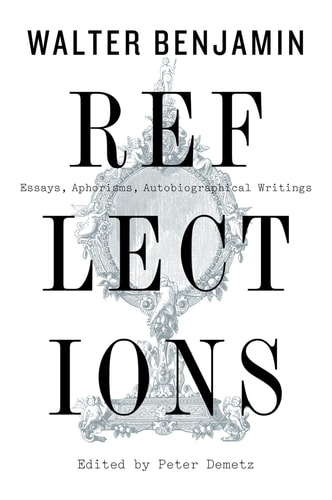
Reflections: Essays, Aphorisms, Autobiographical Writings
“This book is just that: reflections of a highly polished mind that uncannily approximate the century’s fragments of shattered traditions.” — Time
A companion volume to Illuminations, the first collection of Walter Benjamin’s writings, Reflections presents a further sampling of his wide-ranging work. Here Benjamin evolves a theory of language as the medium of all creation, discusses theater and surrealism, reminisces about Berlin in the 1920s, recalls conversations with Bertolt Brecht, and provides travelogues of various cities, including Moscow under Stalin.
Benjamin moves seamlessly from literary criticism to autobiography to philosophical-theological speculations, cementing his reputation as one of the greatest and most versatile writers of the twentieth century.
Copies
-
$19.99

Reflections: Essays, Aphorisms, Autobiographical Writings
A companion volume to Illuminations, the first collection of Walter Benjamin's writings, Reflections presents a further sampling of his wide-ranging work. Here Benjamin evolves a theory of language as the medium of all creation, discusses theater and surrealism, reminisces about Berlin in the 1920s, recalls conversations with Bertolt Brecht, and provides travelogues of various cities, including Moscow under Stalin. He moves seamlessly from literary criticism to autobiography to philosophical-theological speculations, cementing his reputation as one of the greatest and most versatile writers of the twentieth century. Also included is a new preface by Leon Wieseltier that explores Benjamin's continued relevance for our times.
Copies
No copies available.

The "Berlin Chronicle" Notices: By Walter Benjamin (PUBLICATION STU)
A companion volume to Walter Benjamin's (1892-1940) memoir Berlin Childhood circa 1900, The "Berlin Chronicle" Notices is now in a new translation by Carl Skoggard. The German-Jewish philosopher, theorist and critic Walter Benjamin began to ruminate on his comfortable Berlin childhood in 1932, not long before he would flee Germany for good to escape the Nazis. The resulting "Berlin Chronicle" notices--40 in all--do not result in a linear narrative but instead remain fragmentary recollections of Benjamin's young years, from his early childhood to the threshold of adulthood. More generally, they are a series of profound explorations of memory and of the ways memory relates to place. Rich in and of themselves, these notices greatly illuminate "Berlin Childhood circa 1900," written by Benjamin months later. This translation, in a charming pocket-sized format, comes with an extensive commentary, a historical map of Berlin and numerous illustrations.
Copies
No copies available.

Berlin Childhood circa 1900: By Walter Benjamin
This fresh translation by Carl Skoggard of philosopher Walter Benjamin's (1892-1940) engaging memoir remains faithful to the author's voice. Readers are offered glimpses of an anonymous Berlin childhood which might have been Benjamin's own, with recollections of an affluent Jewish home in Berlin's West End, circa 1900. Focusing less on events and characters than on places and things, Benjamin vividly reimagines a young child's idiosyncratic private world. Written in the months before and after the Nazi takeover of Germany, these recollections served as a coping mechanism for Benjamin, a way of working through irrevocable loss.
This edition is illustrated with 30 black-and-white images and comes with a foldable color map of Berlin circa 1900 as well as a translator's essay and an extensive commentary.
Copies
No copies available.

Sonnets: By Walter Benjamin (PUBLICATION STU)
Review
It may be that an understanding of Benjamin cannot avoid passing through these poems. (Barry Schwabsky Hyperallergic)
Product Description
Walter Benjamin's sonnets, written to mourn his friend Fritz Heinle, constitute an important though little-known part of the philosopher's literary achievement and a unique contribution to the history of the German sonnet. Benjamin would add to their number over a decade, having begun his project soon after the outbreak of World War I and the suicide of his friend. They were among the writings that Benjamin, forced to flee France, entrusted to Georges Bataille in 1940 for safekeeping. Here, for the first time, readers of English are offered translations of all 73 "Heinle sonnets" along with the original German text and an extensive commentary. The Introductory Essay examines the poems' biographical context as well as Benjamin's bold approach to sonnet writing. These poems weave the deeply personal together with Benjamin's evolving religious and philosophical perspective--shedding new light on the emergence of the man and the thinker.
Copies
No copies available.

Walter Benjamin's Archive: Images, Texts, Signs
An absorbing selection of Walter Benjamin’s personal manuscripts, images, and documents
The work of the great literary and cultural critic Walter Benjamin is an audacious plotting of history, art, and thought; a reservoir of texts, commentaries, scraps, and fragments of everyday life, art, and dreams. Throughout his life, Benjamin gathered together all kinds of artifacts, assortments of images, texts, and signs, themselves representing experiences, ideas, and hopes, each of which was enthusiastically logged, systematized, and analyzed by their author. In this way, Benjamin laid the groundwork for the salvaging of his own legacy.
Intricate and intimate, Walter Benjamin’s Archive leads readers to the heart of his intellectual world, yielding a rich and detailed portrait of its author.
Copies
No copies available.

Walter Benjamin's Archive: Images, Texts, Signs
The work of the great literary and cultural critic Walter Benjamin is an audacious plotting of history, art and thought; a reservoir of texts, commentaries, scraps and fragments of everyday life, art and dreams. It comprises myriad smaller archives, in which Benjamin gathered together all kinds of artefacts, assortments of images, texts and signs, themselves representing experiences, ideas and hopes, each of which was enthusiastically logged, systematized and analyzed by their author. In them, Benjamin laid the groundwork for the salvaging of his own legacy.
This unique book, produced in association with the Benjamin Archive, delves into these archives. They include carefully laid-out manuscripts; photograps of a home with luxurious furniture, arcades, Russian toys; picture postcards from Tuscany and the Balearics; meticulous and unconventional registers, card indexes and catalogs; notebooks, in which every single square centimeter is covered; a collation of his son’s first words and sentences; riddles and enigmatic Sibyls. Everything here is subtly interlinked with everything else.
Intricate and intimate, Walter Benjamin’s Archive leads right into the core of his work, yielding a rich and detailed portrait of its author.
Copies
No copies available.

Radio Benjamin
Walter Benjamin was fascinated by the impact of new technology on culture, an interest that extended beyond his renowned critical essays. From 1927 to ’33, he wrote and presented something in the region of eighty broadcasts using the new medium of radio. Radio Benjamin gathers the surviving transcripts, which appear here for the first time in English. This eclectic collection demonstrates the range of Benjamin’s thinking and his enthusiasm for popular sensibilities. His celebrated “Enlightenment for Children” youth programs, his plays, readings, book reviews, and fiction reveal Benjamin in a creative, rather than critical, mode. They flesh out ideas elucidated in his essays, some of which are also represented here, where they cover topics as varied as getting a raise and the history of natural disasters, subjects chosen for broad appeal and examined with passion and acuity.
Delightful and incisive, this is Walter Benjamin channeling his sophisticated thinking to a wide audience, allowing us to benefit from a new voice for one of the twentieth century’s most respected thinkers.
Copies
No copies available.

One-Way Street: And Other Writings
A classic collection of Walter Benjamin's essays, including some of his most celebrated writing
Walter Benjamin is one of the most fascinating and enigmatic intellectual figures of this century. Not only was he a thinker who made an enormous impact with his critical and philosophical writings, he shattered disciplinary and stylistic conventions.
This collection, introduced by Susan Sontag, contains the most representative and illuminating selection of his work over a twenty-year period, and thus does full justice to the richness and the multi-dimensional nature of his thought. Included in these pages are aphorisms and townscapes, esoteric meditation and reminiscences of childhood, and reflections on language, psychology, aesthetics and politics.
Copies
No copies available.

Berlin Childhood around 1900
A new translation of philsopher Walter Benjamin's moving and groundbreaking memoir of growing up.
Completed in exile in Paris, as the second World War was dawning, Walter Benjamin looks back at the city of his birth at the beginning of the century. The book is both a sensory memoir of childhood as well as a tour of the iconic spaces of city. These are 'expeditions into the depths of memory', moving through vignettes of domestic settings and classrooms, city squares, parks and streets. The memories of childhood merge with a city that is about to disappear into darkness.
As his friend, Adorno, wrote, the work is 'illuminated by lightning flashes of immediate remembrance . . .the images this book unearths and brings strangely near are not idyllic and not contemplative. Over them lies the shadow of the Third Reich. And through them dreamily runs a shudder at the long forgotten.'
Copies
-
$24.95

Berlin Childhood around 1900
Begun in Poveromo, Italy, in 1932, and extensively revised in 1938, Berlin Childhood around 1900 remained unpublished during Walter Benjamin’s lifetime, one of his “large-scale defeats.” Now translated into English for the first time in book form, on the basis of the recently discovered “final version” that contains the author’s own arrangement of a suite of luminous vignettes, it can be more widely appreciated as one of the masterpieces of twentieth-century prose writing.
Not an autobiography in the customary sense, Benjamin’s recollection of his childhood in an upper-middle-class Jewish home in Berlin’s West End at the turn of the century becomes an occasion for unified “expeditions into the depths of memory.” In this diagram of his life, Benjamin focuses not on persons or events but on places and things, all seen from the perspective of a child―a collector, flâneur, and allegorist in one. This book is also one of Benjamin’s great city texts, bringing to life the cocoon of his childhood―the parks, streets, schoolrooms, and interiors of an emerging metropolis. It reads the city as palimpsest and labyrinth, revealing unexpected lyricism in the heart of the familiar.
As an added gem, a preface by Howard Eiland discusses the genesis and structure of the work, which marks the culmination of Benjamin’s attempt to do philosophy concretely.
Copies
No copies available.

The Origin of German Tragic Drama (Radical Thinkers)
Cited by Lukács as a principal source of literary modernism, Walter Benjamin’s study of the baroque stage-form called Trauerspiel (literally, “mourning play”) is the most complete document of his prismatic literary and philosophical practice. Engaging with sixteenth- and seventeenth-century German playwrights as well as the plays of Shakespeare and Calderón and the engravings of Dürer, Benjamin attempts to show how the historically charged forms of the Trauerspiel broke free of tragedy’s mythological timelessness. From its philosophical prologue, which offers a rare account of Benjamin’s early aesthetics, to its mind-wrenching meditation on allegory, The Origin of German Tragic Drama sparkles with early insights and the seeds of Benjamin’s later thought.
Copies
No copies available.

Dreams: By Walter Benjamin.
by Walter Benjamin, Burkhardt Lindner
Though published during his lifetime, Walter Benjamin’s dream notes and theoretical reflections on dreams are collected here for the first time in a single volume.
Dreams highlights a dimension of Benjamin’s thinking that was invaluable for his writing and thought but which has thus far received little attention.
The first section, “Dream Notes,” is a comprehensive and chronological collection of Benjamin’s transcriptions of his own dreams and includes unpublished manuscript materials. The second section, “On Perception of Dreams: Awakening and Dream,” features his theoretical reflections on dreams, ranging from short aphorisms and longer analyses of dream literature and the history of dreams to the political conception of a “dreaming collective” and its awakening. Editor Burkhardt Lindner describes Benjamin’s literary approach to his own dreams in the epilogue and gives a sketch of Benjamin’s own definition of the dream sphere, independent of and in contrast to Surrealism and Freud’s interpretation of dreams.
This handsome, pocket-sized reader presents Benjamin as both a great dreamer and an important theorist of dreams.
Walter Benjamin (1892–1940) is one of the 20th century’s most influential theorists and critics. A member of the Frankfurt school alongside Theodor Adorno, Ernst Bloch and Max Horkheimer, he also maintained close friendships with thinkers such as Marxist theorist Georg Lukács, playwright Bertolt Brecht and Kabbalah scholar Gershom Scholem. Among Benjamin’s best-known works are the essays “The Task of the Translator” (1923), “The Work of Art in the Age of Mechanical Reproduction” (1936) and “Theses on the Philosophy of History” (1940). His major work as a literary critic included essays on Baudelaire, Goethe, Kafka, Kraus, Leskov, Proust, Walser and Scheerbart. In 1940, at the age of 48, Benjamin committed suicide in Portbou at the French–Spanish border while attempting to escape from invading Nazi forces.
Copies
No copies available.

POUR UNE CRITIQUE DE LA VIOLENCE
Product Description
Benjamin ne critique pas naïvement la violence, il en étudie méthodiquement les ressorts afin de pouvoir fonder en raison une véritable justice sociale.Quelle serait la validité morale de la violence en tant que moyen dès lors que les fins sont justes ? Pour le droit naturel, seule la justesse de la fin compte. Pour le droit positif, tout droit s’établit sur la critique des moyens. Or, il convient de distinguer les différents types de violence indépendamment des circonstances de leur exercice. Pour Benjamin, c’est in fine le droit qui s’octroie le privilège de la violence vu qu’il serait menacé si elle venait à s’exercer en dehors de lui. La violence peut être fondatrice de droit ou lui être inhérente, raison pour laquelle le pouvoir y recourt. Le droit positif constitue aux yeux de Benjamin un obstacle à une justice véritable et plaide pour l’usage de moyens d’action « purs », parmi lesquels la grève générale.
About the Author
Proche de Theodor Adorno, Gershom Scholem et Bertolt Brecht, Walter Benjamin (1892-1940) a d’abord été critique littéraire, avant de publier en 1928 Rue à sens unique (Allia, 2015) et Origine du drame baroque allemand. Il publie également dans des revues Petite Histoire de la photographie (Allia, 2012), préfiguration de L’Œuvre d’art à l’époque de sa reproductibilité technique (Allia, 2011). Exilé à Paris en 1933, il gagne l'Espagne. Or, menacé d'être remis aux Allemands, il se suicide en 1940.
Copies
No copies available.

The Storyteller Essays (New York Review Books Classics)
A new translation of philosopher Walter Benjamin's work as it pertains to his famous essay, "The Storyteller," this collection includes short stories, book reviews, parables, and as a selection of writings by other authors who had an influence on Benjamin's work.
“The Storyteller” is one of Walter Benjamin’s most important essays, a beautiful and suggestive meditation on the relation between narrative form, social life, and individual existence—and the product of at least a decade’s work. What might be called the story of The Storyteller Essays starts in 1926, with a piece Benjamin wrote about the German romantic Johann Peter Hebel. It continues in a series of short essays, book reviews, short stories, parables, and even radio shows for children. This collection brings them all together to give readers a new appreciation of how Benjamin’s thinking changed and ripened over time, while including several key readings of his own—texts by his contemporaries Ernst Bloch and Georg Lukács; by Paul Valéry; and by Herodotus and Montaigne. Finally, to bring things around, there are three short stories by “the incomparable Hebel” with whom the whole intellectual adventure began.
Copies
No copies available.

Passagen: Schriften zur französischen Literatur
Walter Benjamin ist einer der bedeutendsten Theoretiker der Gegenwart. Sein Einfluß auf die Philosophie und Soziologie, aber auch auf die Literatur-, Medien- und Kulturwissenschaft ist kaum zu überschätzen. Viele seiner Texte gehören heute zum Kanon der Theorie. Das Spektrum seiner Texte, ihrer Genres und Disziplinen, ihrer Themen und Formen ist enorm. Sein Werk ist überaus vielfältig und kaum zu überschauen. Die Auswahlbände der Reihe suhrkamp taschenbuch wissenschaft, die von renommierten Benjamin-Forschern herausgegeben werden und jeweils ein ausführliches Nachwort enthalten, unternehmen es, seine theoretischen Haupttexte thematisch zu bündeln und in kompakten Leseausgaben zugänglich zu machen.
Copies
No copies available.

Charles Baudelaire: Ein Lyriker im Zeitalter des Hochkapitalismus (Suhrkamp Taschenbuch Wissenschaft) (German Edition)
Text: German
Copies
No copies available.

Copies
No copies available.

Sprache und Geschichte. Philosophische Essays.
by Walter Benjamin, Theodor W. Adorno, Rolf. Tiedemann
Book by Benjamin, Walter
Copies
No copies available.

Das Kunstwerk im Zeitalter seiner technischen Reproduzierbarkeit
In seinem wohl berühmtesten Aufsatz beschreibt Walter Benjamin die geschichtlichen, sozialen und ästhetischen Prozesse, die mit der technischen Reproduzierbarkeit des Kunstwerks zusammenhängen.
»Man kann, was hier ausfällt, im Begriff der Aura zusammenfassen und sagen: was im Zeitalter der technischen Reproduzierbarkeit des Kunstwerks verkümmert, das ist seine Aura. Der Vorgang ist symptomatisch; seine Bedeutung weist über den Bereich der Kunst hinaus.«
Copies
No copies available.

Illuminationen. Ausgewählte Schriften.
Benjamins Prosa ist nicht etikettierbar, auf keine Formel zu bringen: sie umgreift alle literarischen Formen, von der profunden wissenschaftlichen Abhandlung bis zum »Denkbild« und zum geschliffenen Aphorismus. Die Auswahl aus den von Adorno 1955 herausgegebenen Schriften faßt Arbeiten zusammen, die für das Denken Benjamins charakteristisch sind
Inhaltsverzeichnis:
Das Leben der Studenten
Zwei Gedichte von Friedrich Hölderlin
Schicksal und Charakter
Die Aufgabe des Übersetzers
Goethes Wahlverwandtschaften
Das Kunstwerk im Zeitalter seiner technischen Reproduzierbarkeit
Paris, die Hauptstadt des XIX. Jahrhunderts
Über einige Motive bei Baudelaire. Zentralpark
Über den Begriff der Geschichte
Theologisch-politisches Fragment
Kommentare zu Briefen aus dem bürgerlichen Jahrhundert
Auswahl aus der Berliner Kindheit um Neunzehnhundert
Der destruktive Charakter
Erfahrung und Armut
Kurze Schatten
Schönes Entsetzen
Denkbilder
Kleine Kunst-Stücke
Ibizenkische Folge
Haschisch in Marseille
Zum Bilde Prousts
Robert Walser
Karl Kraus
Der Erzähler
Copies
No copies available.

The Arcades Project
"To great writers," Walter Benjamin once wrote, "finished works weigh lighter than those fragments on which they labor their entire lives." Conceived in Paris in 1927 and still in progress when Benjamin fled the Occupation in 1940, The Arcades Project (in German, Das Passagen-Werk) is a monumental ruin, meticulously constructed over the course of thirteen years--"the theater," as Benjamin called it, "of all my struggles and all my ideas."
Focusing on the arcades of nineteenth-century Paris-glass-roofed rows of shops that were early centers of consumerism--Benjamin presents a montage of quotations from, and reflections on, hundreds of published sources, arranging them in thirty-six categories with descriptive rubrics such as "Fashion," "Boredom," "Dream City," "Photography," "Catacombs," "Advertising," "Prostitution," "Baudelaire," and "Theory of Progress." His central preoccupation is what he calls the commodification of things--a process in which he locates the decisive shift to the modern age.
The Arcades Project is Benjamin's effort to represent and to critique the bourgeois experience of nineteenth-century history, and, in so doing, to liberate the suppressed "true history" that underlay the ideological mask. In the bustling, cluttered arcades, street and interior merge and historical time is broken up into kaleidoscopic distractions and displays of ephemera. Here, at a distance from what is normally meant by "progress," Benjamin finds the lost time(s) embedded in the spaces of things.
Copies
No copies available.

Gesammelte Schriften IV. Kleine Prosa, Baudelaire- Übertragungen.
by Walter Benjamin, Tillman Rexroth
Rare Book
Copies
No copies available.

Moscow Diary
The life of the German-Jewish literary critic and philosopher Walter Benjamin (1892–1940) is a veritable allegory of the life of letters in the twentieth century. Benjamin’s intellectual odyssey culminated in his death by suicide on the Franco–Spanish border, pursued by the Nazis, but long before he had traveled to the Soviet Union. His stunning account of that journey is unique among Benjamin’s writings for the frank, merciless way he struggles with his motives and conscience.
Perhaps the primary reason for his trip was his affection for Asja Lācis, a Latvian Bolshevik whom he had first met in Capri in 1924 and who would remain an important intellectual and erotic influence on him throughout the twenties and thirties. Asja Lācis resided in Moscow, eking out a living as a journalist, and Benjamin’s diary is, on one level, the account of his masochistic love affair with this elusive―and rather unsympathetic―object of desire. On another level, it is the story of a failed romance with the Russian Revolution; for Benjamin had journeyed to Russia not only to inform himself firsthand about Soviet society, but also to arrive at an eventual decision about joining the Communist Party. Benjamin’s diary paints the dilemma of a writer seduced by the promises of the Revolution yet unwilling to blinker himself to its human and institutional failings.
Moscow Diary is more than a record of ideological ambivalence; its literary value is considerable. Benjamin is one of the great twentieth-century physiognomists of the city, and his portrait of hibernal Moscow stands beside his brilliant evocations of Berlin, Naples, Marseilles, and Paris. Students of this particularly interesting period will find Benjamin’s eyewitness account of Moscow extraordinarily illuminating.
Copies
No copies available.

The Complete Correspondence, 1928–1940
by Walter Benjamin, Theodor W. Adorno
The correspondence between Walter Benjamin and Theodor Adorno, which appears here for the first time in its entirety in English translation, must rank among the most significant to have come down to us from that notable age of barbarism, the twentieth century. Benjamin and Adorno formed a uniquely powerful pair. Benjamin, riddle-like in his personality and given to tactical evasion, and Adorno, full of his own importance, alternately support and compete with each other throughout the correspondence, until its imminent tragic end becomes apparent to both writers. Each had met his match, and happily, in the other. This book is the story of an elective affinity. Adorno was the only person who managed to sustain an intimate intellectual relationship with Benjamin for nearly twenty years. No one else, not even Gershom Scholem, coaxed so much out of Benjamin.
The more than one hundred letters in this book will allow readers to trace the developing character of Benjamin's and Adorno's attitudes toward each other and toward their many friends. When this book appeared in German, it caused a sensation because it includes passages previously excised from other German editions of the letters--passages in which the two friends celebrate their own intimacy with frank remarks about other people. Ideas presented elliptically in the theoretical writings are set forth here with much greater clarity. Not least, the letters provide material crucial for understanding the genesis of Benjamin's Arcades Project.
Copies
No copies available.

On Hashish
Walter Benjamin's posthumously published collection of writings on hashish is a detailed blueprint for a book that was never written--a "truly exceptional book about hashish," as Benjamin describes it in a letter to his friend Gershom Scholem. A series of "protocols of drug experiments," written by himself and his co-participants between 1927 and 1934, together with short prose pieces that he published during his lifetime, On Hashish provides a peculiarly intimate portrait of Benjamin, venturesome as ever at the end of the Weimar Republic, and of his unique form of thought.
Consciously placing himself in a tradition of literary drug-connoisseurs from Baudelaire to Hermann Hesse, Benjamin looked to hashish and other drugs for an initiation into what he called "profane illumination." At issue here, as everywhere in Benjamin's work, is a new way of seeing, a new connection to the ordinary world. Under the influence of hashish, as time and space become inseparable, experiences become subtly stratified and resonant: we inhabit more than one plane in time. What Benjamin, in his contemporaneous study of Surrealism, calls "image space" comes vividly to life in this philosophical immersion in the sensuous.
This English-language edition of On Hashish features a section of supplementary materials--drawn from Benjamin's essays, letters, and sketches--relating to hashish use, as well as a reminiscence by his friend Jean Selz, which concerns a night of opium-smoking in Ibiza. A preface by Howard Eiland discusses the leading motifs of Benjamin's reflections on intoxication.
Copies
No copies available.

1935–1938 (3) (Walter Benjamin: Selected Writings)
Radical critic of a European civilization plunging into darkness, yet commemorator of the humane traditions of the old bourgeoisie--such was Walter Benjamin in the later 1930s. This volume, the third in a four-volume set, offers twenty-seven brilliant pieces, nineteen of which have never before been translated.
The centerpiece, A Berlin Childhood around 1900, marks the first appearance in English of one of the greatest German works of the twentieth century: a profound and beautiful account of the vanished world of Benjamin's privileged boyhood, recollected in exile. No less remarkable are the previously untranslated second version of Benjamin's most famous essay, "The Work of Art in the Age of Its Technological Reproducibility," with its striking insights into the relations between technology and aesthetics, and German Men and Women, a book in which Benjamin collects twenty-six letters by distinguished Germans from 1783 to 1883 in an effort to preserve what he called the true humanity of German tradition from the debasement of fascism.
Volume 3 also offers extensively annotated translations of essays that are key to Benjamin's rewriting of the story of modernism and modernity--such as "The Storyteller" and "Paris, the Capital of the Nineteenth Century"--as well as a fascinating diary from 1938 and penetrating studies of Bertolt Brecht, Franz Kafka, and Eduard Fuchs. A narrative chronology details Benjamin's life during these four harrowing years of his exile in France and Denmark. This is an essential collection for anyone interested in his work.
Copies
No copies available.

Walter Benjamin Selected Writings
This volume covers studies of Baudelaire, Brecht, and the historian Carl Jochmann to appraisals of photography, film, and poetry, with the underlying question of how art can survive and thrive in a tumultuous time. Here Benjamin lays out an ethic for the critic and artist of a subdued but resilient heroism.
Copies
No copies available.

On Photography
Walter Benjamin’s 1931 essay “A Short History of Photography” is a landmark in the understanding and criticism of the medium, offering surprising new takes on such photographic pioneers as David Octavius Hill and Nicéphore Niépce and their aesthetic and technical achievements.
On Photography presents a new translation of that essay along with a number of other writings by Benjamin, some of them presented in English for the first time. Translator and editor Esther Leslie sets Benjamin’s work in context with prefaces to each piece and contributes a substantial introduction that considers Benjamin’s engagement with photography in all its forms, including early commercial studio photography, the uses of photography in science, and much more.
Copies
No copies available.

The Correspondence of Walter Benjamin, 1910-1940
Called “the most important critic of his time” by Hannah Arendt, Walter Benjamin has only become more influential over the years, as his work has assumed a crucial place in current debates over the interactions of art, culture, and meaning. A “natural and extraordinary talent for letter writing was one of the most captivating facets of his nature,” writes Gershom Scholem in his Foreword to this volume; and Benjamin's correspondence reveals the evolution of some of his most powerful ideas, while also offering an intimate picture of Benjamin himself and the times in which he lived.
Writing at length to Scholem and Theodor Adorno, and exchanging letters with Rainer Maria Rilke, Hannah Arendt, Max Brod, and Bertolt Brecht, Benjamin elaborates on his ideas about metaphor and language. He reflects on literary figures from Kafka to Karl Kraus, and expounds his personal attitudes toward such subjects as Marxism and French national character. Providing an indispensable tool for any scholar wrestling with Benjamin’s work, The Correspondence of Walter Benjamin, 1910–1940 is a revelatory look at the man behind much of the twentieth century’s most significant criticism.
Copies
No copies available.

Facing Value: Radical Perspectives from the Arts
by Walter Benjamin, Franco Berardi, Michel Certeau
Value is an important concept in contemporary society, an immaterial force shaping the way we live together. Today, however, we seem to measure value only in terms of time and money. To reformulate value as a constitutive factor in an open and caring society requires a new way of looking that can reclaim it from the logic of capital.
Facing Value anthologizes the work of philosophers, scientists, historians, architects and economists including Walter Benjamin, Franco “Bifo” Berardi, Michel de Certeau, Anthony Huberman, Charles Jencks, Siegfried Kracauer, Jan Ritsema, Viktor Shklovsky and Jan Verwoert, presenting alternative visions of value that will inspire readers to regain personal power, share energy and creativity, and build toward a vital and just society. Alternative values--like hesitation, care, giving and disconnection--are proposed as potential foci of new value systems.
Copies
No copies available.

The Storyteller: Tales out of Loneliness
A beautiful collection of the legendary thinker’s short stories
The Storyteller gathers for the first time the fiction of the legendary critic and philosopher Walter Benjamin, best known for his groundbreaking studies of culture and literature, including Illuminations, One-Way Street and The Arcades Project. His stories revel in the erotic tensions of city life, cross the threshold between rational and hallucinatory realms, celebrate the importance of games, and delve into the peculiar relationship between gambling and fortune-telling, and explore the themes that defined Benjamin. The novellas, fables, histories, aphorisms, parables and riddles in this collection are brought to life by the playful imagery of the modernist artist and Bauhaus figure Paul Klee.
Copies
No copies available.

Aesthetics and Politics
by Bertolt Brecht, Theodor Adorno, Walter Benjamin, Georg Lukacs, Ernst Bloch
No other country and no other period has produced a tradition of major aesthetic debate to compare with that which unfolded in German culture from the 1930s to the 1950s. In Aesthetics and Politics the key texts of the great Marxist controversies over literature and art during these years are assembled in a single volume. They do not form a disparate collection but a continuous, interlinked debate between thinkers who have become giants of twentieth-century intellectual history.
Copies
No copies available.

The Sonnets
As the Third Reich advanced on Paris, Walter Benjamin entrusted his writings to the philosopher George Bataille. These eighty religious, lyric sonnets, produced in Benjamin’s twenties in a sustained response to the suicide of his college friend in protest of the First World War, were among those writings. This first English translation, a bilingual edition, features extensive context and commentary.
Copies
No copies available.

Walter Benjamin: a Little History of Photography
An extraordinary document in the history of photographic criticism.
Perhaps more than any other text, A Little History of Photography by the German-Jewish thinker Walter Benjamin has shaped the way in which we understand early photography and the photographic act. One of the first theoretical studies of visual culture, this essay laid the foundation for modern cultural criticism. Instead of regarding the artwork as a unique object, Benjamin emphasized the political and artistic potential of a new technology based on endless reproduction. A Little History of Photography was originally published in the German literary journal Die Literarische Welt in 1931 as three short essays reviewing several books dedicated to early photography. In this text, Benjamin introduced concepts that remain central to critical theory of the medium: the aura, optical unconscious, reproducibility, among other topics. It constitutes a remarkably prescient description of the limits and potentials of photography which remains thought-provoking today.
Copies
No copies available.

On Goethe
On Goethe contains the full range of Walter Benjamin's reflections on the central figure in modern German culture. The writings in this volume--newly translated, fully annotated, and framed by an extensive introduction--display a variety of styles and cover a vast array of topics. The collection revolves around two strikingly different essays. Whereas "Goethe's Elective Affinities" develops a theory of critique in which a work is illuminated wholly from within itself, an article Benjamin wrote on Goethe for the Soviet Encyclopedia represents his first large-scale attempt to elaborate a historical-materialist methodology. The other thirty translations stand in similarly productive tension with one another. Some are concerned with concepts of beauty and categories of the aesthetic, others with the relation of art to politics and the status of "classical authors" in contemporary culture, and still others with what remains of humanistic traditions in the wake of their disappearance under fascist regimes and what synthesis is required for the construction of a historical object. The volume provides a glimpse into the laboratory of Benjamin's thought, while granting readers a series of insights into the epochal phenomena that gather around the name "Goethe."
Copies
No copies available.

The Storyteller Tales out of Loneliness
A beautiful collection of the legendary thinker’s short stories
The Storyteller gathers for the first time the fiction of the legendary critic and philosopher Walter Benjamin, best known for his groundbreaking studies of culture and literature, including Illuminations, One-Way Street and The Arcades Project. His stories revel in the erotic tensions of city life, cross the threshold between rational and hallucinatory realms, celebrate the importance of games, and delve into the peculiar relationship between gambling and fortune-telling, and explore the themes that defined Benjamin. The novellas, fables, histories, aphorisms, parables and riddles in this collection are brought to life by the playful imagery of the modernist artist and Bauhaus figure Paul Klee.
Copies
No copies available.

Toward the Critique of Violence A Critical Edition
Marking the centenary of Walter Benjamin's immensely influential essay, "Toward the Critique of Violence," this critical edition presents readers with an altogether new, fully annotated translation of a work that is widely recognized as a classic of modern political theory.
The volume includes twenty-one notes and fragments by Benjamin along with passages from all of the contemporaneous texts to which his essay refers. Readers thus encounter for the first time in English provocative arguments about law and violence advanced by Hermann Cohen, Kurt Hiller, Erich Unger, and Emil Lederer. A new translation of selections from Georges Sorel's Reflections on Violence further illuminates Benjamin's critical program. The volume also includes, for the first time in any language, a bibliography Benjamin drafted for the expansion of the essay and the development of a corresponding philosophy of law. An extensive introduction and afterword provide additional context.
With its challenging argument concerning violence, law, and justice--which addresses such topical matters as police violence, the death penalty, and the ambiguous force of religion--Benjamin's work is as important today as it was upon its publication in Weimar Germany a century ago.
Copies
No copies available.