Books by William Faulkner

A Summer of Faulkner: As I Lay Dying/The Sound and the Fury/Light in August (Oprah's Book Club)
The 2005 Summer Selection is available in an exclusive three volume boxed edition that includes a special reader’s guide with an introduction by Oprah Winfrey.
Titles include:
As I Lay Dying
This novel is the harrowing account of the Bundren family’s odyssey across the Mississippi countryside to bury Addie, their wife and mother. Told in turns by each of the family members–including Addie herself–the novel ranges in mood from dark comedy to the deepest pathos. Originally published in 1930.
The Sound and the Fury
First published in 1929, Faulkner created his “heart’s darling,” the beautiful and tragic Caddy Compson, whose story Faulkner told through separate monologues by her three brothers–the idiot Benjy, the neurotic suicidal Quentin and the monstrous Jason.
Light in August
Light in August, a novel about hopeful perseverance in the face of mortality, features some of Faulkner’s most memorable characters: guileless, dauntless Lena Grove, in search of the father of her unborn child; Reverend Gail Hightower, who is plagued by visions of Confederate horsemen; and Joe Christmas, a desperate, mysterious drifter consumed by his mixed ancestry. Originally published in 1932.
Take a seat in Oprah’s Classroom and sign up for Faulkner 101 on www.oprah.com/bookclub.
Copies
No copies available.

Selected Short Stories (Modern Library)
From the Modern Library’s new set of beautifully repackaged hardcover classics by William Faulkner—also available are Snopes, As I Lay Dying, The Sound and the Fury, Light in August, and Absalom, Absalom!
William Faulkner was a master of the short story. Most of the pieces in this collection are drawn from the greatest period in his writing life, the fifteen or so years beginning in 1929, when he published The Sound and the Fury. They explore many of the themes found in the novels and feature characters of small-town Mississippi life that are uniquely Faulkner’s. In “A Rose for Emily,” the first of his stories to appear in a national magazine, a straightforward, neighborly narrator relates a tale of love, betrayal, and murder. The vicious family of the Snopes trilogy turns up in “Barn Burning,” about a son’s response to the activities of his arsonist father. And Jason and Caddy Compson, two other inhabitants of Faulkner’s mythical Yoknapatawpha County, are witnesses to the terrorizing of a pregnant black laundress in “That Evening Sun.” These and the other stories gathered here attest to the fact that Faulkner is, as Ralph Ellison so aptly noted, “the greatest artist the South has produced.”
Including these stories:
“Barn Burning”
“Two Soldiers”
“A Rose for Emily”
“Dry September”
“That Evening Sun”
“Red Leaves”
“Lo!”
“Turnabout”
“Honor”
“There Was a Queen”
“Mountain Victory”
“Beyond”
“Race at Morning”
Copies
-
$25.00

The Hamlet
The Hamlet, the first novel of Faulkner's Snopes trilogy, is both an ironic take on classical tragedy and a mordant commentary on the grand pretensions of the antebellum South and the depths of its decay in the aftermath of war and Reconstruction. It tells of the advent and the rise of the Snopes family in Frenchman's Bend, a small town built on the ruins of a once-stately plantation. Flem Snopes -- wily, energetic, a man of shady origins -- quickly comes to dominate the town and its people with his cunning and guile.
Copies
-
$16.95

Absalom, Absalom! The Corrected Text
NOBEL PRIZE WINNER • Family drama and the legacy of slavery haunt this epic tale of an enigmatic stranger in Jefferson, Mississippi—from one of the most acclaimed writers of the twentieth century.
One of The Atlantic’s Great American Novels of the Past 100 Years
“Read, read, read. Read everything—trash, classics, good and bad, and see how they do it. Just like a carpenter who works as an apprentice and studies the master. Read! You’ll absorb it. Then write. If it is good, you’ll find out. If it’s not, throw it out the window.” —William Faulkner
Absalom, Absalom! is Faulkner’s epic tale of Thomas Sutpen, a man who comes to the South in the early 1830s to wrest his mansion out of the muddy bottoms of the north Mississippi wilderness. He was a man, Faulkner said, “who wanted sons and the sons destroyed him.”
Copies
-
$17.00

Light in August
From the Nobel Prize winner—one of the most highly acclaimed writers of the twentieth century—a novel set in the American South during Prohibition about hopeful perseverance in the face of mortality.
Light in August features some of Faulkner’s most memorable characters: guileless, dauntless Lena Grove, in search of the father of her unborn child; Reverend Gail Hightower, who is plagued by visions of Confederate horsemen; and Joe Christmas, a desperate, enigmatic drifter consumed by his mixed ancestry.
“Read, read, read. Read everything—trash, classics, good and bad, and see how they do it. Just like a carpenter who works as an apprentice and studies the master. Read! You’ll absorb it. Then write. If it is good, you’ll find out. If it’s not, throw it out the window.” —William Faulkner
Copies
-
$18.00

Light in August
Selected by the Modern Library as one of the 100 best novels of all time
From the Modern Library’s new set of beautifully repackaged hardcover classics by William Faulkner—also available are Snopes, As I Lay Dying, The Sound and the Fury, Absalom, Absalom!, and Selected Short Stories
One of William Faulkner’s most admired and accessible novels, Light in August reveals the great American author at the height of his powers. Lena Grove’s resolute search for the father of her unborn child begets a rich, poignant, and ultimately hopeful story of perseverance in the face of mortality. It also acquaints us with several of Faulkner’s most unforgettable characters, including the Reverend Gail Hightower, plagued by visions of Confederate horsemen, and Joe Christmas, a ragged, itinerant soul obsessed with his mixed-race ancestry. Powerfully entwining these characters’ stories, Light in August brings to life Faulkner’s imaginary South, one of literature’s great invented landscapes, in all of its unerringly fascinating glory. Along with a new Foreword by C. E. Morgan, this edition reproduces the corrected text of Light in August as established in 1985 by Faulkner expert Noel Polk.
Copies
-
$26.00

Big Woods
"The Bear, " "The Old People, " "A Bear Hunt, " "Race at Morning"--some of Nobel Prize-winning author William Faulkner's most famous stories are collected in this volume--in which he observed, celebrated, and mourned the fragile otherness that is nature, as well as the cruelty and humanity of men. "Contains some of Faulkner's best work."
Copies
-
$20.00

As I Lay Dying: The Corrected Text
A true 20th-century classic from the Nobel Prize-winning author of The Sound and the Fury: the famed harrowing account of the Bundren family’s odyssey across the Mississippi countryside to bury Addie, their wife and mother.
As I Lay Dying is one of the most influential novels in American fiction in structure, style, and drama. Narrated in turn by each of the family members, including Addie herself as well as others, the novel ranges in mood from dark comedy to the deepest pathos.
“I set out deliberately to write a tour-de-force. Before I ever put pen to paper and set down the first word I knew what the last word would be and almost where the last period would fall.” —William Faulkner on As I Lay Dying
This edition reproduces the corrected text of As I Lay Dying as established in 1985 by Noel Polk.
Copies
-
$17.00

Sanctuary: The Corrected Text
A powerful novel examining the nature of evil, informed by the works of T. S. Eliot and Freud, mythology, local lore, and hardboiled detective fiction. Sanctuary is the dark, at times brutal, story of the kidnapping of Mississippi debutante Temple Drake, who introduces her own form of venality into the Memphis underworld where she is being held.
Copies
-
$17.00

Sound and the Fury, The
NOBEL PRIZE WINNER • One of the greatest novels of the twentieth century is the story of a family of Southern aristocrats on the brink of personal and financial ruin.
One of The Atlantic’s Great American Novels of the Past 100 Years
The Sound and the Fury is the tragedy of the Compson family, featuring some of the most memorable characters in literature: beautiful, rebellious Caddy; the manchild Benjy; haunted, neurotic Quentin; Jason, the brutal cynic; and Dilsey, their black servant. Their lives fragmented and harrowed by history and legacy, the character’s voices and actions mesh to create what is arguably Faulkner’s masterpiece and one of the greatest novels of the twentieth century.
“I give you the mausoleum of all hope and desire.... I give it to you not that you may remember time, but that you might forget it now and then for a moment and not spend all of your breath trying to conquer it. Because no battle is ever won he said. They are not even fought. The field only reveals to man his own folly and despair, and victory is an illusion of philosophers and fools.” —from The Sound and the Fury
Copies
-
$17.00

The Reivers
One of Faulkner’s comic masterpieces, The Reivers is a picaresque that tells of three unlikely car thieves from rural Mississippi. Eleven-year-old Lucius Priest is persuaded by Boon Hogganbeck, one of his family’s retainers, to steal his grandfather’s car and make a trip to Memphis. The Priests’ black coachman, Ned McCaslin, stows away, and the three of them are off on a heroic odyssey, for which they are all ill-equipped, that ends at Miss Reba’s bordello in Memphis. From there a series of wild misadventures ensues—involving horse smuggling, trainmen, sheriffs’ deputies, and jail.
Copies
-
$18.00

Go Down, Moses
“I believe that man will not merely endure: he will prevail. He is immortal, not because he alone among creatures has an inexhaustible voice, but because he has a soul, a spirit capable of compassion and sacrifice and endurance.” —William Faulkner, on receiving the Nobel Prize
Go Down, Moses is composed of seven interrelated stories, all of them set in Faulkner’s mythic Yoknapatawpha County. From a variety of perspectives, Faulkner examines the complex, changing relationships between blacks and whites, between man and nature, weaving a cohesive novel rich in implication and insight.
Copies
-
$18.00

Collected Stories of William Faulkner
“I’m a failed poet. Maybe every novelist wants to write poetry first, finds he can’t and then tries the short story which is the most demanding form after poetry. And failing that, only then does he take up novel writing.” —William Faulkner
Winner of the National Book Award
Forty-two stories make up this magisterial collection by the writer who stands at the pinnacle of modern American fiction. Compressing an epic expanse of vision into hard and wounding narratives, Faulkner’s stories evoke the intimate textures of place, the deep strata of history and legend, and all the fear, brutality, and tenderness of the human condition. These tales are set not only in Yoknapatawpha County, but in Beverly Hills and in France during World War I. They are populated by such characters as the Faulknerian archetypes Flem Snopes and Quentin Compson, as well as by ordinary men and women who emerge so sharply and indelibly in these pages that they dwarf the protagonists of most novels.
Copies
-
$23.00

Mosquitoes: A Novel
A delightful surprise, Faulkner wrote his second novel "for the sake of writing because it was fun." Mosquitoes centers around a colorful assortment of passengers, out on a boating excursion from New Orleans. The rich and the aspiring, social butterflies and dissolute dilettantes are all easy game for Faulkner's barbed wit in this engaging high-spirited novel which offers a fascinating glimpse of Faulkner as a young artist."It approaches in the first half and reaches in the second half a brilliance that you can rightfully expect only in the writings of a few men. It is full of the fine kind of swift and lusty writing that comes from a healthy, fresh pen."--Lillian Hellman, New York Herald Tribune
Copies
No copies available.
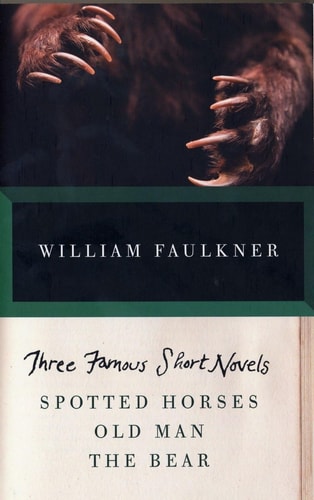
THREE FAMOUS SHORT NOVELS: Spotted Horses, Old Man, The Bear (Vintage International)
“You cannot swim for new horizons until you have courage to lose sight of the shore.” —William Faulkner
These short works offer three different approaches to Faulkner, each representative of his work as a whole. Spotted Horses is a hilarious account of a horse auction, and pits the “cold practicality” of women against the boyish folly of men. Old Man is something of an adventure story. When a flood ravages the countryside of the lower Mississippi, a convict finds himself adrift with a pregnant woman. And The Bear, perhaps his best known shorter work, is the story of a boy’s coming to terms wit the adult world. By learning how to hunt, the boy is taught the real meaning of pride, humility, and courage.
Copies
-
$16.95

The Sound and the Fury: The Corrected Text with Faulkner's Appendix (Modern Library 100 Best Novels)
Selected by the Modern Library as one of the 100 best novels of all time • One of The Atlantic’s Great American Novels of the Past 100 Years
From the Modern Library’s new set of beautifully repackaged hardcover classics by William Faulkner—also available are Snopes, As I Lay Dying, Light in August, Absalom, Absalom!, and Selected Short Stories
The Sound and the Fury, first published in 1929, is perhaps William Faulkner’s greatest book. It was immediately praised for its innovative narrative technique, and comparisons were made with Joyce and Dostoyevsky, but it did not receive popular acclaim until the late forties, shortly before Faulkner received the Nobel Prize for Literature.
The novel reveals the story of the disintegration of the Compson family, doomed inhabitants of Faulkner’s mythical Yoknapatawpha County, through the interior monologues of the idiot Benjy and his brothers, Quentin and Jason. Featuring a new Foreword by Marilynne Robinson, this edition follows the text corrected in 1984 by Faulkner expert Noel Polk and corresponds as closely as possible to the author’s original intentions. Included also is the Appendix that Faulkner wrote for The Portable Faulkner in 1946, which he called the “key to the whole book.”
Copies
-
$24.00

The William Faulkner Audio Collection
William Faulkner never stood taller than five feet, six inches, but in the realm of American literature, he is a giant. More than simply a renowned Mississippi writer, the Nobel-Prize winning novelist and short story writer is acclaimed throughout the world as one of the twentieth century's greatest writers, one who transformed his "postage stamp" of native soil into an apocryphal setting in which he explored, articulated, and challenged the "old verities and truths of the heart."
In this collection, we are proud to present a historic recording of Mr. Faulkner reading his 1949 Nobel acceptance speech and excerpts from As I Lay Dying and The Old Man.
Copies
-
$29.99

The Sound and the Fury: (Penguin Classics Deluxe Edition)
The masterpiece of Nobel Prize winner William Faulkner, and perhaps the greatest novel about the decline of the Southern aristocracy, now in Penguin Classics for the first time, with a new introduction by Ayana Mathis, the New York Times bestselling author of The Twelve Tribes of Hattie
One of The Atlantic’s Great American Novels of the Past 100 Years
A Penguin Classics Deluxe Edition, with flaps and deckle-edged paper
The Sound and the Fury traces the downfall of the aristocratic Compson family in their fictional home of Yoknapatawpha County, Mississippi. Here the landed gentry of the Reconstruction-era South still cling to their obsolete constructs of race, class, and sex for salvation from financial and personal ruin. In kaleidoscopic prose, Faulkner relates the Compson siblings’ tales of their own demise: Benjy, the brother whose mental disability blends the past with the present; Quentin, who is consumed by his obsession with his family’s honor; Jason, whose blind rage inflicts itself upon the rest of the household; and the elusive sister, Caddy, whose tragic exile from the family sets in motion their fall from grace. The Sound and the Fury brings to life Faulkner’s South as a land of poverty and decadence, of gallantry and greed, that reveals the rich cultural and historical context in which it was written. What Faulkner once considered his “most splendid failure” now sits among the cornerstones of American literature.
Copies
-
$19.00

The Sound and the Fury (Penguin Vitae)
A collectible hardcover edition of Nobel Prize winner William Faulkner’s masterpiece, and perhaps the greatest novel about the decline of the Southern aristocracy, with a new introduction by Ayana Mathis, the New York Times bestselling author of The Twelve Tribes of Hattie
One of The Atlantic’s Great American Novels of the Past 100 Years
A Penguin Vitae Edition
The Sound and the Fury traces the downfall of the aristocratic Compson family in their fictional home of Yoknapatawpha County, Mississippi. Here the landed gentry of the Reconstruction-era South still cling to their obsolete constructs of race, class, and sex for salvation from financial and personal ruin. In kaleidoscopic prose, Faulkner relates the Compson siblings’ tales of their own demise: Benjy, the brother whose mental disability blends the past with the present; Quentin, who is consumed by his obsession with his family’s honor; Jason, whose blind rage inflicts itself upon the rest of the household; and the elusive sister, Caddy, whose tragic exile from the family sets in motion their fall from grace. The Sound and the Fury brings to life Faulkner’s South as a land of poverty and decadence, of gallantry and greed, that reveals the rich cultural and historical context in which it was written. What Faulkner once considered his “most splendid failure” now sits among the cornerstones of American literature.
Copies
-
$28.00

The Portable Faulkner (Penguin Classics)
“A real contribution to the study of Faulkner’s work.” —Edmund Wilson
A Penguin Classic
In prose of biblical grandeur and feverish intensity, William Faulkner reconstructed the history of the American South as a tragic legend of courage and cruelty, gallantry and greed, futile nobility and obscene crimes. He set this legend in a small, minutely realized parallel universe that he called Yoknapatawpha County, Mississippi.
No single volume better conveys the scope of Faulkner’s vision than The Portable Faulkner. The book includes self-contained episodes from the novels The Sound and the Fury, Light in August, and Sanctuary; the stories “The Bear,” “Spotted Horses,” “A Rose for Emily,” and “Old Man,” among others; a map of Yoknapatawpha County and a chronology of the Compson family created by Faulkner especially for this edition; and the complete text of Faulkner’s 1950 address upon receiving the Nobel Prize in literature. Malcolm Cowley’s critical introduction was praised as “splendid” by Faulkner himself.
For more than seventy years, Penguin has been the leading publisher of classic literature in the English-speaking world. With more than 1,800 titles, Penguin Classics represents a global bookshelf of the best works throughout history and across genres and disciplines. Readers trust the series to provide authoritative texts enhanced by introductions and notes by distinguished scholars and contemporary authors, as well as up-to-date translations by award-winning translators.
Copies
-
$25.00

William Faulkner's "Absalom, Absalom ": A Casebook (Casebooks in Criticism)
Absalom, Absalom! has long been seen as one of William Faulkner's supreme creations, as well as one of the leading American novels of the twentieth century. In this collection Fred Hobson has brought together eight of the most stimulating essays on Absalom, essays written over a thirty-year span which approach the novel both formally and historically. Here are critical responses by Cleanth Brooks, John Irwin, Thadious Davis, and Eric Sundquist, as well as four essays published in the last decade. The casebook concludes with Faulkner's own remarks on the novel, delivered in a discussion with students at the University of Virginia. What emerges from all the selections is a rich and suggestive treatment of a work which Faulkner himself called "the best novel yet written by an American" and a less biased critic has called "the greatest American novel of the century... joining Moby-Dick and Huckleberry Finn at the pinnacle of American fiction."
Copies
No copies available.

Sherwood Anderson and Other Famous Creoles: A Gallery of Contemporary New Orleans
by William Faulkner, William Spratling
"When Bill Faulkner came to New Orleans he was a skinny little guy, three years older than I, and was not taken very seriously except by a few of us." Thus the late William Spratling, popularly known as the Taxco "Silver King," recalled the mid-1920's, when Faulkner, a young man fresh from Oxford, Mississippi, roomed with Spratling in Pirates Alley.
"By the time I would be up, say at seven, Bill would already be out on the little balcony over the garden tapping away on his portable, an invariable glass of alcohol-and-water at hand."
A result of their friendship was a book depicting "various people who were then engaged … with the arts in New Orleans." It was based on firsthand observation.
"There were casual parties with wonderful conversation and with plenty of grand, or later to be grand, people." Some of the names, in addition to Sherwood Anderson, were Horace Liveright, Carl Van Doren, Carl Sandberg, John Dos Passos, Anita Loos, and Oliver La Farge.
Spratling supplied sharp caricatures of the people and Faulkner contributed succinct captions and a Foreword. It was all "sort of a private joke," but the four hundred copies were sold within a week and the original edition is now a collector's item. This book is a charming reminder of exciting days and talented people.
Copies
No copies available.

The Mansion (Vintage International)
The Mansion completes Faulkner’s great trilogy of the Snopes family in the mythical county of Yoknapatawpha, Mississippi, which also includes The Hamlet and The Town. Beginning with the murder of Jack Houston, and ending with the murder of Flem Snopes, it traces the downfall of this indomitable post-bellum family, who managed to seize control of the town of Jefferson within a generation.
Copies
-
$20.00

Pylon (Vintage International)
One of the few of William Faulkner’s works to be set outside his fictional Yoknapatawpha County, Pylon, first published in 1935, takes place at an air show in a thinly disguised New Orleans named New Valois. An unnamed reporter for a local newspaper tries to understand a very modern ménage a trois of flyers on the brainstorming circuit. These characters, Faulkner said, “were a fantastic and bizarre phenomenon on the face of the contemporary scene. . . . That is, there was really no place for them in the culture, in the economy, yet they were there, at that time, and everyone knew that they wouldn’t last very long, which they didn’t. . . . That they were outside the range of God, not only of respectability, of love, but of God too.” In Pylon Faulkner set out to test their rootless modernity to see if there is any place in it for the old values of the human heart that are the central concerns of his best fiction.
Copies
-
$20.00

Flags in the Dust (Vintage International)
The complete text of Faulkner’s third novel, published for the first time in 1973, appeared with his reluctant consent in a much cut version in 1929 as Sartoris.
Copies
-
$19.00

A Fable (Vintage International)
This novel won both the Pulitzer Prize and the National Book Award in 1955. An allegorical story of World War I, set in the trenches in France and dealing ostensibly with a mutiny in a French regiment, it was originally considered a sharp departure for Faulkner. Recently it has come to be recognized as one of his major works and an essential part of the Faulkner oeuvre. His descriptions of the war "rise to magnificence," according to The New York Times, and include, in Malcolm Cowley's words, "some of the most powerful scenes he ever conceived."
Copies
-
$18.00

Knight's Gambit (Vintage International)
Gavin Stevens, the wise and forbearing student of crime and of the folk ways of Yoknapatawpha County, Mississippi, plays the major role in these six stories of violence. In each, Stevens’sharp insights and ingenious detection uncover the underlying motives.
Copies
-
$15.95

The Town (Vintage International)
This is the second volume of Faulkner’s trilogy about the Snopes family, his symbol for the grasping, destructive element in the post-bellum South. Like its predecessor, The Hamlet, and its successor, The Mansion, The Town is completely self-contained, but it gains resonance from being read with the other two. The story of Flem Snopes’s ruthless struggle to take over the town of Jefferson, Mississippi, the book is rich in typically Faulknerian episodes of humor and profundity.
Copies
-
$19.00

Requiem for a Nun (Vintage International)
This sequel to Faulkner’s most sensational, Sanctuary, was written twenty years later but takes up the story of Temple Drake eight years after the events related in Sanctuary. Temple is now married to Gowan Stevens. The book begins when the death sentence is pronounced on the nurse Nancy for the murder of Temple and Gowan’s child. Told partly in prose, partly in play form, Requiem for a Nun is a haunting exploration of the impact of the past on the present.
Copies
-
$18.00

As I Lay Dying (Modern Library 100 Best Novels)
Selected by the Modern Library as one of the 100 best novels of all time
From the Modern Library’s new set of beautifully repackaged hardcover classics by William Faulkner—also available are Snopes, The Sound and the Fury, Light in August, Absalom, Absalom!, and Selected Short Stories
One of William Faulkner’s finest novels, As I Lay Dying, originally published in 1930, remains a captivating and stylistically innovative work. The story revolves around a grim yet darkly humorous pilgrimage, as Addie Bundren’s family sets out to fulfill her last wish: to be buried in her native Jefferson, Mississippi, far from the miserable backwater surroundings of her married life. Told through multiple voices, As I Lay Dying vividly brings to life Faulkner’s imaginary South, one of literature’s great invented landscapes, and is replete with the poignant, impoverished, violent, and hypnotically fascinating characters that were his trademark. Along with a new Foreword by E. L. Doctorow, this edition reproduces the corrected text of As I Lay Dying as established in 1985 by Faulkner expert Noel Polk.
Copies
-
$26.00

The Uncollected Stories of William Faulkner
This invaluable volume contains some of the greatest short fiction by a writer who defined the course of American literature. Its forty-five stories fall into three categories: those not included in Faulkner’s earlier collections; previously unpublished short fiction; and stories that were later expanded into such novels as The Unvanquished, The Hamlet, and Go Down, Moses. The Uncollected Stories of William Faulkner is an essential addition to its author’s canon—as well as a book of some of the most haunting, harrowing, and atmospheric short fiction written in the twentieth century.
Copies
-
$26.00

Thinking of Home: William Faulkner's Letters to His Mother and Father, 1918-1925
"What a pleasure! . . . Essential for understanding Faulkner, and a good read for everybody." ―Noel Polk "How often have I lain beneath rain on a strange roof, thinking of home," says Darl Bundren in William Faulkner's As I Lay Dying. How much Faulkner himself is speaking may be suggested by this moving collection of nearly 150 letters. Written during his twenties, these letters describe Faulkner's first encounters with the North ("...I made my first subway trip yesterday. The experience showed me that we are not descended from monkeys, as some say, but from lice."); his brief World War I military service, which grew in the retelling; the productive New Orleans months with Sherwood Anderson; and his first trip to Europe, with cold autumn days in Paris ("Good thing the Lord gave these folks wine--they rate a recompense of some kind for this climate.") Fascinating in themselves for their close observation of people and places, the letters also offer glimmers of The Sound and the Fury and other future works, as the young writer stores up characters, settings, and events that will re-emerge, transformed, int the great novels of his maturity. Never before published, these letters are from the Faulkner collection at the Harry Ransom Humanities Research Center at the University of Texas at Austin. "These letters, for years sequestered and unavailable, are among the most informative, touching, and eloquent William Faulkner ever wrote. No Faulkner specialist can be without this book; no Faulkner admirer should be without it."―Joseph Blotner, author of Faulkner: A Biography
Copies
-
$21.95

Copies
No copies available.

A Fable
This novel won both the Pulitzer Prize and the National Book Award in 195. An allegorical story of World War I, set in the trenches in France and dealing ostensibly with a mutiny in a French regiment, it was originally considered a sharp departure for Faulkner. Recently it has come to be recognized as one of his major works and an essential part of the Faulkner oeuvre. Faulkner himself fought in the war, and his descriptions of it "rise to magnificence," according to The New York Times, and include, in Malcolm Cowley's words, "some of the most powerful scenes he ever conceived."
Copies
No copies available.

Knight's Gambit
Gavin Stevens, the wise student of crime and folkways of Mississippi's Yoknapatawpha county, plays the major role in these six stories of violence.
Copies
No copies available.

Knight's Gambit
Originally published in 1949, William Faulkner’s Knight’s Gambit is a collection of six stories written in the 1930s and 1940s that focus on the criminal investigations of Yoknapatawpha’s long-time county attorney, Gavin Stevens―a man more interested in justice than the law. All previous and current editions of Knight’s Gambit have been based on the first edition, which is fraught with a number of problems. Since tear sheets of the five previously published stories were used in setting the first edition, the original Knight’s Gambit is a hodgepodge of various magazines’ house styles with no consistency in punctuation and spelling conventions from story to story.
Far greater issues arise, however, from the substantive (and sometimes substantial) changes magazine editors made to Faulkner’s prose. These changes were made variously for concision, propriety, or magazine design. Sometimes northern editors removed the southernness of Faulkner’s stories, either out of ignorance of the South or in order to appeal to a mass audience. Using four previously unknown Faulkner typescripts, along with other manuscript and typescript evidence, John N. Duvall presents an edition of Knight’s Gambit that restores over four thousand words that editors cut from the stories.
Also included is an introduction by Duvall discussing the role of detective fiction and popular magazines in creating a different kind of postwar readership for Faulkner that paves the way for the eventual republication of Faulkner’s modernist masterpieces. The new edition enables readers to reevaluate the stories of Knight’s Gambit and their place in Faulkner’s career as a short story writer.
Copies
-
$25.00

As I Lay Dying (Norton Critical Editions)
Long been recognized not only as one of William Faulkner’s greatest works, but also as the most accessible of his major novels. This Norton Critical Edition is based on the 1985 corrected text and is accompanied by detailed explanatory annotations.
“Backgrounds and Contexts” is divided into three sections, each of which includes a concise introduction by Michael Gorra that carefully frames the issues presented, with particular attention to As I Lay Dying’s place in Faulkner’s literary life. “Contemporary Reception” reprints American, English, and French reviews by Clifton Fadiman, Henry Nash Smith, Edwin Muir, and Maurice Coindreau, among others, along with Valery Larbaud’s never-before-translated preface to the first French edition of the novel. “The Writer and His Work” examines Faulkner’s claim to have written the novel in six weeks without changing a word. It includes his comments on the book’s composition along with his later thoughts on and changing opinions of it, sample pages from the manuscript, his Nobel Prize address, and the little-known short story in which he first used the title. “Cultural Context” reprints an essay by Carson McCullers and an excerpt from James Agee’s Let Us Now Praise Famous Men along with other materials that address questions of Southern Agrarianism and the Southern grotesque.
“Criticism” begins with the editor’s introduction to As I Lay Dying’s critical history and scholarly reception. Eleven major essays are provided by Olga W. Vickery, Cleanth Brooks, Calvin Bedient, André Bleikasten, Eric Sundquist, Stephen M. Ross, Doreen Fowler, Patrick O’Donnell, Richard Gray, John Limon, and Donald M. Kartiganer.
A Chronology and a Selected Bibliography are also included.
Copies
No copies available.

Light in August: A Norton Critical Edition (Norton Critical Editions)
"Taylor’s edition is an invaluable resource for students and researchers. Faulkner’s own commentary, and that of leading historians and critics, will help readers sense the many historical and cultural tributaries converging in this great novel. The economic, racial, and gendered conditions of Depression-era Mississippi, along with the vibrant milieu of literary modernism, become visible in this Norton Critical Edition.” ― Susan Scott Parrish, University of Michigan
This Norton Critical Edition includes:
The authoritative text of Light in August, established by Noel Polk in 1985 and accompanied by Melanie Benson Taylor’s preface and explanatory footnotes.
A rich selection of background and contextual materials, thoughtfully and practically arranged to draw readers into the American South of Faulkner’s imagination. Topics include “The Writer’s World and Words,” “Reception and Influence,” and “Historical and Cultural Contexts.”
Thirteen critical essays on the novel’s major themes.
A chronology and a selected bibliography.
About the Series
Read by more than 12 million students over fifty-five years, Norton Critical Editions set the standard for apparatus that is right for undergraduate readers. The three-part format―annotated text, contexts, and criticism―helps students to better understand, analyze, and appreciate the literature, while opening a wide range of teaching possibilities for instructors. Whether in print or in digital format, Norton Critical Editions provide all the resources students need.?
“The Norton Critical Edition of Light in August appears at a key juncture, and Melanie Benson Taylor’s editorship points this up keenly. The novel and the scholarship included here attest to the centrality of race in Yoknapatawpha, a fact well-known in the Faulkner community, yet wider understanding of which this volume will ensure. Benson Taylor has done more than skillfully edit a compendium. She has made a volume that is essential to ongoing efforts to teach and write about the increasingly race-conscious writer Faulkner became following The Sound and the Fury and As I Lay Dying in the mid-1930s and beyond.” ― Peter Lurie, University of Richmond
Copies
-
$20.50

The Town: A Novel of the Snopes Family
This is the second volume of Faulkner's trilogy about the Snopes family, his symbol for the grasping, destructive element in the post-bellum South.
Like its predecessor The Hamlet and its successor The Mansion, The Town is completely self-contained, but it gains resonance from being read with the other two. The story of Flem Snopes' ruthless struggle to take over the town of Jefferson, Mississippi, the book is rich in typically Faulknerian episodes of humor and of profundity.
Copies
No copies available.

Requiem for a Nun
This sequel to Faulkner's SANCTUARY written 20 years later, takes up the story of Temple Drake eight years after the events related in SANCTUARY.
Copies
No copies available.

Flags in the Dust: The complete text of Faulkner's third novel, which appeared in a cut version as Sartoris
The complete text of Faulkner's third novel, published for the first time in 1973, appeared with his reluctant consent in a much cut version in 1929 as SARTORIS.
Copies
No copies available.

The Mansion
This completes the great trilogy of the Snopes family in Yoknapatawpha and traces the downfall of this indomitable post-bellum family.
Copies
No copies available.

Three Famous Short Novels: Spotted Horses / Old Man / The Bear
Three different ways to approach Faulkner, each of them representative of his work as a whole. Includes "Spotted Horses," "Old Man," and his famous "The Bear."
Copies
No copies available.

Ole Miss Juvenilia (Dover Thrift Editions: Literary Collections)
Faulkner's prolific publication history began at the age of 16 with poems and sketches for the Ole Miss campus newspaper, The Mississippian. The author continued to contribute to the publication throughout his student days at the university as well as after dropping out. These early works of poetry and prose reflect his gift for keen observations and the growing refinement of his voice as one of the greatest of America's Southern authors. Eighteen of Faulkner's elegant pen-and-ink drawings provide an atmospheric complement to the selections. An Introduction by noted Faulkner scholar Carvel Collins is also included.
Mississippi native William Faulkner (1897–1962) made his reputation with such psychologically intense and technically innovative novels as The Sound and the Fury, As I Lay Dying, and Light in August, and he received the 1949 Nobel Prize for Literature in addition to two Pulitzer Prizes. Faulkner is especially noted for the rich literary landscape he created in the fictional setting of Yoknapatawpha County, from which he drew characters, places, and themes that reappeared throughout his fiction.
Copies
No copies available.

Mosquitoes (Vintage International)
Faulkner's second novel is a high-spirited satiric romp set on an ill-fated pleasure cruise out of New Orleans.
Wealthy Mrs. Maurier, the widowed heiress of an old New Orleans family, likes to collect "artistic types." When she plans a multi-day outing on her yacht and manages to corral aboard a group that includes a melancholic poet, a brooding sculptor, a self-important writer, her unconventional young niece, and assorted other odd characters, the results are both disastrous and hilarious. When the ship runs aground near an overheated swamp, the pretensions and frustrations of its various passengers reach a fever pitch. Faulkner's lyrical descriptions, witty dialogue, and forays into fluid stream-of-consciousness demonstrate in lighter form the literary techniques that the young author later came to be so celebrated for.
Copies
-
$23.00

Soldiers' Pay (Vintage International)
William Faulkner's first novel is one of the most compelling works of American fiction to emerge from the First World War.
A wounded veteran's homecoming is at the center of Faulkner's first novel. Badly scarred in body and mind, and unable to remember much, Donald Mahon is brought home at the end of the World War I by a fellow soldier and a young war widow they befriend on the train. Mahon's arrival is a shock to his hometown, however, for he had long since been reported dead. His flighty young fiancee is caught between her revulsion at his condition and her sense of duty, while Mahon's father greets his unexpected survival first with joy and then with a determined denial of what his grievous injuries mean. As events unfold, alliances are formed and broken, sacrifices are made, and Faulkner deftly invests his heartbreaking tale with some of the deeper themes that would come to mark his later masterpieces.
Copies
-
$18.00

Knight's Gambit: The Restored Edition (Vintage International)
Faulkner's six dectective stories feature attorney Gavin Stevens, a recurring character from Faulkner's novels, as he investigates violent crimes. This newly restored edition presents the stories the way Faulkner intended them.
Originally published in 1949, Knight's Gambit is a collection of six stories written in the 1930s and 1940s that focus on the criminal investigations of Gavin Stevens, the county attorney of Faulkner's fictional Yoknapatawpha County, Mississippi, where so many of his famous novels are set.
These stories originally appeared in magazines, where editors made substantial changes to Faulkner's manuscripts before publishing them. Some of these changes seem to have been intended to make the stories conform to prevailing styles, some were made for concision or propriety, and some to remove the regional "Southernness" of Faulkner's tales. Scholar John N. Duvall uncovered edited typescripts that revealed the deletions and changes and allowed him to restore these six stories to their original Faulknerian glory.
Copies
-
$17.00

Absalom, Absalom! (Modern Library (Hardcover))
From the Modern Library’s new set of beautifully repackaged hardcover classics by William Faulkner—also available are Snopes, As I Lay Dying, The Sound and the Fury, Light in August, and Selected Short Stories
One of The Atlantic’s Great American Novels of the Past 100 Years
First published in 1936, Absalom, Absalom! is William Faulkner’s ninth novel and one of his most admired. It tells the story of Thomas Sutpen and his ruthless, single-minded attempt to forge a dynasty in Jefferson, Mississippi, in 1830. Although his grand design is ultimately destroyed by his own sons, a century later the figure of Sutpen continues to haunt young Quentin Compson, who is obsessed with his family legacy and that of the Old South. “Faulkner’s novels have the quality of being lived, absorbed, remembered rather than merely observed,” noted Malcolm Cowley. “Absalom, Absalom! is structurally the soundest of all the novels in the Yoknapatawpha series—and it gains power in retrospect.” This edition follows the text of Absalom, Absalom! as corrected in 1986 under the direction of Faulkner expert Noel Polk and features a new Foreword by John Jeremiah Sullivan.
Copies
-
$28.00

Snopes: A Trilogy (Snopes Trilogy)
From the Modern Library’s new set of beautifully repackaged hardcover classics by William Faulkner—also available are As I Lay Dying, The Sound and the Fury, Light in August, Absalom, Absalom!, and Selected Short Stories
Here, published in a single volume as he always hoped they would be, are the three novels that comprise William Faulkner’s famous Snopes trilogy, a saga that stands as perhaps the greatest feat of this celebrated author’s incomparable imagination. The Hamlet, the first book of the series chronicling the advent and rise of the grasping Snopes family in mythical Yoknapatawpha County, is a work that Cleanth Brooks called “one of the richest novels in the Faulkner canon.” It recounts how the wily, cunning Flem Snopes dominates the rural community of Frenchman’s Bend—and claims the voluptuous Eula Varner as his bride. The Town, the central novel, records Flem’s ruthless struggle to take over the county seat of Jefferson, Mississippi. Finally, The Mansion tells of Mink Snopes, whose archaic sense of honor brings about the downfall of his cousin Flem. “For all his concerns with the South, Faulkner was actually seeking out the nature of man,” noted Ralph Ellison. “Thus we must turn to him for that continuity of moral purpose which made for the greatness of our classics.”
Copies
-
$30.00

The Unvanquished: The Corrected Text
Set in Mississippi during the Civil War and Reconstruction, THE UNVANQUISHED focuses on the Sartoris family, who, with their code of personal responsibility and courage, stand for the best of the Old South's traditions.
Copies
-
$17.00

The Wild Palms
In this feverishly beautiful novel—originally titled If I Forget Thee, Jerusalem—William Faulkner interweaves two narratives, each wholly absorbing in its own right, each subtly illuminating the other. In New Orleans in 1937, a man and a woman embark on a headlong flight into the wilderness of illicit passion, fleeing her husband and the temptations of respectability. In Mississippi ten years earlier, a convict sets forth across a flooded river, risking his own chance at freedom to rescue a pregnant woman. From these separate stories Faulkner composes a symphony of deliverance and damnation, survival and self-sacrifice, a novel in which elemental danger is juxtaposed with fatal injuries of the spirit. The Wild Palms is grandly inventive, heart-stopping in its prose, and suffused on every page with the physical presence of the country that Faulkner made his own.
Copies
-
$16.95

Intruder in the Dust
A classic Faulkner novel which explores the lives of a family of characters in the South. An aging black who has long refused to adopt the black's traditionally servile attitude is wrongfully accused of murdering a white man.
Copies
-
$15.95

Country Lawyer and Other Stories for the Screen (Center for the Study of Southern Culture Series)
by William Faulkner, Robert W. Hamblin, Louis Daniel Brodsky
Three screenplays deal with a conflict between generations, petty problems that delay the production of a warplane, and love between a poor girl and a rich boy
Copies
No copies available.

Essays, Speeches & Public Letters
An essential collection of William Faulkner’s mature nonfiction work, updated, with an abundance of new material.
This unique volume includes Faulkner’s Nobel Prize acceptance speech, a review of Hemingway’s The Old Man and the Sea (in which he suggests that Hemingway has found God), and newly collected gems, such as the acerbic essay “On Criticism” and the beguiling “Note on A Fable.” It also contains eloquently opinionated public letters on everything from race relations and the nature of fiction to wild-squirrel hunting on his property. This is the most comprehensive collection of Faulkner’s brilliant non-fiction work, and a rare look into the life of an American master.
Copies
-
$23.00

Helen: A Courtship and Mississippi Poems
Two collections of early poems by William Faulkner; a sonnet sequence dedicated to his sweetheart, Helen Baird, c. 1925; and "Mississippi Poems," c. 1926, which were typed for Faulkner at the law office of his mentor, Phil Stone. Each section has a separate scholarly introduction; "Helen: A Courtship," intro. by Carvel Collins; "Mississippi Poems," intro. by Joseph Blotner.
Copies
No copies available.

William Faulkner : Novels 1936-1940 : Absalom, Absalom! / The Unvanquished / If I Forget Thee, Jerusalem / The Hamlet (Library of America)
The four novels in this Library of America collection show Faulkner at the height of his powers and fully demonstrate the range of his genius. They explore the tragic and comic aspects of a South haunted by its past and uncertain of its future.
In the intricate, spellbinding masterpiece Absalom, Absalom! (1936), Quentin Compson descends into a vortex of images, voices, passions, and doomed desires as he and his Harvard roommate re-create the story of Thomas Sutpen and the insane ambitions, romantic hopes, and distortions of honor and conscience that trap Sutpen and those around him, until their grief and pride and fate become the inescapable and unbearable legacy of a past that is not dead and not even past.
In seven episodes, The Unvanquished (1938) recounts the ordeals and triumphs of the Sartoris family during and after the Civil War as seen through the maturing consciousness of young Bayard Sartoris. The indomitable Granny Millard, the honor-driven patriarch Colonel Sartoris, the quick-witted and inventive Ringo, the ferociously heroic Drusilla, and the scheming, mendacious Ab Snopes embody the inheritance that Bayard must reconcile with a new, but diminished, South.
If I Forget Thee, Jerusalem (published in 1939 as The Wild Palms) tells of desperate lovers fleeing convention and of a convict escaping the chaos of passion. In “The Wild Palms,” an emotional and geographic odyssey ends in a Mississippi coastal town. In counterpoint, “Old Man” recounts the adventures of an inarticulate “tall convict” swept to freedom by a raging Mississippi flood, but who then fights to return to his simple prison life.
In The Hamlet (1940), the first book of the great Snopes family trilogy, the outrageous scheming energy of Flem Snopes and his relatives is vividly and hilariously juxtaposed with the fragile communal customs of Frenchman’s Bend. Here are Ike Snopes, in love with a cow, the sexual adventures of Eula Varner Snopes, and the wild saturnalia of the spotted horses auction, a comic masterpiece.
The Library of America edition of Faulkner’s work publishes for the first time new, corrected texts of The Unvanquished, If I Forget Thee, Jerusalem, and The Hamlet. (The corrected text of Absalom, Absalom! was published by Random House in 1986.) Manuscripts, typescripts, galleys, and published editions have been collated to produce versions that are faithful to Faulkner’s intentions and free of the changes introduced by subsequent editors.
LIBRARY OF AMERICA is an independent nonprofit cultural organization founded in 1979 to preserve our nation’s literary heritage by publishing, and keeping permanently in print, America’s best and most significant writing. The Library of America series includes more than 300 volumes to date, authoritative editions that average 1,000 pages in length, feature cloth covers, sewn bindings, and ribbon markers, and are printed on premium acid-free paper that will last for centuries.
Copies
-
$42.50

Mosquitoes
“Full of the kind of swift and lusty writing that comes from a healthy, fresh pen.”―Lillian Hellman, New York Herald Tribune A delightful surprise, Faulkner’s second novel introduces us to a colorful band of passengers on a boating excursion from New Orleans. This engaging, high-spirited novel―which Faulkner wrote “for the sake of writing because it was fun”―offers a fascinating glimpse of Faulkner as a young artist.
Copies
No copies available.

Mosquitoes
“Full of the kind of swift and lusty writing that comes from a healthy, fresh pen.”―Lillian Hellman, New York Herald Tribune A fascinating glimpse of the author as a young artist, Faulkner’s sophomore novel, Mosquitoes (1927), introduces us to a colorful band of passengers on a boating excursion from New Orleans. This engaging, high-spirited tale―which Faulkner wrote “for the sake of writing because it was fun”―provides a delightful accompaniment to his canonical works.
Copies
-
$17.95

William Faulkner : Novels 1942-1954 : Go Down, Moses / Intruder in the Dust / Requiem for a Nun / A Fable (Library of America)
The years 1942 to 1954 saw William Faulkner’s rise to literary celebrity—sought after by Hollywood, lionized by the critics, awarded a Nobel Prize in 1950 and the Pulitzer and National Book Award for 1954. But, despite his success, he was plagued by depression and alcohol and haunted by a sense that he had more to achieve—and a finite amount of time and energy to achieve it.
This Library of America volume collects the novels written during this crucial period; defying the odds, Faulkner continued to break new ground in American fiction. He delved deeper into themes of race and religion and furthered his experiments with fictional structure and narrative voice. These newly restored texts, based on Faulkner’s manuscripts, typescripts, and proof sheets, are free of the changes introduced by the original editors and are faithful to the author’s intentions.
Go Down, Moses (1942) is a haunting novel made up of seven related stories that explore the intertwined lives of black, white, and Indian inhabitants of Yoknapatawpha County. It includes “The Bear,” one of the most famous works in all American fiction, with its evocation of “the wilderness, the big woods, bigger and older than any recorded document.”
Characters from Go Down, Moses reappear in Intruder in the Dust (1948). Part detective novel, part morality tale, it is a compassionate story of a black man on trial and the growing moral awareness of a southern white boy.
Requiem for a Nun (1951) is a sequel to Sanctuary. With an unusual structure combining novel and play, it tells the fate of the passionate, haunted Temple Drake and the murder case through which she achieves a tortured redemption. Prose interludes condense millennia of local history into a swirling counterpoint.
In A Fable (1954), a recasting of the Christ story set during World War I, Faulkner wanted to “try to tell what I had found in my lifetime of truth in some important way before I had to put the pen down and die.” The novel, which earned a Pulitzer Prize, is both an anguished spiritual parable and a drama of mutiny, betrayal, and violence in the barracks and on the battlefields.
LIBRARY OF AMERICA is an independent nonprofit cultural organization founded in 1979 to preserve our nation’s literary heritage by publishing, and keeping permanently in print, America’s best and most significant writing. The Library of America series includes more than 300 volumes to date, authoritative editions that average 1,000 pages in length, feature cloth covers, sewn bindings, and ribbon markers, and are printed on premium acid-free paper that will last for centuries.
Copies
-
$40.00

William Faulkner : Novels 1930-1935 : As I Lay Dying, Sanctuary, Light in August, Pylon (Library of America)
Between 1930 and 1935, William Faulkner came into full possession of the genius and creativity that made him one of America’s finest writers of the twentieth century. The four novels in this Library of America collection display an astonishing range of characters and treatments in his Depression-era fiction.
As I Lay Dying (1930) is a combination of comedy, horror, and compassion, a narrative woven from the inarticulate desires of a peasant family in conflict. It presents the conscious, unconscious, and sometimes hallucinatory impressions of the husband, daughter, and four sons of Addie Bundren, the long-suffering matriarch of her rural Mississippi clan, as the family marches her body through fire and flood to its grave in town.
Sanctuary (1931) is a novel of sex and social class, of collapsed gentility and amoral justice, that moves from the back roads of Mississippi and the fleshpots of Memphis to the courthouse of Jefferson and the appalling spectacle of popular vengeance. With its fascinating portraits of Popeye, a sadistic gangster and rapist, and Temple Drake, a debutante with an affinity for evil, it offers a horrific and sometimes comically macabre vision of modern life.
Light in August (1932) incorporates Faulkner’s religious vision of the hopeful stubbornness of ordinary life. The guileless Lena Grove, in search of the father of her unborn child; the disgraced minister Gail Hightower, who dreams of Confederate cavalry charges; Byron Bunch, who thought working Saturdays would keep a man out of trouble, and the desperate, enigmatic Joe Christmas, consumed by his mixed ancestry—all find their lives entangled in the inexorable succession of love, birth, and death.
Pylon (1935), a tale of barnstorming aviators in the carnival atmosphere of an air show in a southern city, examines the bonds of desire and loyalty among three men and a woman, all characters without a past. Dramatizing what, in accepting his Nobel Prize, Faulkner called “the human heart in conflict with itself,” it illustrates how he became one of the great humanists of twentieth-century literature.
The Library of America edition of Faulkner’s work publishes, for the first time, new, corrected texts of these four works. Manuscripts, typescripts, galleys, and published editions have been collated to produce versions that are free of the changes introduced by the original editors and that are faithful to Faulkner’s intentions.
LIBRARY OF AMERICA is an independent nonprofit cultural organization founded in 1979 to preserve our nation’s literary heritage by publishing, and keeping permanently in print, America’s best and most significant writing. The Library of America series includes more than 300 volumes to date, authoritative editions that average 1,000 pages in length, feature cloth covers, sewn bindings, and ribbon markers, and are printed on premium acid-free paper that will last for centuries.
Copies
-
$40.00

The Bear (American Roots)
William Faulkner's short story "The Bear" was first published in the May 9, 1942 issue of The Saturday Evening Post . The piece--considered one of the best short stories of the twentieth century--is a coming-of-age tale that weaves together themes of family, race, and the taming of the wilderness, as the young main character learns to hunt and track the huge bear known as Old Ben. "Be scared. You can't help that. But don't be afraid. Ain't nothing in the woods going to hurt you unless you corner it, or it smells that you are afraid." This short work is part of Applewood's "American Roots," series, tactile mementos of American passions by some of America's most famous writers and thinkers.
Copies
-
$12.95

Faulkner's Families (Faulkner and Yoknapatawpha Series)
by William Faulkner, Jr., Jay Watson, James G. Thomas, University Press Of Mississippi, Faulkner And Yoknapatawpha Conference (46th: 2019: University Of Mississippi), Faulkner And Yoknapatawpha Conference 2019
Contributions by Josephine Adams, Jeff Allred, Garry Bertholf, Maxwell Cassity, John N. Duvall, Katherine Henninger, Maude Hines, Robert Jackson, Julie Beth Napolin, Rebecca Nisetich, George Porter Thomas, Jay Watson, and Yuko Yamamoto
If it seems outrageous to suggest that one of the twentieth century’s most important literary cartographers of the private recesses of consciousness is also among its great novelists of family, William Faulkner nonetheless fits the bill on both counts. Family played an outsized role in both his life and his writings, often in deeply problematic ways, surfacing across his oeuvre in a dazzling range of distorted, defamiliarized, and transgressive forms, while on other occasions serving as a crucible for crushing forces of conformity, convention, and tradition. The dozen essays featured in this collection approach Faulkner’s many families—actual and imagined—as especially revealing windows to his work and his world.
Contributors explore the role of the child in Faulkner’s vision of family and regional society; sibling relations throughout the author's body of work; the extension of family networks beyond blood lineage and across racial lines; the undutiful daughters of Yoknapatawpha County; the critical power of family estrangement and subversive genealogies in Faulkner’s imagination; forms of queer and interspecies kinship; the epidemiological imagination of Faulkner’s notorious Snopes family as social contagion; the experiences of the African American families who worked on the writer’s Greenfield Farm property; and Faulkner’s role in promoting a Cold War–era ideology of “the family of man” in post–World War II Japan.
Copies
-
$35.00

Reading Faulkner's Best Short Stories
by William Faulkner, Hans Hanssen Skei
This text should provide readers with an introduction to William Faulkner as a short-story writer and offers readings of 12 short stories representative of his achievements within the genre. The author describes the circumstances surrounding the stories' composition, revision, and publication.
Copies
No copies available.

New Orleans Sketches
In 1925 William Faulkner began his professional writing career in earnest while living in the French Quarter of New Orleans. He had published a volume of poetry (The Marble Faun), had written a few book reviews, and had contributed sketches to the University of Mississippi student newspaper. He had served a stint in the Royal Canadian Air Corps and while working in a New Haven bookstore had become acquainted with the wife of the writer Sherwood Anderson.
In his first six months in New Orleans, where the Andersons were living, Faulkner made his initial foray into serious fiction writing. Here in one volume are the pieces he wrote while in the French Quarter. These were published locally in the Times-Picayune and in the Double Dealer.
The pieces in New Orleans Sketches broadcast seeds that would take root in later works. In their themes and motifs these sketches and stories foreshadow the intense personal vision and style that would characterize Faulkner’s mature fiction. As his sketches take on parallels with Christian liturgy and as they portray such characters as an idiot boy similar to Benjy Compson, they reveal evidence of his early literary sophistication.
In praise of New Orleans Sketches, Alfred Kazin wrote in the New York Times Book Review that “the interesting thing for us now, who can see in this book the outline of the writer Faulkner was to become, is that before he had published his first novel he had already determined certain main themes in his work.”
In his trailblazing introduction, Carvel Collins often called “Faulkner’s best-informed critic,” illuminates the period when the sketches were written as the time that Faulkner was making the transition from poet to novelist.
“For the reader of Faulkner,” Paul Engle wrote in the Chicago Tribune, “the book is indispensable. Its brilliant introduction . . . is full both of helpful information . . . and of fine insights.” “We gain something more than a glimpse of the mind of a young genius asserting his power against a partially indifferent environment,” states the Book Exchange (London). “The long introduction . . . must rank as a major literary contribution to our knowledge of an outstanding writer: perhaps the greatest of our times.”
Copies
No copies available.

William Faulkner: Stories (LOA #375): Knight's Gambit / Collected Stories / Big Woods / Other Works (Library of America, 375)
Library of America caps its six-volume edition of William Faulkner's works with a volume gathering of all the stories he collected in his lifetime, in corrected texts
Faulkner called the short story “the most demanding form after poetry” and wrote to an editor that “even to a collection of short stories, form, integration, is as important as to a novel—an entity of its own, single, set for one pitch, contrapuntal in integration, toward one end, one finale.” Faulkner was a major practitioner of the short story form and keenly sensitive to its aesthetic demands.
The Library of America edition of the collected writings of William Faulkner culminates with this volume presenting all the stories the author gathered for his book collections, in newly edited and authoritative texts. This is Faulkner as he was meant to be read.
Faulkner’s monumental Collected Stories (1950) presented the author’s first two collections, These Thirteen (1931) and Doctor Martino (1934), along with seventeen new stories, all carefully selected and arranged by the author; Knight’s Gambit (1949) collected six stories about attorney Gavin Stevens’ detective work; and in Big Woods (1955) Faulkner gathered four hunting stories connected with interstitial material. This volume presents these three collections as carefully arranged by Faulkner, with new authoritative and corrected texts that best represent Faulkner’s intentions for the stories. Here are such well-known stories as “A Rose for Emily,” “Barn Burning,” and “A Bear Hunt,” as well as some of his most poetic--“Carcassone”—and less known, such as “The Tall Men,” “Elly,” and “Uncle Willy.”
Also included are Faulkner’s stories “The Hound” (collected in Doctor Martino but omitted by the author from Collected Stories), “Spotted Horses,” Faulkner’s fictionalized autobiographical essay “Mississippi,” as well as his Nobel Prize acceptance speech and helpful explanatory notes by Faulkner scholar Theresa M. Towner.
Copies
-
$45.00

New Orleans Sketches (Banner Books)
In 1925 William Faulkner began his professional writing career in earnest while living in the French Quarter of New Orleans. He had published a volume of poetry (The Marble Faun), had written a few book reviews, and had contributed sketches to the University of Mississippi student newspaper. He had served a stint in the Royal Canadian Air Corps and while working in a New Haven bookstore had become acquainted with the wife of the writer Sherwood Anderson.
In his first six months in New Orleans, where the Andersons were living, Faulkner made his initial foray into serious fiction writing. Here in one volume are the pieces he wrote while in the French Quarter. These were published locally in the Times-Picayune and in the Double Dealer.
The pieces in New Orleans Sketches broadcast seeds that would take root in later works. In their themes and motifs these sketches and stories foreshadow the intense personal vision and style that would characterize Faulkner’s mature fiction. As his sketches take on parallels with Christian liturgy and as they portray such characters as an idiot boy similar to Benjy Compson, they reveal evidence of his early literary sophistication.
In praise of New Orleans Sketches, Alfred Kazin wrote in the New York Times Book Review that “the interesting thing for us now, who can see in this book the outline of the writer Faulkner was to become, is that before he had published his first novel he had already determined certain main themes in his work.”
In his trailblazing introduction, Carvel Collins often called “Faulkner’s best-informed critic,” illuminates the period when the sketches were written as the time that Faulkner was making the transition from poet to novelist.
“For the reader of Faulkner,” Paul Engle wrote in the Chicago Tribune, “the book is indispensable. Its brilliant introduction . . . is full both of helpful information . . . and of fine insights.” “We gain something more than a glimpse of the mind of a young genius asserting his power against a partially indifferent environment,” states the Book Exchange (London). “The long introduction . . . must rank as a major literary contribution to our knowledge of an outstanding writer: perhaps the greatest of our times.”
Copies
-
$25.00

Soldiers' Pay
“A deft hand has woven this narrative. . . . This book rings true.”―New York Times Faulkner’s debut novel, Soldiers’ Pay (1926), is among the most memorable works to emerge from the First World War. Through the story of a wounded veteran’s homecoming, it examines the impact of soldiers’ return from war on the people―particularly the women―who were left behind.
Copies
-
$17.95

Soldiers' Pay
“A deft hand has woven this narrative. . . . This book rings true.”―The New York Times Faulkner’s first novel, Soldiers’ Pay (1926), is among the most memorable works to emerge from the First World War. Through the story of a wounded veteran’s homecoming, it examines the impact of soldiers’ return from war on the people―particularly the women―who were left behind.
Copies
No copies available.

A Rose for Emily
The short tale A Rose for Emily was first published on April 30, 1930, by American author William Faulkner. This narrative is set in Faulkner's fictional city of Jefferson, Mississippi, in his fictional county of Yoknapatawpha County. It was the first time Faulkner's short tale had been published in a national magazine.
Emily Grierson, an eccentric spinster, is the subject of A Rose for Emily. The peculiar circumstances of Emily's existence are described by a nameless narrator, as are her strange interactions with her father and her lover, Yankee road worker Homer Barron.
Copies
No copies available.

William Faulkner: Novels, 1957-1962: The Town / The Mansion / The Reivers (Library of America)
William Faulkner’s fictional chronicle of Yoknapatawpha County culminates in his three last novels, rich with the accumulated history and lore of the microcosmic domain where he set most of his work. Faulkner wanted to use the time remaining to him to achieve a summing-up of his fictional world: “I know I won’t live long enough to write all I need to write about my imaginary country and county,” he wrote to a friend, “so I must not waste what I have left.”
The Town (1957) is the second novel in the Snopes trilogy that began with The Hamlet (collected in a previous Library of America volume). Here the rise of the rapacious Flem Snopes and his extravagantly extended family, as they connive their way into power in the county seat of Jefferson—“every Snopes in Frenchman’s Bend moving up one step, leaving that last slot at the bottom open for the next Snopes to appear from nowhere and fill”—is brilliantly filtered through three separate narrative voices. Faulkner was particularly proud of the women characters—the doomed Eula and her daughter Linda—who stand at the novel’s center.
Flem’s relentless drive toward wealth and control plays itself out in The Mansion (1959), in which a wronged relative, the downtrodden sharecropper Mink Snopes, succeeds in avenging himself and bringing down the corrupt Snopes dynasty. In this last part of the trilogy, Faulkner brings in elements from many earlier novels to round out his fictional enterprise.
His last novel, The Reivers: A Reminiscence (1962), is distinctly mellower and more elegiac than his earlier work. A picaresque adventure set early in the twentieth century and involving a Memphis brothel, a racehorse, and a stolen automobile, it evokes the world of childhood with a final burst of comic energy.
LIBRARY OF AMERICA is an independent nonprofit cultural organization founded in 1979 to preserve our nation’s literary heritage by publishing, and keeping permanently in print, America’s best and most significant writing. The Library of America series includes more than 300 volumes to date, authoritative editions that average 1,000 pages in length, feature cloth covers, sewn bindings, and ribbon markers, and are printed on premium acid-free paper that will last for centuries.
Copies
No copies available.

William Faulkner: Novels 1926-1929: Soldiers' Pay / Mosquitoes / Flags in the Dust / The Sound and the Fury (Library of America)
The Library of America edition of the complete novels of William Faulkner culminates with this volume presenting his first four full-length works of fiction, each newly edited, and, in many cases, restored with passages that were altered or (in the case of Mosquitoes) expurgated by the original publishers. This is Faulkner as he was meant to be read.
In these four novels we can track Faulkner’s extraordinary evolution as, over the course of a few years, he discovers and masters the mode and matter of his greatest works. Soldiers’ Pay (1926) expresses the disillusionment provoked by World War I through its account of the postwar experiences of homecoming soldiers, including a severely wounded R.A.F. pilot, in a style of restless experimentation. In Mosquitoes (1927), a raucous satire of artistic poseurs, many of them modeled after acquaintances of Faulkner in New Orleans, he continues to try out a range of stylistic approaches as he chronicles an ill-fated cruise on Lake Pontchartrain.
With the sprawling Flags in the Dust (published in truncated form in 1929 as Sartoris), Faulkner began his exploration of the mythical region of Mississippi that was to provide the setting for most of his subsequent fiction. Drawing on family history from the Civil War and after, and establishing many characters who recur in his later books, Flags in the Dust marks the crucial turning point in Faulkner’s evolution as a novelist.
The volume concludes with Faulkner’s masterpiece, The Sound and the Fury (1929). This multilayered telling of the decline of the Compson clan over three generations, with its complex mix of narrative voices and its poignant sense of isolation and suffering within a family, is one of the most stunningly original American novels.
LIBRARY OF AMERICA is an independent nonprofit cultural organization founded in 1979 to preserve our nation’s literary heritage by publishing, and keeping permanently in print, America’s best and most significant writing. The Library of America series includes more than 300 volumes to date, authoritative editions that average 1,000 pages in length, feature cloth covers, sewn bindings, and ribbon markers, and are printed on premium acid-free paper that will last for centuries.
Copies
-
$42.50

Copies
-
$8.95

The Sound and the Fury
A New Collectible Hardcover Edition Of Faulkner's Masterpiece, With Thirteen Brand-new Illustrations A Classic Of American Literature From A Nobel Prize-winning Author, The Sound And The Fury Is Widely Considered To Be One Of The Best Novels Of The Twentieth Century. William Faulkner Expertly Illustrates The Epic And Tragic Story Of The Compson Family, Three Generations Of Southern Aristocrats On The Brink Of Ruin. Unprecedented For Its Time, Faulkner Weaves A Tale Spanning Nearly Two Decades And Told From Multiple Points Of View In A Style All Its Own. Featuring Some Of The Most Memorable Characters In Literature--the Beautiful And Rebellious Caddy; The Haunted And Neurotic Quentin; The Brutal And Cynical Jason; And Dilsey, The Matriarchal Servant Who Observes Them All--this Novel Is A Heartrending Investigation Of Family, Legacy, Social Change, And The Decline Of A Once Powerful Aristocratic Dynasty.
Copies
-
$24.99

The Sound and the Fury: A Norton Critical Edition (Norton Critical Editions)
“A man is the sum of his misfortunes.”
―William Faulkner, The Sound and the Fury William Faulkner’s provocative and enigmatic 1929 novel, The Sound and the Fury, is widely acknowledged as one of the most important English-language novels of the twentieth century. This revised and expanded Norton Critical Edition builds on the strengths of its predecessors while focusing new attention on both the novel’s contemporary reception and its rich cultural and historical contexts. The text for the Third Edition is again that of the corrected text scrupulously prepared by Noel Polk, whose textual note precedes the novel. David Minter’s annotations, designed to assist readers with obscure words and allusions, have been retained.
“Contemporary Reception,” new to the Third Edition, considers the broad range of reactions to Faulkner’s extraordinary novel on publication. Michael Gorra’s headnote sets the stage for assessments by Evelyn Scott, Henry Nash Smith, Clifton P. Fadiman, Dudley Fitts, Richard Hughes, and Edward Crickmay. New materials by Faulkner (“The Writer and His Work”) include letters to Malcolm Cowley about The Portable Faulkner and Faulkner’s Nobel Prize for Literature address. “Cultural and Historical Contexts” begins with Michael Gorra’s insightful headnote, which is followed by seven seminal considerations―five of them new to the Third Edition―of southern history, literature, and memory. Together, these works―by C. Vann Woodward, Richard H. King, Richard Gray, William Alexander Percy, Lillian Smith, William James, and Henri Bergson―provide readers with important contexts for understanding the novel.
“Criticism” represents eighty-five years of scholarly engagement with The Sound and the Fury. New to the Third Edition are essays by Eric Sundquist, Noel Polk, Doreen Fowler, Richard Godden, Stacy Burton, and Maria Truchan-Tataryn.
A Chronology of Faulkner’s life and work is newly included along with an updated Selected Bibliography.
Copies
No copies available.

Absalom, Absalom! (Modern Library College Editions)
Recounts the story of the Sutpens, a Southern family, and how their dynasty fell into decadence after the Civil War
Copies
No copies available.

As I Lay Dying
From Nobel Prize winning author William Faulkner, As I Lay Dying is a masterpiece of Southern Gothic literature and one of the best books of the twentieth century. This gorgeous hardcover edition includes ...
As she nears the end of her life, Addie Bundren wants nothing more than to be buried in her native Jefferson, Mississippi, far from the miserable backwater surroundings of her married life. A captivating and stylistically innovative work, the narrative revolves around the grim, yet darkly humorous, pilgrimage as the Bundren family sets out to fulfill her last wish.
Told from fifteen different points of view over fifty-nine chapters, As I Lay Dying vividly brings to life Faulkner's imaginary South, and is replete with poignant, complex, violent, and fascinating characters.
Copies
-
$29.99

Copies
No copies available.